IMPOSSIBLEIMPOSSIBLE. Attending exhibition of Dmitry Nalbandyan’s works at the Moscow Museum of Modern Art

The Moscow Museum of Modern Art is hosting a big exhibition called “Dmitry Nalbandyan. IMPOSSIBLEIMPOSSIBLE” timed to coincide with the 30th anniversary of the museum-workshop of the People’s Artist of the USSR. Visitors can explore the diversity of his work, learn more about his life, myths and controversies, as well as about the events he witnessed. Ekaterina Novokshonova, Head of the Nalbandyan Museum-Workshop, and the Vadim Sidur Museum, told us about how the exhibition was organized.
End of an era. 1993 exhibition at the Manege
One of the most important reference points for the event was the exhibition of Dmitry Nalbandyan’s works at the Manege Central Exhibition Hall staged in 1993. In the same year, a museum was founded on the site of the artist’s workshop — at that time, he donated 36 of his works to Moscow.
“1993 played a significant role in Russia’s new history, like the entire period from 1991 to 1995, and we were wondering what Dmitry Nalbandyan was like at that time and what he felt about the paradigm shift. He lived in the Soviet era and witnessed its fall. However, a big solo exhibition of Dmitry Nalbandyan’s works took place in 1993, when Moscow boasted a fairly large range of works of contemporary art,” says Ekaterina Novokshonova.

The Manege exhibition guest book found in the museum’s holdings has been deciphered. Visitors can find out what people of different ages thought of the artist’s work, what questions they asked (for example, many people were surprised by the absence of his painting “Brezhnev at Malaya Zemlya”).
According to Ekaterina Novokshonova, the interview that Dmitry Nalbandyan gave to Nina Zaretskaya in 1993, perhaps the most wide-ranging interview about his sense of himself, conflicts and vicissitudes, was a real treasure. It is on display in the first hall. Interestingly, the artist gave the interview against the portrait of Joseph Stalin, for which he had been awarded the Stalin Prize of 1st degree in 1947. The painting was not included in the retrospectives until 1993, and it is of scientific interest to know which works appear in the selection replacing other ones.

“We wanted to strike the right balance for the sake of artistic justice. Since the mid-1980s, there was an imbalance in the representation of Dmitry Nalbandyan: he distanced himself from historical and revolutionary works, realizing that they did not resonate, and showed himself to be a realist, an heir of the 19th century Russian painting, a versatile still life and landscape master. But the history of art knows him as a ceremonial portrait painter, and this is important,” highlights Ekaterina Novokshonova.
Dmitry Nalbandyan’s later works
The next hall accumulates the artist’s later works. It showcases paintings dating back to the late 1980s and early 1990s and several 1993 late works. In addition, visitors can see the people closest and most important to Dmitry Nalbandyan: the famous portrait of his mother from the collection of the Vladimir-Suzdal Museum Reserve, the portrait of his wife Valentina Terekhova from the collection of the State Tretyakov Gallery.


The showcase contains regalia associated with the recognition of the artist: membership cards, union certificates and certificates of honor. But it also reveals Dmitry Nalbandyan’s youth, about which he always spoke little and his official biography during the Soviet era contained very few facts. The archives include photographs of Dmitry Nalbandyan as a schoolboy in Tiflis, photographs taken during his studies at the Tbilisi State Academy of Arts under the tutorship of Eugene Lanceray.
There is virtually no mention of what Dmitry Nalbandyan did after moving to Moscow in 1931. It is only known that he worked as a cartoonist. But at that time there was a self-perpetuating myth that already in the 1930s the artist painted a portrait of Stalin. The rare photograph taken at the workshop on Verkhnyaya Maslovka Street, where Dmitry Nalbandyan worked in the second half of the 1930s, sheds some light on it. Reproductions of works by Leonardo da Vinci, which the artist was apparently inspired by, are in the background.
“The showcase features a map of some beacons to explore the life of Dmitry Nalbandyan as a person, not only the People’s Artist. Anyone who wants to learn more about his biography will face huge shortages of materials. They are stored only in the archive, and this is the first time they are exhibited,” explains Ekaterina Novokshonova.
Abundance
The next large hall is called “Abundance” describing the numerous landscapes and still lifes that are found there.


Ekaterina Novokshonova suggests paying attention to the 1975 “Georgian Still Life.” Interestingly, Dmitry Nalbandyan usually did not characterize his works as having a reference to a certain location. Visitors can compare them with the 1934–1938 works and see how the artist’s style and skill evolved.
“The Red Square,” which we also placed in this hall, turned out to be a challenge for the exhibitor. City landscapes, mostly ceremonial, cannot be classified as a theme. Archival photographs show that Dmitry Nalbandyan painted “en plein air” at his dacha in the Nikolina Gora area and on and around the Red Square. On the one hand, this can be explained by the proximity to his workshop, on the other hand, by the need to promote monumental work,” argues Ekaterina Novokshonova.
Dmitry Nalbandyan in Armenia
There are blank spots in the biography of Dmitry Nalbandyan, both in his early and last days. One of them was evacuation during the Great Patriotic War. Based on his nationality, the artist was evacuated not to Tbilisi, where he was born, but to Armenia. There were not many works dedicated to Armenia at that time, but the exhibition creators tried to collect the motifs that interested Dmitry Nalbandyan to be exhibited in the hall.
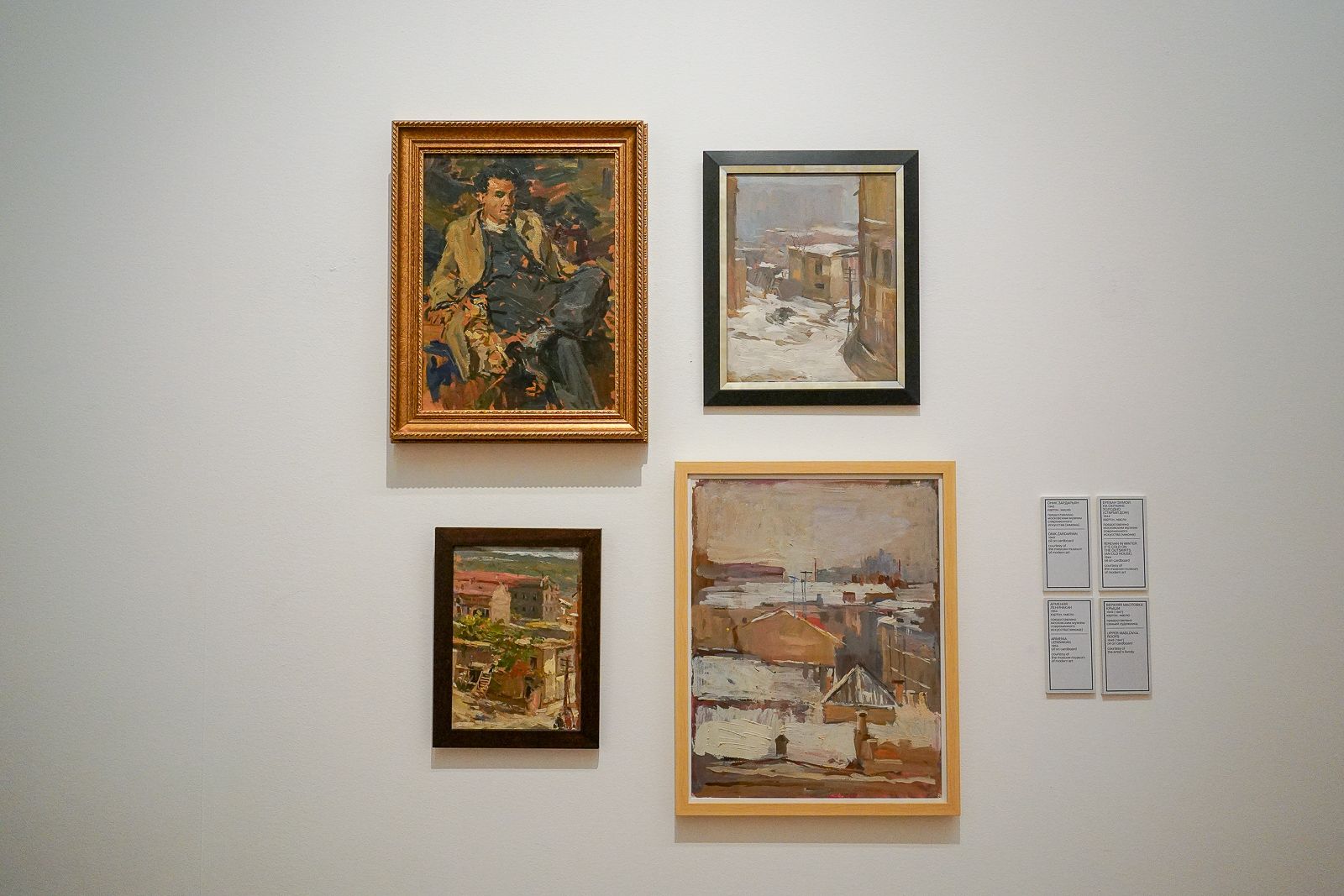
“For the attentive public, Dmitry Nalbandyan during the evacuation appears as a person experiencing military life challenges. In this group of works, one can see the dull palette, the lack of space and perspective. It shows the anxiety of the artist and many people at that time,” says Ekaterina Novokshonova.
While living in Armenia, Dmitry Nalbandyan joined ArmTAG Windows, an analog of TASS Windows, and created war posters. Unfortunately, there are few works left, however the exhibition showcases the album donated to the museum by the artist’s family not so long ago. Looking at one of the photographs, one can at least get an idea of what the posters looked like.
The main work of the hall is “Vernatun”, for which Dmitry Nalbandyan was granted the title of the People’s Artist of the Armenian SSR and a gold medal from the USSR Academy of Arts. “Vernatun” is the first Armenian literary society to promote the development of national art. It was founded in 1899 by Hovhannes Tumanyan. The painting depicts 15 members of the society. Having worked on it for several years, Dmitry Nalbandyan finished it in 1976. The question of why he turned to such subject being so little known of in the Soviet times remains open, as Dmitry Nalbandyan gave little evidence of his choice.


The showcase displays materials used by the artist: sketches and portraits of members of the society over the years. The curators wanted Dmitry Nalbandyan’s method to be clear to the public with its photographic evidence and subsequent elaboration. The artist did not rely only on his memory or sketches; his reality had to be fundamental.
Dmitry Nalbandyan as a traveler
Moving to the next hall, the exhibition visitors find themselves in a new era of Dmitry Nalbandyan as a traveler. Called “Tourist,” the hall shows the different places that the artist visited and admired.
Most of the works were inspired by five tours to India. Dmitry Nalbandyan visited India for the first time in 1954, where he met representatives of the political elite, for example, Indira Gandhi whose portrait he also painted.


According to Ekaterina Novokshonova, it should be borne in mind that the Soviet tourism only emerged in 1958 and few people were privileged to travel. In 1956, Dmitry Nalbandyan, along with other representatives of the intelligentsia, went on his first 25-day cruise around Europe having visited Italy, Greece, France and other countries. The exhibition gives a detailed description of this voyage by the Pobeda motor ship and the trip program.
By the way, Dmitry Nalbandyan made overseas trips with some violations of the Ministry of Foreign Travel rules: Soviet citizens were allowed to travel abroad once in every two years, but the artist traveled more often. From 1956 to the 1980s he made more than 30 trips, his exhibitions were held in France, Finland, Germany and other countries. The showcase includes documentary evidence: the project of the winners of the Jawaharlal Nehru Award, which he received together with Yevgeny Vuchetich in 1970, a photograph of those years and a note in the newspaper, booklets and catalogs.
Official portrait painter. Leniniana
A shift to Dmitry Nalbandyan’s portraiture began with a gallery of portraits of the Soviet-era cultural figures and labor leaders. To move on to the subject more smoothly, the same hall showcases, for example, portraits of Dmitry Nalbandyan’s son Arkady, Angela Davis and illusionist Dimitrius Longo.


“I believe that the modern public understands that Dmitry Nalbandian did portrait paintings both to earn money and to represent himself as an artist. Dmitry Nalbandyan painted portraits of Anastas Mikoyan, Kliment Voroshilov, Georgy Mosolov, a close friend of Yuri Gagarin, with whom he visited the studio several times. Well, he depicted his environment — rarely anyone asked him for a portrait, everything was done rather through intimacy,” says Ekaterina Novokshonova.
The painting called “Brezhnev at Malaya Zemlya” missed by visitors to the 1993 exhibition at the Manege is on show in one of the halls. The bewilderment of the public of that time was obvious: it was a classic image that surrounded contemporaries; it was replicated using posters and postcards. Even a record was released by Firma Melodiya — Brezhnev read his memoirs titled “Malaya Zemlya.” Dmitry Nalbandyan requested portraits of the General Secretary from the state archives — one can see photographs of Brezhnev in his youth, completely different from how he was remembered.


The exhibition also reveals Leniniana, an important part of Dmitry Nalbandyan’s work, in an unexpected way.
“The modern young public naturally has a question: how did it even occur to the artist to paint Lenin on the Red Square in October, 1919? The contract illustrating what the official government order was like is on display. The USSR Ministry of Culture gave orders, selected subjects and fixed dates by which works should have been created. That applied to all types of art,” explains Ekaterina Novokshonova.
Foreign and Soviet newspapers perpetuated the myth that Leniniana was the leitmotif of Dmitry Nalbandyan’s work. However, according to Ekaterina Novokshonova, it is an ideal example of how the artist’s work can be used to show trends in Soviet official art. For example, during de-Stalinization, all the works associated with Stalin were removed, Lenin came to the fore and Dmitry Nalbandyan depicted him. Followed by a decline, revolutionary ideas regained popularity in the 1970s and Lenin again appeared on the artist’s canvases.


The tools Dmitry Nalbandyan used to make his portraits look realistic are also exhibited. He had a device to enlarge a slide to any size, and, using the famous ruling method, the artist transferred the image to the canvas.
The exhibition is circular: from the last halls you can get back to the first one and take a fresh look at the late works relying on Dmitry Nalbandyan’s previous experience. One can appreciate that he was emerging as the unexpected artist whose skills were hidden during his entire career. One can see how the man who always treated impressionism and other avant-garde movements coldly, used abstract forms, dark colors, dynamism — in a word, one can explore the creative (and emotional) evolution.
The exhibition in the museum’s building at 25 Petrovka Street will be run until March 31, 2024.