Oil, gas and the man on the street: three centuries of Moscow street lighting
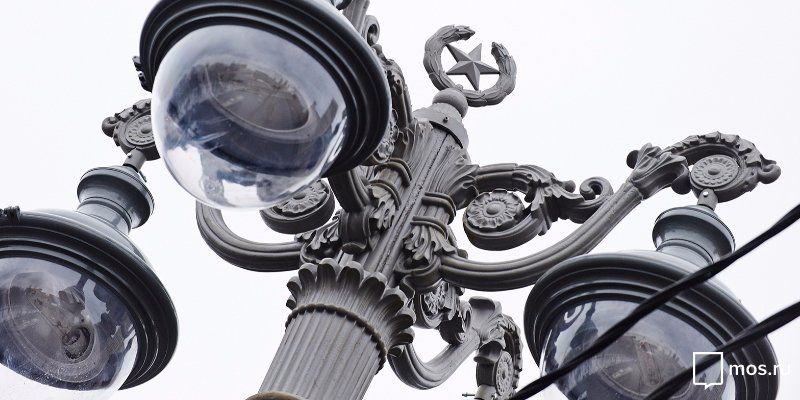
Muscovites owe their thanks to Empress Anna Ioannovna for the city’s first street lights. According to Ivan Zabelin, a leading Moscow historian, the first lanterns were installed in the city when the Empress visited Moscow with her court in the autumn of 1730. On 27 November, according the old calendar, the Senate ordered: “Glass lamps shall be installed on posts along the bigger streets of Moscow in the Kremlin, Kitai-gorod, Bely Gorod, Zemlyanoi Gorod and Nemetskaya Sloboda (German Borough).” [1]
The posts were to be placed at a10 sazhen (21 metre) distance from each other. The works were scheduled to finish before a 25 December deadline. Meanwhile, until this happened landlords were obliged to put burning candles in their windows, no less than two per window, or install their own glass or mica lamps on posts before their houses. Street lamps were lit on order of Her Imperial Majesty’s Court and were to be put out at midnight. It was the public’s duty to supervise and repair these lamps.
According to Zabelin, however, Muscovites did not actually need street lighting. They walked about the city, lantern in hand, both before and after the November decree. Police did not let people without lanterns through turnstiles dividing streets – a relevant safety measure. Another measure prohibited the carrying of hand lanterns from May through August to prevent fires.
A total of 600 street lamps were installed in Moscow in 1766. By 1782 their number had increased to 3,500 and by 1800 to 6,559. In keeping with the seasonally changed lighting calendar, they were lit for no more than 18 nights a month from August through May.
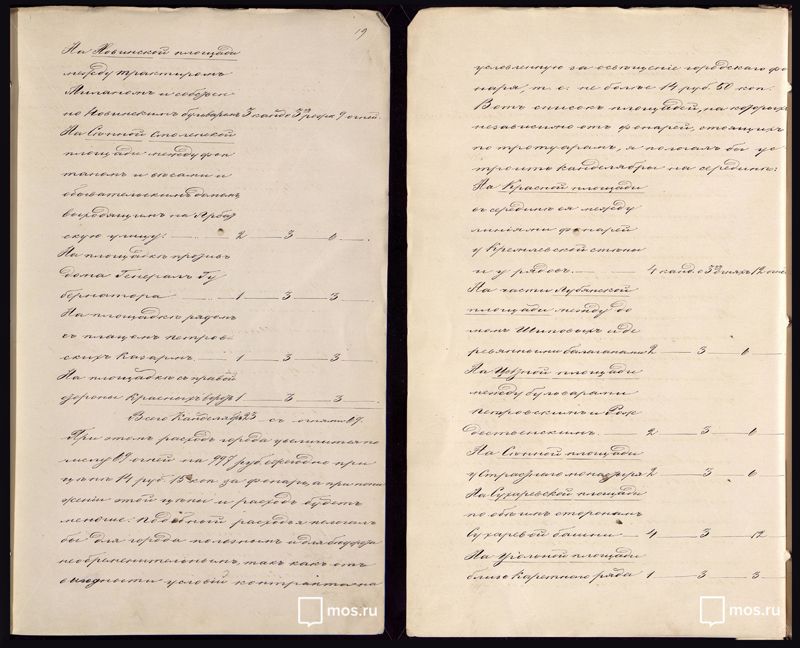
Moscow Mayor Prince Alexander Shcherbatov’s application to install lamps in the centre of city squares to improve their lighting. 1864. Central Moscow Archive
Gas lighting
In the landmark year 1865, the Municipal Public Board launched the first-ever street lighting reforms after the termination of the mineral oil lighting contract.
The first applications for gas and other lighting improvement options were submitted to City Hall as early as 1849. All those projects were doomed from the start; either their implementation was unaffordable or the applicant companies had gone bankrupt by the time their project was accepted.
Dietrich, an entrepreneur of Mainz, and St Petersburg-based Siemens & Halske Co managed to impress progressed the Moscow governor-general with their idea and progressed furthest in pursuing a municipal contract. The contract drawn by the applicants entitled them to exclusive rights to equip the city centre with gas lamps for a 60-year term. The company also promised to build a gas plant outside Moscow, lay the piping, install 2,000 lamps and subsequently service them. Gas lighting was to appear in the Gorodskaya [Kitai-gorod], Tverskaya, Myasnitskaya, Prechistenka, Arbat, Sretenka and Yauza neighbourhoods within 10 years – a vast area within the present-day Garden Ring. – The plan called for the bypass of Zamoskvorechye area of the city. Every lamp was to be lit for no less than 2,000 hours a year.
After debates on the project, the City Council determined to place announcements in Russian and foreign magazines inviting potential contractors to tender for the installation of gas lighting in Moscow.
“Following the announcement, the commission received ten applications: from Ehrlanger & Co of Frankfurt am Main and Riedinger of Augsburg; three from Britain – from Walkstaff & Bauer, Roberts & Co, and Nicholson, Beauville, Durasov, Sarochenkov & Co; from Holland’s Van der Maale & Co; Bouquier of Belgium; and three from Moscow – from Shilovsky, Troullier and Moscow merchant Yegorov.” [2]
Following the resulting tender, the city signed a gas lighting contract on 29 January 1865 with Dutch citizen Armand Bouquier and Britain’s Neville Goldsmith on terms previously offered to Dietrich and Siemens & Halske, though for 30 years instead of 60. The lighting contract stipulated that every lamp be lit 24 nights a month, from August through May.
18 months later new proposals appeared to expand the gas-lit area to the Rogozhskaya, Lefortovo and Basmannaya neighbourhoods. The application of Moscow Condensed Gas Bag Company was turned down as Bouquier and Goldsmith reported, via their partners Leslie and Shilovsky, their intention to lay gas pipes far outside the initially appointed area.
By 1867 there were some 3,083 gas lamps lighting the streets of Moscow, while the overall number of lamps reached 9,213. “All hempseed oil lamps have been dismantled and replaced with mineral oil, or kerosene, lamps.” [3] The city shifted to the use of kerosene as a fuel due to the realisation that the use of hempseed oil meant “wasting a comparatively expensive substance, rather than producing efficient lighting”. [4]
Other options being discussed and considered envisaged the use of American mineral oil and a liquid pure alcohol-turpentine blend (from the Zotov merchants) and photogen (from merchant Rosen and Moscow Condensed Gas Bag Company).
Scheme of electric lamp placement in Moscow’s central streets. 1890. Central Moscow Archive

Electric lighting
Gas lighting lost its innovative status fairly soon. In March 1880, the Moscow Administrative Board (Uprava) discussed the feasibility of installing electric lighting on the embankment along the Cathedral of Christ the Saviour. An offer to install Yablochkov candles in the city came a month later. Renowned inventor Pavel Yablochkov, a living legend in the West, applied for a land plot between the Kitai-gorod Wall and the Chelyshev public baths (on the site of the present-day Metropol Hotel) where he intended to build a power station. The engineer wanted to rent the plot for 12 years and ventured to light Teatralnaya Square with six electric lamps replacing 28 gas brackets and a part of Voskresenskaya Square with four electric lamps instead of 30 gas brackets. The municipal authorities granted his request.
Electricity shone gloriously during the coronation of Emperor Alexander III in 1883. Naval electrical engineer Yevgeny Tveritinov and a team of sailors and cadets took on and completed the huge job of building a temporary power station on Sofiiskaya Embankment, stretching telephone wiring across the Moskva River, and installing 3,500 Edison lamps on the Ivan the Great Bell Tower and 18 large and small floodlights on the Kremlin towers.
The illumination of the Cathedral of Christ the Saviour was timed with the coronation of the Emperor. “The area around the Cathedral of the Saviour is being illuminated by 32 lamps, but only by 16 after midnight to reduce the expense. On moonlit nights, there is no lighting at all or only specific localities are lit.” [5]
Three years later, when the first electric generator was brought to Moscow by Schuckert Co, the number of lamps was increased round the cathedral, likewise lamps were installed all along the Bolshoi Kamenny Bridge. At this time the Sokolniki Park’s central square also received electric lighting for summer evening concerts.
Companies and private persons continued to shower City Hall with proposals to install electric street lighting. In 1886, the Moscow Lighting Commission maintained constant communication with several companies specialising in electric lighting: Moscow’s Phillip, Smith and Co, Siemens & Halske of St Petersburg, and the Budapest-based Hanz & Co. Though the commission found the latter’s bid the most promising of all, a contract was never signed due to reasons beyond the parties’ control.
In 1887, the Moscow Lighting Commission received two landmark proposals: The first from the 1st Russian Electric Machine Plant, which described the benefits of hydropower generation and incandescent lamps; and a second from the 1886 Electric Lighting Society (ELS), whose bid eventually won. The commission signed a contract with ELS, according to which priority for the installation of electric lighting was given to “the following squares: Tverskaya, at the Triumphal Gates and the Governor-General’s residence, Trubnaya, Lubyanskaya, Teatralnaya, Iverskaya, Okhotny Ryad and Pushkinskaya; Tverskoi, Strastnoi, Petrovsky, Rozhdestvensky and Sretensky boulevards; Bolshaya Nikitskaya Street; Tverskaya Street from the Triumphal Gates to the Chapel of Our Lady of Iberia; Bolshaya Dmitrovka, Petrovka, Neglinny Proyezd, Bolshaya Lubyanka and Myasnitskaya streets; Kozma-Damianovsky, Stoleshnikov and Kamergersky lanes (pereulok) ; and Kuznetsky Most Street”. [6]
In 1895 a general contract was signed with the 1886 Electric Lighting Society to terminate on 23 September 1945. In addition a private contract, for a term of seven years envisaged the installation of electric lights in Tverskaya Street. The society started installing lampposts immediately, with the first 99 street lamps appearing on 1 May 1896.
A total of 448 electric lamps of varying systems and voltages had been installed in the central streets and squares by the end of 1910.
According to the Moscow Administrative Board’s report for 1911, there was kerosene, gas and electric lighting in the city. The districts outside the Garden Ring, a majority of lanes in Zamoskvorechye, and all boulevards and public gardens were illuminated by a total of 13,444 kerosene lamps. 532 incandescent kerosene lamps were installed along tram tracks after 1908. Most of the city centre used gas lamps (8,501).
A map of Moscow with planned lighting systems. 1910s. Central Moscow Archive

Nationwide electrification
Improving the needs of Moscow’s lighting needs receded into the background with the beginning of World War I and the ensuing revolution in Russia. In February 1917, city Governor Vadim Shebeko asked Mayor Mikhail Chelnokov to guarantee gas lighting at least till 1 a.m. if it was impossible to restore it in full, and install lines of electric bulbs along tram tracks. But there was no chance to grant his request.
Lighting was partly repaired as late as January 1919 when there were more than 7,600 gas and electric street lamps. The State Commission for Electrification of Russia (GOELRO) was established a year later. The number of street lamps had increased to 8,779 by the end of 1924, with half of these lamps being electric. The last kerosene lamp was dismantled in 1926 and gas lamp in 1932, to be replaced by electric lamps.
The types of lamps used have been updated since then from incandescent to LED, and their numbers have grown from 40,000 in 1944 to 540,000 by the end of 2015.
Archive materials by courtesy of the Moscow Central Archive Board
- Compendium of the Laws of the Russian Empire since 1649 (Полное собрание законов Российской империи с 1649 года). Vol. VIII. St Petersburg, 1830. P. 344.
- Central Moscow Archive. Fund 179. Series 21. File 3. Sheet 107.
- Collection of Essays on the City of Moscow (Сборник очерков по городу Москве). Moscow, 1897. P. 165.
- Central Moscow Archive. Fund 179. Series 21. File 3. Sheet 17 rev.
- Moscow City Hall Herald, September (Известия Московской городской Думы. Сентябрь). Moscow, 1909. P. 21.
- Central Moscow Archive. Fund 179. Series 21. File 860. Sheet 94-94 rev.