Go past Ostankino Tower and through a tunnel of trees. Explore Moscow sights through tram window
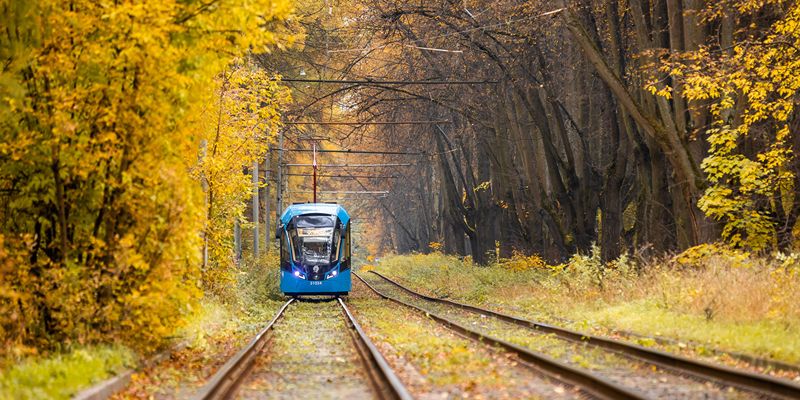
The Moscow tram is over 120 years old, and this oldest city transport is justly loved by the capital residents. Some routes opened in the early 19th century when horse-drawn trams (konka) and little steam locomotives (‘parovichok’) ran along them. Today, trams are still popular: about 600 thous. trips are made every day, and the total length of tracks in Moscow is more than 400 kilometers.
One of the advantages of the tram over the metro is that passengers can admire Moscow sights through the windows. Passengers can go past the famous high-rise on Kotelnicheskaya Embankment and near the main building of the Moscow State University (MGU), Ostankino Tower, or old Danilov Monastery walls. Read on to find out about other sights on tram routes.
Get off at the oldest stop
Tram route No. 27 is one of the most picturesque and oldest in Moscow. It has changed significantly since its opening in the late 19th century, when the famous Moscow steam tram (‘parovichok’) ran past these sites.
Nowadays, tram No. 27 runs from the Voykovskaya metro station to the Dmitrovskaya metro station. The route features the Bolshoi Sadovy Pond and the historic Petrovsko-Razumovskoye estate, where the main building of the Moscow Timiryazev Agricultural Academy is now located. From the Timiryazev Academy stop you can easily get to the university park. The site features sculptures inspired by different seasons, a fountain, flowerpots with plaster moldings, a memorial and an old grotto.
Getting to Krasnostudenchesky Proyezd, passengers can see the oldest tram stop pavilion. Designed by Franz Kognovitsky, the wooden pavilion was built in the late 1890s to be reconstructed in the 1920s by architect Evgeny Shervinsky using cast iron parts. Several years ago, the pavilion was restored to its historical appearance with its lost elements recreated, and in 2018, this unique piece of industrial architecture became a laureate of the Moscow Restoration competition.


Annushka: from Novokonnaya Square to Chistye Prudy
The most famous tram route in Moscow is A, or ‘Annushka’, as Muscovites call it. It is an inspiration to poets and songwriters. People give historic car postcards as a present. Since its launch in 1911, the route has changed many times: initially it was a circular route with the tram passing the Boulevard Ring. By the way, the latter then had a letter designation – ‘A’. That is why the tram has such an atypical number.

The last time the route changed was in 2020; today, it connects three districts in the center starting at Novokonnaya Square in the Tagansky District. It offers a picturesque view of the Kalitnikovsky Pond, which appeared more than 100 years ago on the site of the Khokhlovka River dam. Trams run along the Novospassky Bridge and the landscape park on Paveletskaya Square, which was landscaped in 2021. In addition to the original canopies over the entrances, the site is decorated with a fountain, artificial hills and an open amphitheater. Going through the Zamoskvorechye District and past the Novokuznetskaya metro station, Vityaz-Moskva trams transport passengers to the Chistye Prudy metro station.

Approach two Stalin’s high-rises
At the Chistye Prudy metro station, passengers can change to tram No. 39 and get to the Universitet station. It is one of the longest routes in the capital, and it can be highly recommended to tourists as it offers many sights of the Moscow historic center.
Just like ‘Annushka’, route No. 39 passes Chistoprudny Boulevard, past the House with Animals with its façade featuring fabulous animals and birds, along Pokrovsky and Yauzsky Boulevards, and reaches the Zamoskvorechye District. Passengers can admire the Paveletsky railway station and the old walls of Danilov and Donskoy Monasteries.

Getting off at the Yauzskiye Vorota stop, they can stroll through the square park, and when reaching the Bolshoy Ustinsky Bridge, they can see the high-rise on Kotelnicheskaya Embankment, the River Overlook Footbridge in Zaryadye Park and the Moscow Kremlin.
The route ends at the Universitet metro station, from where passengers can easily get to the main building of the Moscow State University and then to Vorobyovy Gory and catch the cable car.

See 107-meter symbol of space exploration and Ostankino Tower
Tram route No. 17 is one of the most popular routes in the capital. It covers six districts in the north-east of the city, connecting Medvedkovo and Ostankino.
Route 17 offers a view of one of the Moscow symbols, the 24-meter-high Worker and Kolkhoz Woman sculpture. It is the most famous sculpture designed by Vera Mukhina.


If you get off at the VDNKh Metro stop, you can take a closer look at the 107-meter Monument to the Conquerors of Space. It is a rocket-shaped monument taking off into the sky, leaving a silver trail behind it. The monument is installed on the Cosmonauts Alley next to 14 busts of outstanding space explorers and a Solar System model with a gnomon – an ancient astronomical tool to determine the angular height of the Sun by the shortest length of its shadow. This stop is located near VDNKh’s main entrance.
The final stop at the route is next to the main Russian TV symbol – the 540-meter Ostankino Tower with the TV center and the Ostankino memorial estate nearby.
In 2017, Vityaz-Moskva, a modern three-section low-floor tram model, was launched on route No. 17 for the first time. The comfortable car is fitted with USB connectors for charging gadgets, a large number of seats, media screens with useful information, and bicycle and stroller areas.
Go through the park and over the oldest bridge in Moscow
Route No. 4 passes through a tunnel of trees. Trams run from the Bulvar Rokossovskogo metro station amid spreading oaks and old linden trees of Sokolniki Park, as well as past the Bolshoy Oleny Pond to the Krasnoselskaya and Baumanskaya metro stations. Passengers can see one of the most interesting buildings on Baumanskaya Street – Frolov’s revenue house with turrets and lancet windows.
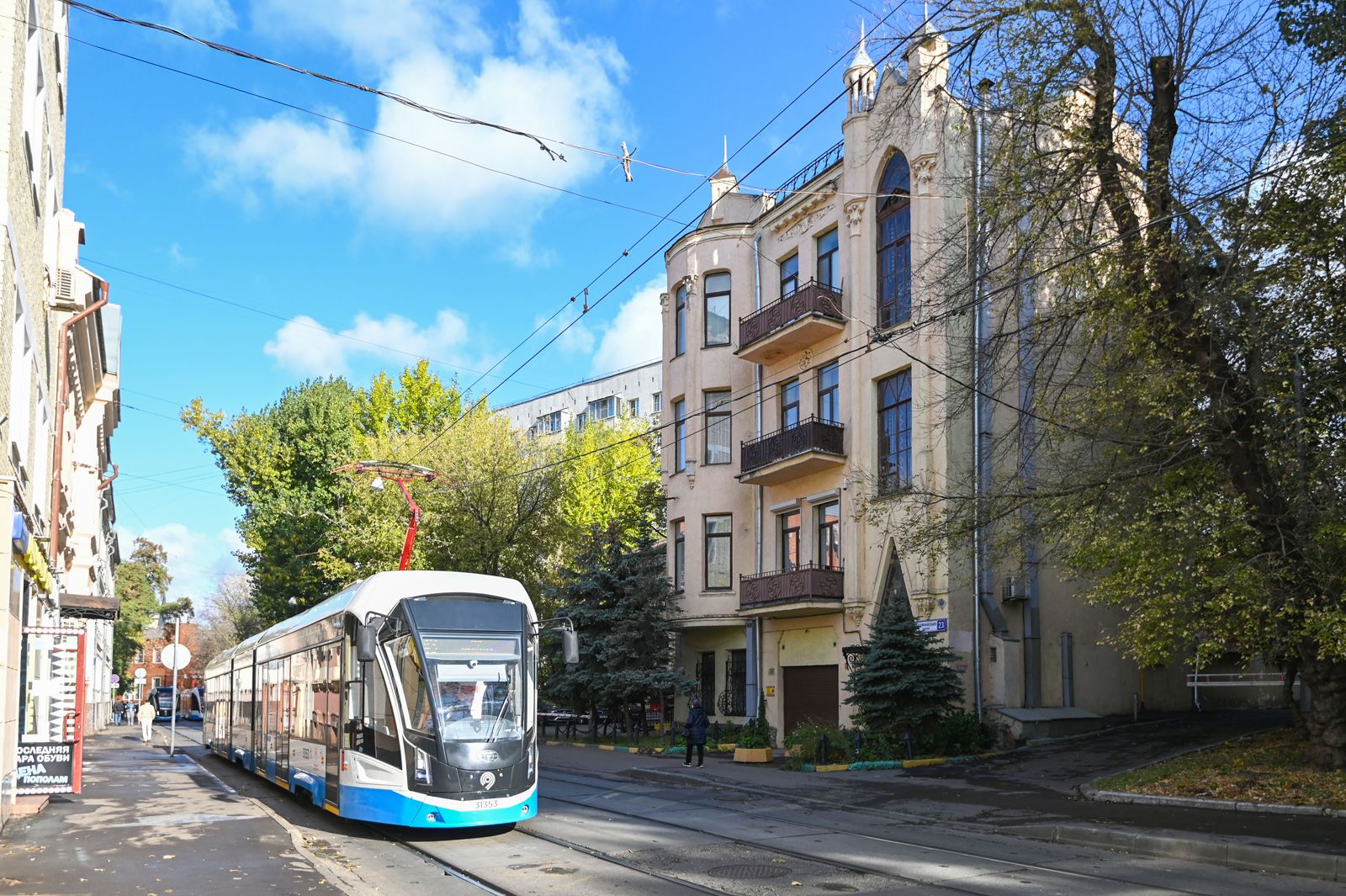

Tram No. 4 runs over the Lefortovsky Bridge, the oldest operating bridge in the city. It was built on the site of the wooden Soldatsky Bridge over the Yauza River in 1781–1799. Not far from the Lefortovsky Bridge stop there is Lefortovsky Park, the first formal garden of the modern capital, as well as the main building of the Bauman Moscow State Technical University.
From the Andrey Rublev Museum stop, you can walk to the Andronikov Monastery, Moscow’s oldest surviving monastery founded in 1357.


Running to the final stop (Kursky railway station), the tram goes past the Church of St. Sergius of Radonezh and along the Kostomarovsky Bridge built on the site of an old brick arched structure in 1941.
Admire the Leningradskaya Hotel and visit the Depo food mall
At the Bulvar Rokossovskogo metro station, another interesting route begins – route No. 7 running to Tverskaya Zastava Square. Passengers travel along the Bogorodskoye District and the Matrossky Bridge, and also stop near Sokolniki Park, where a pre-revolutionary fire tower building has been preserved.
Tram route No. 7 passes Komsomolskaya Square, the main railway station square of Moscow. Next to it there is one of Stalin’s seven high-rises– the Leningradskaya Hotel opened in 1953.


In addition, there is a stop next to the historic building of the former Fleet of the Miussky Horse-Drawn Railway on Lesnaya Street, which at different times was both a tram and a trolleybus depot. Today, it houses the Depo food mall. The route ends at Tverskaya Zastava Square, where the Belorussky railway station is located.