Architects of the future: Moscow to create cutting-edge social facilities
(14).jpg)
Moscow is actively developing its social infrastructure: dozens of new modern schools, kindergartens, hospitals, and polyclinics are opened every year. In doing this, Moscow architects often provide not standard, but individual solutions: they design transformer schools and kindergartens with interactive spaces, carefully consider what the future hospital will be like, and create innovative educational clusters that become the best in the country. mos.ru was told about how modern social facilities are being developed in the Russian capital by the authors of the projects awarded the prestigious Moscow Prize in Architecture and Urban Planning.
Creative approach to a children's hospital
M-Project won in the nomination "The Best Architectural and Urban Planning Solution of a Health Care and Public Protection Facility." The architects received an award for the new building of the multidisciplinary complex of the St. Vladimir Children's City Clinical Hospital, which is being built on Rubtsovsko-Dvortsovaya Street.
The new St. Vladimir's Hospital building will be recognizable, eye-catching. Since the medical facility is intended for children, we were as creative as possible in developing the concept. Interesting color schemes were used for the interiors, and animals and birds were drawn on the walls. The entrance group was made large and unobstructed so that young patients would not feel constrained, and near the building, they placed art objects made of recycled plastic in the form of animals, for example, a funny orange giraffe. The facility will be fitted with modern medical equipment, and a helipad will allow receiving emergency patients .jpg)
The diagonal façade along Matrosskaya Tishina Street is one of the features of the six-story building with two underground floors. The first floor is made of stained glass structures. The façade rusticated pylons are made of aluminum and painted to match natural stone. The main lobby welcomes visitors with a multi-level atrium, play and learning areas.
Energy-efficient materials and technologies as well as translucent structures are used in the building's construction. Once the facility is complete, it will be decorated with architectural lighting.
.jpg)
A vital stage in the hospital design is its internal layout. Specialists accounted for the modern requirements of medical logistics: patients will be able to undergo all types of diagnostics and therapeutic procedures in one facility, without moving to other buildings.
The complex will also house a radial diagnostics department with CT, MRI, and X-ray rooms, a hemodialysis department, an intensive care unit, a block for ten operating theaters, and three laboratories. A pneumatic mail system will be established for the rapid movement of documents and biomaterial between units.
The hospital has bed chairs and family rooms to make it comfortable for parents to stay with their children. Each unit has rooms for relatives to communicate with the doctor, and all common areas are equipped with anti-vandal and atraumatic furniture for children of different ages.
.jpg)
.jpg)
.jpg)
.jpg)
.jpg)
The new hospital building is a major healthcare projects implemented under the Targeted Investment Program of the City of Moscow. The clinic will be the most advanced not only in the Russian capital but also in the whole country.
It should be noted that the winning company specializes in the design of medical facilities. Significant projects include a multidisciplinary hospital in Kommunarka and the Voronovskoye Moscow Infectious Disease Clinical Center (both projects were finalists for the prestigious international MIPIM Awards). The company was awarded the Moscow Prize in Architecture and Urban Planning for the first time.
"For us, this award is an opportunity to prove that healthcare facilities can be modern, functional, and customer-oriented," notes Natalia Garmaza.
Lomonosov: the feeling of flight and the pursuit of knowledge
In January, Moscow opened the Lomonosov educational and training cluster: the flagship of the innovative Scientific and Technological Center of the Lomonosov Moscow State University "Vorobyovy Gory". It is the greatest project of Russia's scientific and technological development. An impressive 10-story building with stained-glass windows on Ramensky Boulevard was built under the project of the architectural bureau Art Group Kamen LLC. It is not surprising that the authors were awarded the prize in the nomination "The Best Architectural and Urban Planning Concept of an Educational Center."
We worked on the cluster project with the chief architect of the city of Moscow, Sergey Kuznetsov. We faced the task of creating a vivid image, a distinctive silhouette. Thus the object turned out to be an urban sculpture, active and dynamic, striving for the future, modern and progressive. This idea and basic principles were used both in the choice of the building form itself and in the functionality and selection of materials for the façades .jpg)
Despite its scale, the Lomonosov leaves an impression of lightness and airiness. This effect is achieved through stained glass glazing, while from one of the angles, the building's shape resembles the swan's wing. "We wanted to evoke a sense of flight, a desire for knowledge and development in those who look at the building. Another challenging task was to fit the cluster into the ensemble of the entire scientific valley of MSU," adds Ivan Grekov.

The Lomonosov project is unique not only for Russia, but also for the whole world. The cluster is based on Russian technologies. The architects used several complex design solutions: large-scale consoles, large-format glass façades, and modular technological elements that are inserted between the slabs on guides. The substructure is created using an exoskeleton: a load-bearing frame that partially extends outwards to form a façade of vertical lamellae. This framework allows you to make large glass surfaces. The façades were finished with anodized aluminum: a technological, lightweight, and durable material. Another feature of the building is a landscaped roof that can be used for events.
The designers created an ergonomic, hybrid public space with high ceilings so that people can study, work and relax comfortably there.
.jpg)
.jpg)
.jpg)
.jpg)
.jpg)
.jpg)
.jpg)
Inside the transformer school
The 825-pupil school on Letnaya Street in the Pokrovskoye-Streshnevo District was also recognized by the jury. The project of Asadov Architectural Bureau LLC won the category "Best Architectural and Urban Planning Solution of a School."
Our bureau has quite a lot of experience working with educational facilities of various sizes and profiles. We already received such an award for a public school in Troitsk three years ago .jpg)
The school is characterized by bright colors: the exterior decoration of the walls is dominated by orange and beige, the façade is finished with non-combustible and durable tiles of dark, light and orange colors. A stadium, running track, and walking areas were placed next to the building.
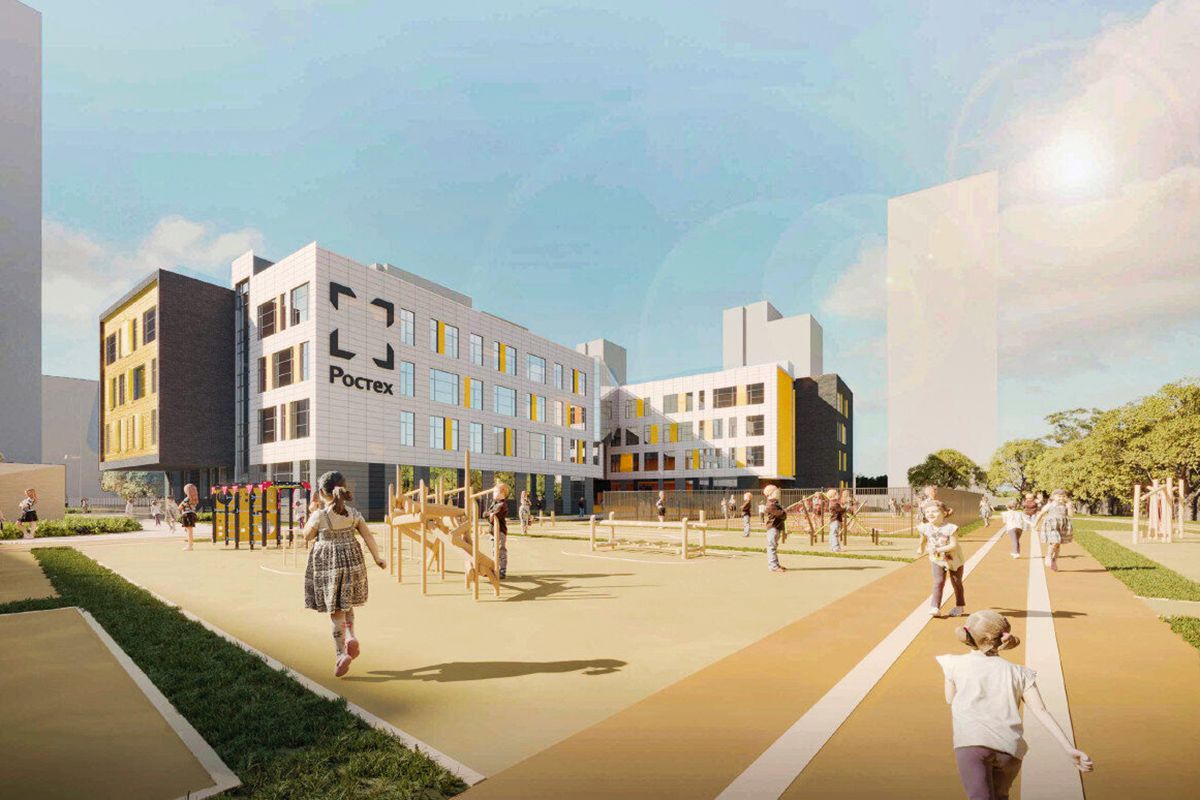
The entrance to the school features a multi-colored atrium with an amphitheater. This is the kind of space architects provide in almost every educational institution. The atrium will provide a comfortable place for socializing, entertainment, and events.
Andrei Asadov emphasizes that the ability to quickly transform the premises is an essential requirement for a modern school or kindergarten. Thus, the school lobby connects the atrium with the assembly hall, where one of the walls is an acoustic curtain, sliding which can unite the spaces. Classrooms can be combined into one if desired: partitions can be moved, furniture can be dismantled.
Kindergarten for little heroes
In the nomination "The Best Architectural and Urban Planning Solution of a Kindergarten" the award was granted to Spetsmoproekt-28 LLC. The preschool is part of a residential complex in the Nagatino-Sadovniki District.
About 30 specialists designed the kindergarten for 300 children. They were tasked with creating an innovative building with versatile rooms and transformable partitions that would be comfortable for children of different ages. The authors of the project took into account the best Russian and international development practices, as well as the advice of psychologists and teachers. Special attention was paid to multifunctionality and quality zoning of rooms.

The three-story kindergarten on Nagatinskaya Street will attract attention with an unusual façade of rounded shape with colored panels of fiber concrete and metal with a bas-relief. The first floor of the building will house 12 group cells, administrative offices with zoning for physical education and music classes, and a swimming pool. The second floor will host a multifunctional hall for holidays and developmental classes, and the third floor — state-of-the-art gymnasiums. The concept of landscaping the kindergarten territory is also interesting; it is based on The Hero's Journey theme.
Modern and safe playgrounds for children of different ages will be set up within the premises: "Call of Adventure", "Hitting the Road", "Adventure", "The Road Home" and "Sports Challenge." The children will be able to explore professions and choose what they want to do in the future. There will also be a holiday tree, a children's theater, a natural area, and a waiting area for parents. The landscaping concept incorporates fairy tale motifs. There will be an eco-trail throughout the whole territory of the facility where kids will learn about a variety of plants while walking along the trail .jpg)
The specialists were assisted by BIM-technologies in their work on the kindergarten. "Construction time is reduced due to the detailed development of design solutions, errors in terms of intersections of engineering systems with building structures are eliminated, and design costs are optimized," stressed the interlocutor of mos.ru.
The company has been developing social facilities in the Russian capital since 2012, and this is the first time the architects have received such an award. "About 50 kindergartens are designed annually in Moscow, and our victory is the highest possible evaluation of the team's work," concluded Maxim Platonov.