India is incredible. Exploring a new Tsaritsyno Museum-Reserve exhibition
(8).jpg)
The Tsaritsyno Museum-Reserve opened the exhibition “Incredible India. View from Russia”. It will tell visitors how for a long time - from the 15th century - the image of an exotic and mysterious country took shape, how its culture was perceived from the Middle Ages to the Soviet era.
The exhibition brought together more than 400 exhibits - works of fine and theatrical art, sculptures, ancient miniatures and much more. Olga Sosnina, Ph.D. in art history and curator of the exhibition, told mos.ru about the most curious of them.

First in India
The journey begins with the video installation "India - Land of Miracles and Righteousness". The footage projected on the walls consists of digitized pages of ancient manuscripts with beautiful miniatures dating from the 16th-17th centuries. A separate story tells visitors about the famous work "A Journey Beyond the Three Seas" by Tver merchant Afanasy Nikitin. The manuscript itself has not survived, but there are several lists from it. One of the earliest list, dating from the second quarter of the 16th century, is on display.


By the way, the mythologization of the image of Nikitin, which gained momentum in the 1950s, is associated with the rapid development of political and cultural ties between independent India and the USSR. The Tver merchant became one of the personifications of the Soviet-Indian friendship. In 1958, artist Vasily Puzanov-Molev decorated a wooden box with the image of Afanasy Nikitin against the backdrop of the Taj Mahal. However, this palace, the greatest monument of Indian architecture, was built only a century and a half after the visit of the merchant.

The Rus pictured India as a fabulous place where the wildest dreams came true and unusual animals lived. The list of "The Lay of Indian Animals" from "Christian Topography" by the Byzantine author Cosmas Indicopleustes, translated into Russian in the 16th century, is a good example of this idea. The exhibition’s visitors can learn more about its contents and see the mysterious myrmecoleon (ant-lion) on the spread. People living in Kievan Rus believed that such a beast could easily be found in the vastness of Hindustan.

What voyagers brought
From the middle of the 19th century, the number of Russian voyagers who were passionate about Indian culture began to grow. They brought rare manuscripts in Sanskrit to study them, as well as weapons, art and household items. For example, Alexander Mervart and his wife Lyudmila, ethnographers and linguists, brought textiles and musical instruments from India after the 1914 expedition - some of them can be seen in Tsaritsyno. The mi gyaung, a crocodile-shaped plucked string instrument, is of particular interest.

Weapons are traditional Indian items that Russian people collected. For example, in the late 19th and in the early 20th century, manufacturer and philanthropist Dmitry Burylin collected unique oriental weapons. It included a very rare Indian item - the bhuj ax (19th century). It differs from other axes as it has a hole to insert a stiletto. This type of weapon is one of a kind, there are no similar items in another collection presented at the exhibition. It belonged to Nicholas Alexandrovich, Tsesarevich of Russia, who got curious pieces of Indian gunsmith art on his travels to the East, including to India, in 1890-1891.

In 1906, one of the most famous Moscow collectors, Alexei Morozov, bought 48 illustrated pages from the “Bāburnāma” manuscript from Persian merchants at a fair in Nizhny Novgorod. This text was written by Zahīr ud-Dīn Muhammad Babur, the founder of the Mughal dynasty, a descendant of Tamerlane and Genghis Khan. The manuscript and its miniatures, illustrating the story, were created in the 1590s under Akbar the Great, the grandson of Babur. Morozov presented it to his friend and collector Pyotr Shchukin; pages from his collection ended up in the Moscow State Museum of Oriental Art. 12 beautiful miniatures from this world-famous work are on display.

Spiritual life
In the 1870s-1910s, many artists had an interest in India. The most famous of them was Nicholas Roerich, an artist, writer, philosopher and mystic. He had been interested in Indian religious and philosophical teachings long before he first came to India in 1923. Later, he traveled there as often as he could. Indian people reciprocated his feelings, they loved his work: from 1932 to 1947, he organized 18 exhibitions there. In 1928, Roerich bought an estate in India and lived there until his death in 1947. Interestingly, he not only painted pictures dedicated to the country and everything associated with it, but also created the religious and philosophical teaching of living ethics (agni yoga). Another artist Vasily Vatagin also adored India. He traveled there in 1913-1914, brought about 180 watercolors and ink drawings, and later made a series of lithographs "India" based on them, some of which can be seen at the exhibition.


India attracted artists, writers and philosophers with its spiritual practices, ancient teachings and religion. The exhibition features sculptural images of ascetics, fakirs and Hindu gods, which appeal to seekers of truth. For example, visitors can see the image of Hanuman, the son of the wind god, the brave and indestructible servant of Rama, as well as Lakshmi, the goddess who gives happiness and abundance, the wife of Vishnu.
.jpg)

From Lakmé to Rāmāyaṇa
Theater shows based on Indian works are always exciting, bright and exotic. The first performances appeared in Russia in the second half of the 19th century: one of the earliest performances was Marius Petipa's ballet “La Bayadère” at the St. Petersburg Bolshoi Theater (1877). The ballet has become iconic. The Mariinsky Theater hosted “The Pearl Fishers” by Georges Bizet in 1889 and “Feramors” by Anton Rubinstein in 1898. The exhibition includes authentic costumes, shown for the first time after restoration. Sketches of Léon Bakst’s costumes for “Le Dieu Bleu” staged in Paris in 1912 have been preserved.

A very rare exhibit is a national dance costume. Ballerina Maya Plisetskaya received it as a gift from Jawaharlal Nehru, the then Prime Minister of India, who visited Moscow in 1955. Shortly before that, along with other Soviet artists, she was on tour in India, where local viewers welcomed them with unprecedented enthusiasm.

In 1960, the Central Children's Theater presented the premiere of “Rāmāyaṇa”. The performance inspired by the ancient Indian epic filled the bill for more than 20 years (one of them, by the way, is on display). In addition, the artists were on tour in India. Actor Gennady Pechnikov, who until his advanced years played the role of Prince Rama, was awarded two of India's highest awards: Jawaharlal Nehru Award and Padma Shri.

Shakuntala
The play “Sakuntala” (1914) based on the work of playwright Kālidāsa, the ancient Indian Shakespeare, deserves a special mention. It is the first production at the newly opened Tairov's Chamber Theater. The work was translated into Russian by Konstantin Balmont, who had visited India two years before. Alexander Tairov was the director, and his wife, leading lady Alisa Koonen, took the lead part. Unusual scenery and artists’ bodies painted in different colors amazed the audience.
“We were attracted by the mystery, grandeur, strength and tenderness of this wonderful work of Kālidāsa, we were captivated by the opportunity to be the first to explore the secrets and images of the Hindu theater. In addition, in this work we were not restrained by the tradition that jealously guards the approaches to all other classical works; it seemed to us, it would be easier to free ourselves from the fetters of the modern theater, because the abyss separating it from the ancient times of Krishna was too deep,” said Tairov.
In 1979, another "Shakuntala" appeared: the creators of the play at the Stanislavsky and Nemirovich-Danchenko Moscow Academic Music Theater slightly changed the title in Russian. The ballet music was written by Sergey Balasanian, Honored Art Worker of the RSFSR, Recipient of the Stalin Prize (2nd degree). The performance has been on the repertoire for many years.


India for children
From theater to animation. Three Soviet cartoons convey the flavor of India. The young audience could learn more about the country watching “The Golden Antelope” (1954), “Rikki-Tikki-Tavi” (1965) and “Adventures of Mowgli” (1967). The exhibition presents sketches by Leonid Shvartsman and Alexander Vinokurov.

It also features sculptures by Vasily Vatagin, perhaps the most famous animal painter of the first half of the 20th century. He visited India in 1912-1913, and it remained in his memory for the rest of his life, which was also reflected in his work. The characters of his wooden sculptures perfectly echo the popular cartoons. One can imagine, for example, that the "Group of Monkeys" created in 1939 is a kind of illustration for the cartoon about Mowgli.

Other artists also dedicated their works to these animated films. In 1959, Olga Bogdanova made the statuary “Golden Antelope”. You can view it at the exhibition.

India and the Soviet Union
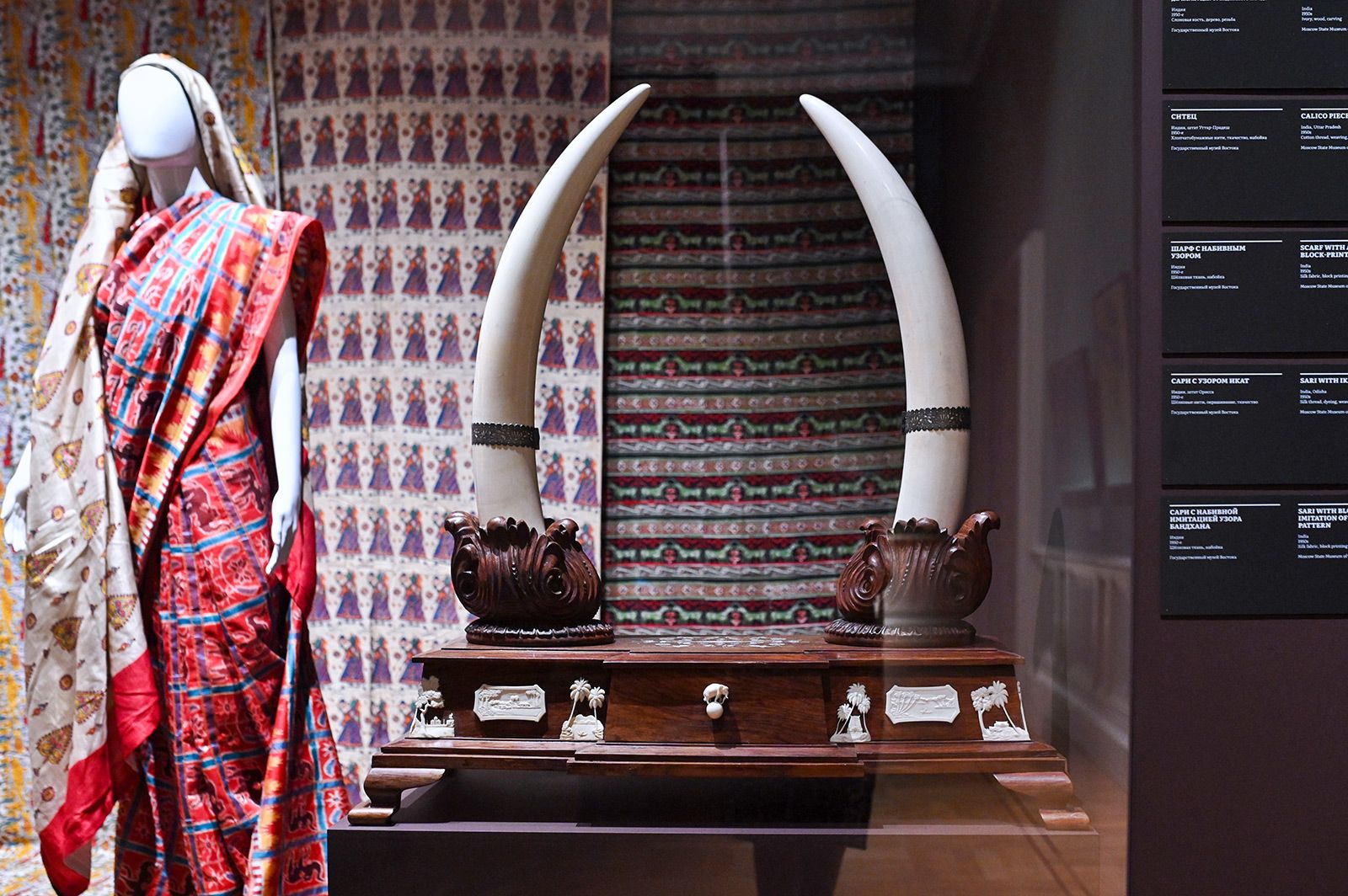
Political and cultural rapprochement between India and the USSR began in the 1950s. The countries exchanged art exhibitions, hosted theater tours and published translations of the classics. After Jawaharlal Nehru visited the Soviet Union in 1955, Nikita Khrushchev made a return visit. In India, he was presented with a wooden composition featuring elephant tusks, which is on display today. In addition, over the years, Russian delegations received various models of the Taj Mahal, fabrics and art objects.
Many artists - even those who have never been to India - reflected the Indian theme in their works, for example, Ural artist Nikolai Rusakov. People's Artists of the USSR Dmitriy Nalbandyan and Semyon Chuikov, who visited India several times, painted a series of portraits of Indians. Preparing for the exhibition, specialists revived them a little: native speakers were asked to voice several phrases in different dialects so that the audience, approaching any of the paintings, could hear speech in the four languages of Hindustan - Hindi, Bengali, Kannada and Tamil.


Items related to India were also made at Soviet enterprises. For example, the "India" dish, which later became an exhibit of the Hermitage, was made at the State Porcelain Factory. It depicts a warrior-liberator stepping over the Ganges River and the Taj Mahal to approach yogis and Rajputs who are already waiting for him.

Interest in India persists. People continue to shoot documentaries about life there, make pictures dedicated to the country. The film “Blacksmiths and Gods” tells about Indian blacksmiths and the weapon tradition of offering gifts to the goddess Durga, and a contemporary photographer from Delhi, Manoj Kumar, provided a series of photographs for large projects “India Face to Face” and “Landscapes and Cities of India”. The last exhibition hall boasts a large painting called “India. Jaipur”, which Dmitriy Nalbandyan created in 1975.

“Here is a market in Jaipur, a charming city. I visited it myself. Early in the morning, I passed these streets, these walls, snake charmers, wagons and a scattering of fruit and flowers. In the foreground of the picture is a beautiful Indian woman who is approaching us and as if inviting us to continue our acquaintance with India, which in fact can be endless,” says curator Olga Sosnina.
The exhibition will run until October 22.