From elevators to flowers: how municipal service providers implement import substitution program
(5).jpg)
For many years, Moscow-based companies providing municipal services have been systematically working on import substitution and localization. Over the past year, this activity is gaining momentum. Read mos.ru to learn more about the most successful projects.
Gas treatment sorbent
This year, Mosvodokanal JSC has launched its own production of gas treatment sorbent on the premises of the Lyubertsy treatment facilities.
The sorbent is used to load filters of systems for removing pollutants from ventilation emissions. The first batches of the product have already been received; they will be allocated to the Mosvodokanal facilities according to the schedule.
The company's need for sorbent this year is estimated at 400 tons. In 2024, the company plans to increase production to 1,000 tons, which ensures a reliable supply even with an increase in the number of units.
The production capacity will allow the company to completely replace the previously used foreign reagent with the Russian one this year.


Elevator parts
In 2023, Moslift JSC launched its own production of elevator parts. The company's engineers have developed an input device that completely replaced imported analogs. This equipment removes voltage from all elevator electric circuits, without turning off the lighting of the shaft and cabin, machine and control rooms, the system to call service personnel, communications and ventilation.
Another important step is to launch the production of supercapacitor-based recuperators. The development helps store additional energy while moving a loaded cab down or an empty cab up, as well as during braking. The elevator winch at such moments operates in a generator mode converting the kinetic energy of the cabin movement into electrical energy, which accumulates in supercapacitors. The development will save up to 35 per cent of energy.
In addition, domestic recuperators are one third cheaper than imported ones. They will be initially installed in the elevators of healthcare institutions. They are needed in case of an emergency: in the event of a power outage, the mechanism will be able to reach the cabin to the nearest floor and open the doors. Later, this development will be used in office buildings and shopping centers.



Gas distribution equipment
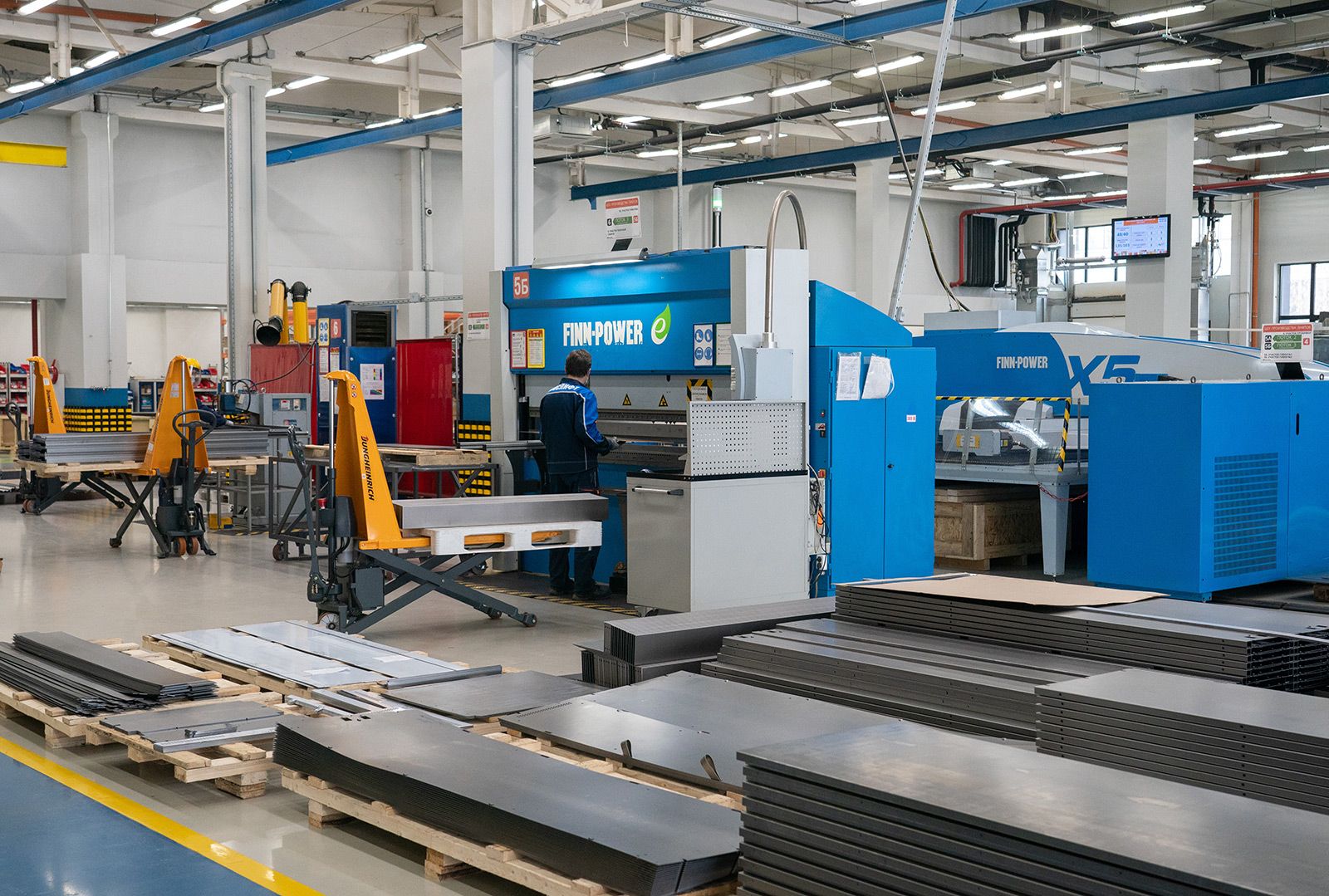
Since 2017, Mosgaz has also been implementing an import substitution program. Now all materials and equipment to construct and reconstruct gas networks and facilities are Russian, including those produced in-house.
On the premises of the company, a full production cycle, from design and documentation development to 3D modeling and manufacturing, is arranged. Mosgaz offers products both for the gas complex and other customers.
Management specialists have developed and implemented standard lines of gas distributing plants and rooftop stations with a capacity of 5 to 100 megawatts. Since 2022, the company has also been manufacturing automation and control cabinets for gas distribution and heat supply systems.
Currently, more than 91 per cent of the company's components are Russian. Over 5 years, the share of imported equipment has decreased by 4.5 times: from 39 to 9 per cent.


Asphalt concrete
The specialists of the Avtomobilnye Dorogi State Budgetary Institution use mixtures produced by 11 city enterprises to pave roads with asphalt. In total, Moscow-based companies are capable of producing more than 2,000 tons of asphalt concrete per hour.
In-house asphalt production offers a number of advantages. Our own modern laboratories control the production. They check the material, the finished product and issue quality certificates. In addition, each plant provides the most convenient part of the city in terms of transport accessibility with asphalt concrete mixtures.


Perennial plants
In 2022, the Ozelenenie State Budgetary Institution developed a program to launch the production of perennial parents. Imported seedlings are gradually being replaced by domestic ones.
The range of plants most in demand in Moscow, including hosta, Astilbe Arendsii, daylilies, heuchera, iris and others, are to be extended. All these plants can be found in the capital's flower beds.
Domestic seedlings are well adapted to the city environment, resistant to diseases, pests and temperature extremes. In addition, they are grown and prepared for planting considering all the climatic features of the region.
The production process is adjusted in such a way as to obtain healthy flower seedlings of the necessary variety and height within a precisely defined time frame. The quality of seedlings is strictly monitored: temperature and humidity levels are observed.


Waterproofing membrane
When reconstructing water disposal systems and constructing runoff treatment facilities, Mosvodostok uses domestic equipment and materials. These are cast-iron hatches and grids, asphalt concrete mixtures to repair and install storm drainage, tools to collect garbage at water bodies, pumping equipment and much more.
For example, water-resistant materials are gradually being replaced with domestic products. In 2022, during the reconstruction of the Konkovo-Derevlevo Nizhny Pond, a Russian waterproofing membrane with a total area of 22,882 square meters was used. Completely impermeable, it creates a reliable waterproof layer without leaks.


Power plant software
Rosseti Moscow Region is focused on the use of domestic electrical equipment, systems, devices, components and software. One of the priority tasks is a reliable operation of the Moscow power grid complex ensuring technological and information security.
The company's import substitution program was launched in 2014, and now the purchase share of domestic equipment has exceeded 90 per cent.
Russia produces its own witches and transformers (35–220 kilovolts), relay protection and automation devices, automated power metering and process control systems, cells (6–20 kilovolts) of switchgears and collection chambers with one-way service, as well as wires, cables, line and cable fittings (0.4–220 kilovolts).
The company widely uses domestic software, ensuring the information security of power facilities.

