Underground history or most fascinating facts about Moscow Metro development
(8).jpeg)
The metro is an essential part of modern Moscow. It has been operating for 88 years. The first train ran from Sokolniki to Park Kultury on May 15, 1935. Many things have changed in the underground transport system since then.
“Over 88 years, the metro has become an indispensable part of the Moscow transport system. Metro passengers make about 8 million trips on weekdays, which is comparable to the population of a small country. At the same time, on behalf of Sergei Sobyanin, the metro continues to develop at a tremendous pace: new lines are being built, modern rolling stock is being purchased, passenger services are being improved making travel more comfortable and safer. Marking the metro’s birthday, we have organized a lot of interesting events. I invite everyone to join our celebration,” said Maxim Liksutov, Deputy Moscow Mayor for Transport.
On the birthday of the Moscow Metro, we tell you how metro builders worked in the last century, which line became the longest and how the logo of the metro changed.
Fact 1. It all started with a pick and shovel
The idea of building an underground railway in Moscow appeared half a century before the project was introduced. Between 1875 and 1930, experts submitted at least 5 projects, but work began only in the early 1930s.
.jpeg)
.jpeg)
.jpeg)
.jpeg)
.jpeg)
The construction of the first stations can be considered a real feat of metro builders. In the early years, the cut and cover method was used with simplest tools such as picks and shovels. The builders faced a lot of difficulties, so several important decisions were made. Firstly, Moscow engineersproposed an advanced idea to build at depth. It was supported by Joseph Stalin, and the project was approved.
Secondly, in 1934, a tunnel-boring shield was delivered from England, and then another one was assembled in the USSR based on its model to facilitate the work of the builders. It looks like so much a giant metal worm: when drilling, it bites into the soil, sucks it in and expels it to the surface. Using shields, builders jumped into work, and by October 1934, the tunnels of the first radial line were ready.
Fact 2. Guinness World Records
The pace of metro construction was quickening. During the first decade, 24.25 kilometers of lines and 22 stations were built. Today, one tunnel boring machine can excavate 12 meters a day, so even taking into account difficult geological conditions, it is possible to build more than 350 meters of tunnels a month. Thanks to the hard work of the iron “sisters” (tunneling shields traditionally bear female names “Nadezhda”, “Marina”, “Roza” and others), the Moscow Metro was being build at record-breaking rates, as never before in the history of domestic metro construction.
.jpeg)
Moreover, Moscow Metro builders set world records. In 2020, the biggest number of tunneling machines working simultaneously on one project was recorded in Moscow: 23 huge machines simultaneously built the Moscow Metro at different sites.
.jpg)
Fact 3. Metro marked as "Most"
The very first line of the Moscow Metro was Sokolnicheskaya. In 1935, it covered a little more than 11 kilometers, and it included 13 stations. At that time, the line connected Sokolniki and Park Kultury with a branch to Smolenskaya: trains ran in both directions, depending on the schedule. The branching was located at the Okhotny Ryad station. It took about 20 minutes to get to Park Kultury or Smolenskaya, whereas a tram journey could take more than 2 hours.
.jpg)
.jpeg)
.jpeg)
.jpeg)
.jpeg)
.jpeg)
In 1954, the Koltsevaya Line was completed: 20 kilometers and 12 stations, each is an interchange today. The travel along the entire circle line takes about half an hour, whereas the journey along the Big Circle Line (BCL), which was fully operational on March 1, takes 90 minutes. This is the longest Moscow Metro line. It covers 70 kilometers. By the way, the BCL is the longest circle line in the world.
Before the opening of the BCL, the longest metro line was Arbatsko-Pokrovskaya covering 45 kilometers. It is slightly more than the distance from Moscow to Podolsk. The line includes 22 stations, the journey takes 65 minutes. The longest haul is located on the same line, it takes about seven minutes to travel from Krylatsky to Strogino.
Today, 258 metro stations are open in Moscow, the length of lines exceeds 450 kilometers. The whole journey takes more than 12 hours.
Fact 4. Cool breeze and air conditioning
The first A-type cars of the Moscow Metro were assembled at the Mytishchi Plant in 1934. It is still the major train manufacturer of the Moscow Metro.The pilot models were so successful that they worked in the metro for 40 years.
.jpg)
The A-type car could accommodate almost 260 people. Each had 52 leather upholstered seats. By the regular traffic launch, 58 such cars had been delivered to Moscow.
On the occasion of the 80th anniversary of the Moscow Metro, which was celebrated in 2015, one train of A-type cars was restored. Passengers can see it at the Izmaylovo electric depot.
.jpeg)
.jpeg)
.jpeg)
.jpeg)
.jpeg)
For almost nine decades, more than 10 different types and modifications of trains have run in the metro. For example, in 2009, Rusich, the first train equipped with air conditioning, began running on the Koltsevaya Line.
Today, both old trains (Nomernaya and Rusich) and new generation trains (Oka, Moskva and Moskva-2020) transport passengers. Starting with the model called Oka, all trains were equipped with an air disinfection system, and Moskva became the first serial train with a through passage and chargers. At present, the most innovative model is Moskva-2020. Each detail has been worked out, from wide doorways to the climate control system and electronic displays to plan your route. 30 years ago, passengers could not even imagine that it would be possible to charge their phone and use the Internet for free in the metro, but now it is available to everyone.
.jpeg)


.jpeg)
.jpeg)
Fact 5. From token to smile to pay
The first passengers of the Sokolnicheskaya Line bought paper tickets at a ticket office and showed them to a ticket inspector at a station. Tickets were designed for one-way travel and differed in color: passengers bought red tickets to travel to Sokolniki and yellow tickets to travel to Park Kultury. By the way, they were available for 35 minutes.
.jpg)
.jpg)
.jpeg)
In the late 1950s, metal tokens began to be used. However, in 1961, after the monetary reform, tokens were replaced by five-kopeck coins: the ticket cost five kopecks then (the coins were used until perestroika). Since 1963, the metro began to sell travel cards. They were valid for three months and cost nine rubles.
.jpg)
In 1991, tokens returned to the ticket offices of the metro, but they were no longer made of metal, but of plastic. Later, cardboard tickets with a magnetic strip appeared, and in 2013, passengers began using the Troika Travel Card.
Today, passengers can pay for travel in a variety of ways, including Troika Travel Card, Unified Travel Card, a bank card, NFC-enabled Android smartphones with a loaded Mir card, the fast payment system at the BCL ticket offices and even biometrics. This contactless payment method was launched at all metro stations in October 2021, and in September 2022, the service was introduced throughout the Moscow Central Circle.
.jpg)
Fact 6. How the metro symbol changed
The red letter "M" above pavilions is familiar to every Moscow resident and visitor. The symbol was designed by the architect Ivan Taranov. In 1935, the letter first appeared on the building façades and station pavilions with illuminated inscriptions "Metro" installed nearby. After a while, the inscriptions were removed, and the letter “M” loved by passengers remained. When the Koltsevaya Line opened, the logo changed again. The letter was decorated with lower gray serifs.
.jpeg)
The metro developed, and its logo changed. Most often, proportions of the letter itself changed, but in 1979, a blue semicircle was added symbolizing a metro tunnel. In 2006, the design was developed using 3D. The today’s logo was designed in 2014.
.jpeg)
Fact 7. Underground city
In Moscow, it is almost impossible to meet a person who has never been in the metro. It is a convenient way to travel for Moscow residents and an attraction for tourists. Back in 1935, the metro was a scary innovation for Muscovites: many were afraid to go underground, fearing unprecedented escalators and fast underground trains.
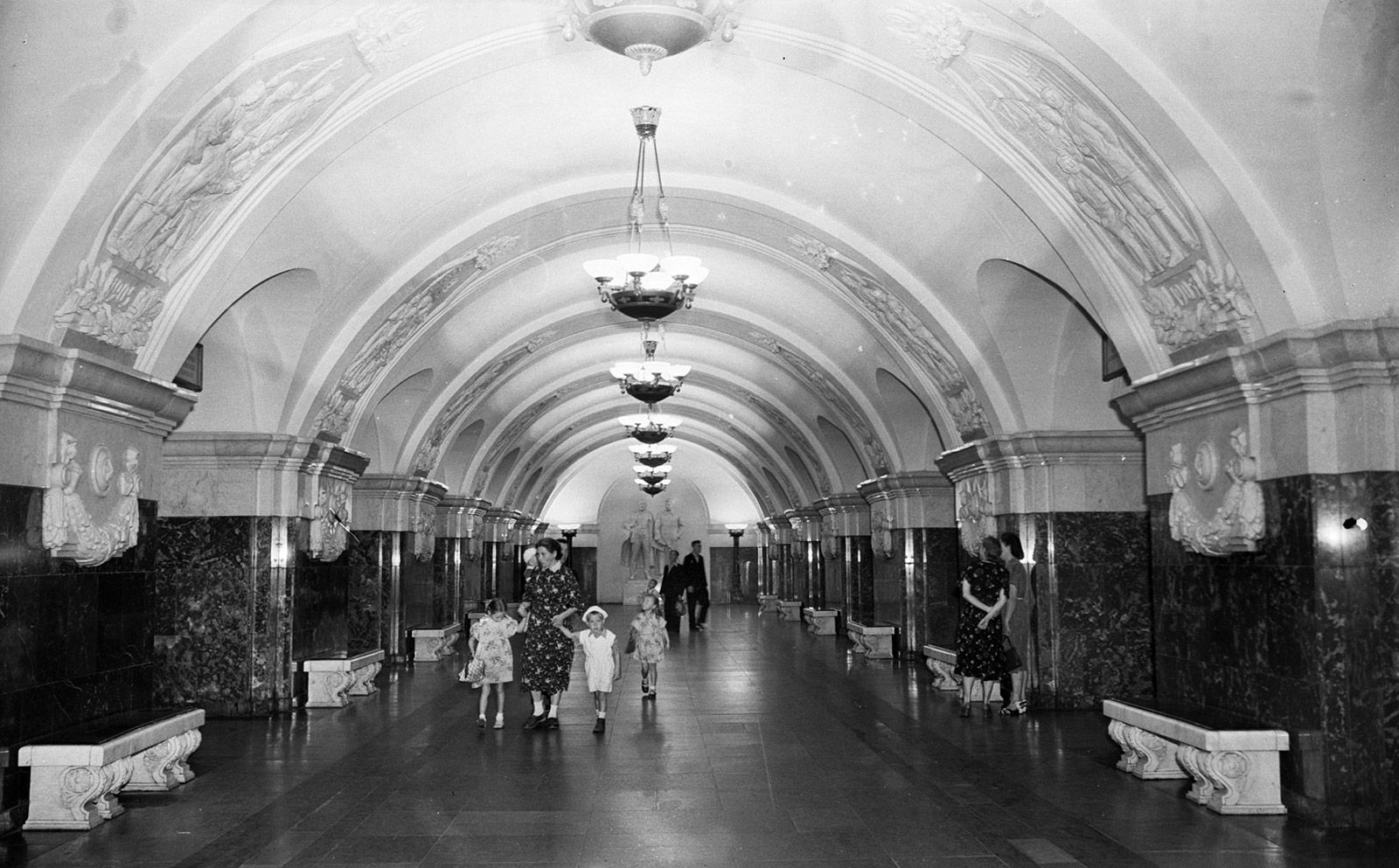
In the first year of the Moscow Metro's operation, passengers made an average of 177,000 trips per day. But the passenger traffic began to grow, and in 1940, trains transported more than a million people a year. In 1962, the metro transported more than 3 million residents per day, and more than a billion passengers traveled along the lines in all the 12 months.
Today, the Moscow Metro transports about 8 million people a day, which is almost 1.5 times the population of St. Petersburg and 7 times the population of Perm.