Open-air stages. Theater history of Moscow parks and estates
Many Moscow parks and estates have long been associated with theater. Some of them keep memories of productions that were applauded by Catherine the Great and her contemporaries, while others are still admired to this day. Some Moscow theaters are used to be located in parks: open-air theatre productions run during the warmer months. Read the mos.ru article to learn more about five parks you can visit to meet Melpomene or look for her traces.
Kuskovo: Sheremetev’s theater
Sheremetev’s theater was one of the most famous serf theaters that retained its fame through the centuries. Its founder, Count Pyotr Sheremetev, hosted amateur performances in his houses in St. Petersburg and Moscow. In the 1760 s, an open-air theater opened in the formal park of Kuskovo estate. Catherine the Great, a great theater lover, frequently attended these local performances.
The stage was located on an embankment and luxuriously decorated: it was surrounded by birch bosquets (a decorative element of landscape design) with strawberries and a high wall of clipped barberry shrubs. The backstage was a spruce trellis; the stage was covered with a grass carpet, which was hidden under a wooden flooring during performances.
Unfortunately, only outlines remained of the stage. A large stage area with an orchestra pit, a count’s box and an amphitheater holding about a hundred people can only be seen on the estate layout of 1782.

The undoubted star of the theater was Praskovya Kovaleva-Zhemchugova, whose talent was developed by the best teachers ever since she was a child. The blacksmith’s daughter became both a beloved actress and the wife of Nikolai Sheremetev, the son of the estate’s owner and heir. The beautiful and tragic story of their love inspired Countess Sheremeteva filmed in 1994 in the historical scenery of the palaces of the Ostankino and Kuskovo estates.

Lyublino: Durasov’s Theater
The building of the drama school at Lyublino estate is reminiscent of the times when the estate was owned by Nikolai Durasov, a great character and theater lover. The Durasov’s theater famous in Moscow along with the Sheremetev’s theater had more than a hundred serfs. The education at the drama school was good: some emancipated actors performed on the stage of the imperial theaters.
Nikolai Durasov enjoyed theater art wherever he lived. Durasov had a troupe of serf actors in Simbirsk, where he comes from. All the local nobility attended performances at his Nikolskoye-on-Cheremshan estate. Having settled in Moscow, Durasov was still sticking to his passion. Performances and concerts were given both in his Moscow house on Pokrovsky Boulevard and in Lyublino estate, which he bought in 1800. Performances in Lyublino were held twice a week, as well as on major holidays and special occasions.
The murals of the palace’s halls in Lyublino estate were inspired by worship of art. Apollo Citharoedus with Muses, Sacrifice, Phoebe the Radiant and Cupid’s Wedding are from left to right from the entrance to the round hall.
In 1818, Nikolai Durasov, who was not even 60 years old, passed away. The Durasov’s theater was closed, and all the serf actors were freed: that was the last will of the deceased.


Tsaritsyno: one of the first theaters near Moscow
Tsaritsyno was originally built as a pleasure summer residence of Catherine the Great. This place was intended for art such as theater and music. However, the theater appeared here only a century later, in 1870, when a high-society holiday village arose around the ruins of the palaces. It was built by the tradesman Shcheglov. The theater was one of the first such establishments in the Moscow region (at that time Tsaritsyno was not part of Moscow).

In the 19 th century, other enthusiasts managed the theater with varying success. In 1887, the new owner Balthasar Dippmann moved the stage to another location and rebuilt it, giving the theater a ‘more decent appearance. ’ Under the direction of Dippman, actors from well-known Moscow troupes, for example, the Korsh Theater, appeared on the stage of the Tsaritsyno summer theater. The repertoire included holiday performances.


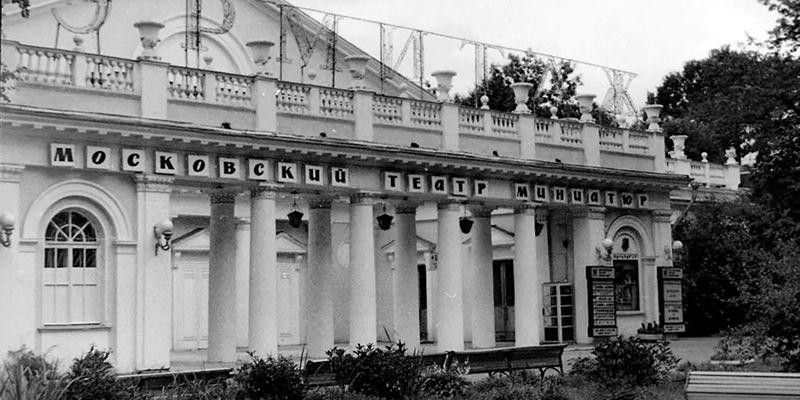
Dippman’s garden, which housed the theater, was a popular recreation area for Tsaritsyno summer residents and their guests. The garden stretched on the shore of Tsaritsyno Upper Pond near the Tsaritsyno dam (today, the Tsaritsyno ROSTA Theater established in 1930 as a branch of the Moscow Youth Theater is located on the site). By the way, Dippman’s garden, in which ‘dances were done’ and ‘military music played, ’ is mentioned in Petka in the Country by Leonid Andreev.
The theatrical traditions of the site are kept by the Tsaritsyno State Museum Reserve. The annual Holiday Tsaritsyno festival devotes most of its program to performances for children and adults.

Hermitage Garden: Sarah Bernhardt performed on its stage
The Hermitage Garden founded in the late 19 th century is not only a piece of garden art, but also a center of the cultural life in Moscow. There are three theaters in the garden: Kolobov Novaya Opera Theater of Moscow, Sfera Moscow Drama Theater and Hermitage Moscow Theater temporarily giving performances on the site of Novy Arbat. Every year in September, the garden hosts the Theater March, the largest open-air theater festival in Russia.


Historically, the name of the garden referred the territory on Bozhedomka (today’s Durova Street), where the famous voksal (pleasure garden) of the entrepreneur Mikhail Lentovsky with opera and drama theaters was located. In 1894, the merchant Yakov Shchukin created his own pleasure garden on Karetny Ryad Street, calling it the New Hermitage (the first word later fell into disuse). Thus, Shchukin showed his desire to develop the initiatives of his predecessor.

Subsequently, Sarah Bernhardt, Maria Yermolova, Vera Komissarzhevskaya, Feodor Chaliapin, Leonid Sobinov and Antonina Nezhdanova performed on the stages of the local summer and winter theaters, Sergei Rachmaninov made his debut as a conductor there. In 1898, the legendary Moscow Art Theater opened in the building of today’s Hermitage Theater.


Gorky Park: Dance Island and Green Theater
The theater traditions of Gorky Park date back almost 200 years. On May 17, 1830, Nicholas I of Russia issued a decree on the opening of an open-air theater in the Neskuchny Garden. The theater accommodating 1500 people was built in 1830. A ravine became the stage, bushes became the wings, and trees became the scenery. In 1830 Alexander Pushkin visited the theater with his fiancee Natalia Goncharova. The theater existed until 1835.
The Green Theater on Pushkinskaya Embankment was built almost 100 years later on the initiative of Betty Glan, then director of the Gorky Central Park of Culture and Leisure. The project of the theater hosting 20,000 people by the architect Lazar Cherikover was implemented in just 30 days; the theater received the first audience on July 6, 1933.

In 1935, the artists of the Bolshoi Theater staged Carmen there. The Green Theater hosted The Fountain of Bakhchisaray and The Prisoner of the Caucasus. The Stanislavsky and Nemirovich-Danchenko Moscow Academic Music Theatre gave Darvaz Gorge featuring Vsevolod Meyerhold.


Betty Glan arranged for building another stage with an amphitheater holding 800 people on an island next to the Golitsyn ponds. This theater was called Dance Island: its repertoire was dominated by ballet performances; it also had its own troupe. Some performances were also staged with the artists at the Bolshoi and Maly theaters involved.
The Dance Island was closed in 1941, and the Green Theater existed until 1956. A new building designed by Yuri Shverdyaev was built at a distance of 25 meters from Pushkinskaya Embankment in 1957; the Green Theater opened during the World Festival of Youth and Students. During the Soviet era, lectures, debates and different concerts took place in the building, and during the perestroika period, rock musicians performed on the stage of the Green Theater. Since 1989, Stas Namin Theater has been located here.
