Tulips, mimosa salad and amber brooch. How people celebrated International Women’s Day in the twentieth century
(9).jpg)
Initially, International Women’s Day had a pronounced political connotation reflected in the holiday’s symbols and the first postcards. Now, many women simply rejoice in spring, flowers and greetings on March 8. Irina Karpacheva, Head of the History of Moscow department at the Museum of Moscow, told mos.ru about how the holiday has changed.
Holiday symbols
Soviet Russia was the first country in the world to completely ensure equality between women and men in all areas of social life according to the Constitution of 1918. The following year, 1919, an official holiday appeared in the young state on March 8, the International Day of Women Workers. March 8 became International Women’s Day in 1921, but for a long time women were honored on this holiday for their achievements in work. March 8 became a public holiday in 1966, and since then families celebrate International Women’s Day.
In the second half of the 20 th century, having won their rights, women wanted attention, flowers and gifts. New traditions of celebrating March 8 began to form in the USSR. At first, women stood in lines and slaved over a hot stove during the holiday.

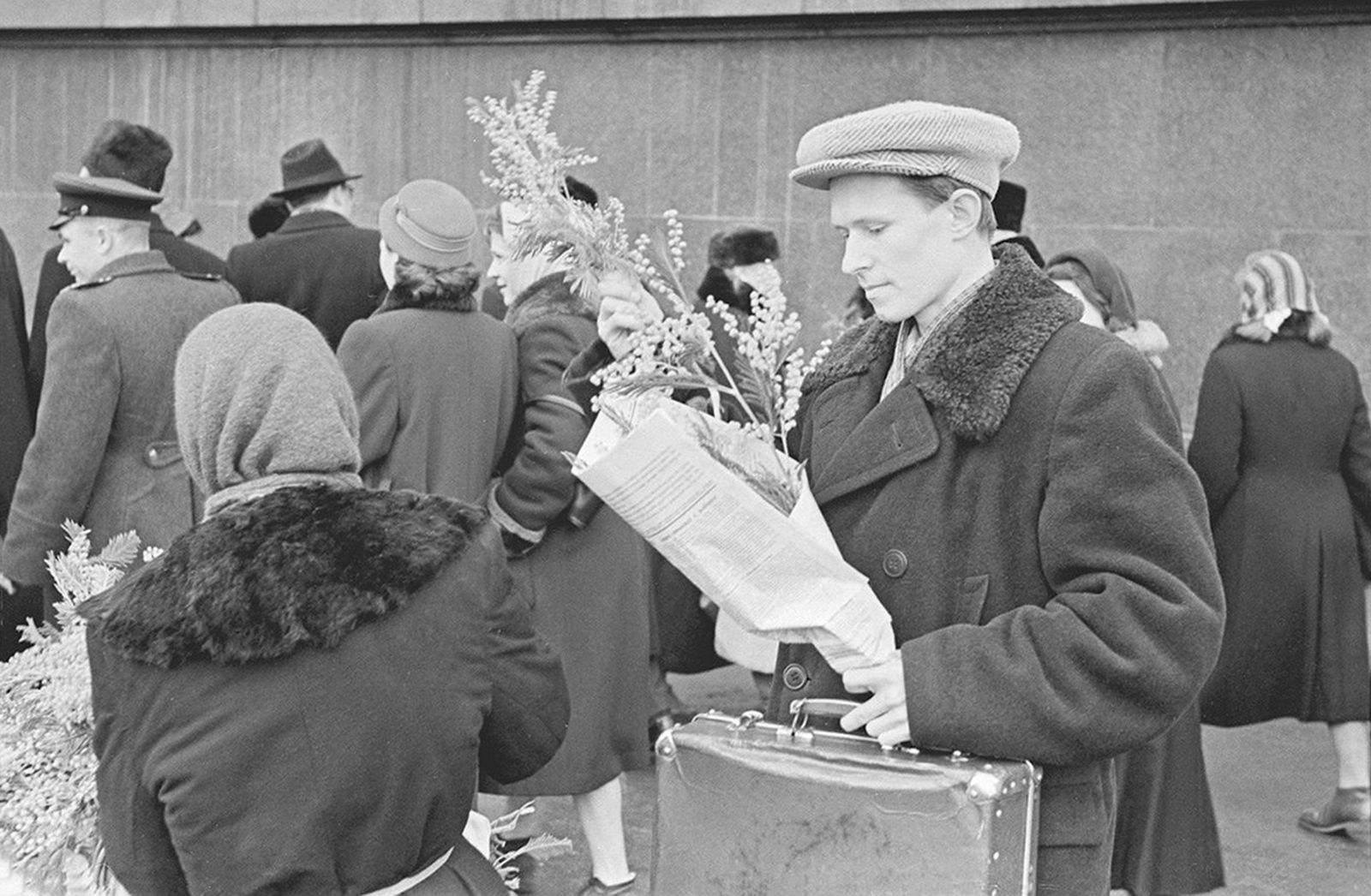
“Unless on March 7, after greetings at work, women left work early so that they could line up at the hairdresser and had their hair done. However, they, as usual, prepared meals and laid the festive table. When it comes to the holiday symbols, there are many myths; one of them is mimosa. Legend has it that Nadezhda Krupskaya, the deputy to the People’s Commissar of Education engaged in arranging holidays, offered to give mimosa to best female workers. At this time of the year, only mimosa could be found in Moscow, so it became a holiday symbol. Moreover, at first, many housewives decorated the iconic mimosa salad not with egg yolk, but with real mimosa balls,” says Irina Karpacheva.
In the early 1960 s, special March 8 candies, posters, fabrics and gift boxes appeared. Towels, napkins, candles with holiday symbols were popular at that time. The Soviet manufacturing industry latched onto the trend when, after World War II, the country had already largely rebuilt, and wages began to rise.
By the end of the 1960 s, perfumes became a common gift, and March 8 perfume sets appeared. In 1967–1968, silver and cupronickel jewelry with amber were given to women, brooches were in high demand. Amber associated with spring and the sun was inexpensive.

In the 1980 s, pantyhose imported from the GDR or Italy were a luxurious gift. Men were hesitant to give cosmetics, such as lipstick, for fear of not choosing the right shade. Good bouquets in those days were in short supply; they were instantly sold out by the holiday.
“But still, Moscow women love flowers most of all. Over the past 40 years, multi-colored tulips, Dutch and Russian ones, have become a symbol of the holiday. By Women’s Day, they are delivered to Moscow in huge quantities. In the 1990 s, it became popular in Moscow to give hyacinths, which also symbolized the arrival of spring. And a few years ago, toys suddenly became the most popular gift: bear cubs decorated with roses,” says Irina Karpacheva.

Postcard evolution
The first postcards mass produced in the USSR since the 1950 s emphasized the international status of the holiday. For example, one of the cards stored in the Museum of Moscow features the faces of an Asian, an African and a Caucasian girl.

As the political component of the holiday became a thing of the past, postcards also changed. They often featured children and toys. Kindergartens and schools established a tradition to wish a happy Women’s Day.
“For several years in a row, on March 8, I found a secret postcard with touching words without a signature in my school bag. I do not even know who wrote them to this day. In the ninth grade, the boys arranged a funny lottery for us. Each girl got a paper with a number on it and, in accordance with it, looked for a gift throughout the classroom. I still remember that I received a trendy present from my classmates, a ceramic candy dish. At that time, ceramics were very popular and inexpensive. I will definitely give this present to the holdings of our museum in addition to the postcard written with an enormous amount of grammatical errors,” smiles Irina Karpacheva.
.jpg)
One of the postcards dating back to 1980 by the artist Tatyana Varlamova is kept in the Museum of Moscow. Her images were very original. The card features the number eight as a Matryoshka doll with schoolchildren holding flowers behind it: the author used the similarity of the number eight with the shape of the traditional Russian doll.

Since the 1960 s, floral postcards have become increasingly common. Majestic red roses were especially successful for Olga Khodataeva, who began painting them in 1954. Interestingly, her works were not created specifically for March 8, but it turned out that men chose them as a gift for women.
The postcards with three-dimensional images of flowers looked beautiful and unusual. In the early 1960 s, artists started making beautiful and sincere Socialist realism cards. Animation artists Vladimir Zarubin and Yury Ryakhovsky worked on images of smiling pioneers, hares, bear cubs with touching bouquets.

Until the 1970 s, postcards were mostly drawn, and then photo postcards with flower arrangements became popular. The collection of the Museum of Moscow features unique copies of Ivan Dergilev, one of the founders of the color photo collage composition.
At first, it was customary to send postcards only by mail, but gradually a tradition to hand them in person putting them in an envelope or in a gift box appeared. Children happily sent postcards to their mothers and grandmothers. The collection of the Museum of Moscow includes many cards with touching words written by children.
“Women living in Moscow really appreciate and carefully store gifts from their loved ones and colleagues,” says Irina Karpacheva. They take care of scarves, shawls, brooches, perfume bottles, sweet boxes given on March 8 as a memory. They convey their joy to the museum for good. We had a letter from the line written in 1942, in which a soldier in the trench wished his mother a happy March 8, although this holiday was not officially celebrated at that time. He wrote that “the air smelled of spring and victory”, and added, “Wait, I’ll be back”. And what could be the best gift if not hope?
.jpg)
.JPG)
.jpg)
.jpg)
.jpg)
.jpg)
.jpg)
.jpg)