Tractor driver, mountain climber and steelworker: the best male sculptures at VDNKh
(29).jpg)
VDNKh features 40 male statues that adorn the pavilions and grounds. Marking the Defender of the Fatherland Day, the main exhibition of Russia has prepared a selection of the strongest, well-built and brave male images that visitors should definitely pay attention to while walking.
Majestic worker
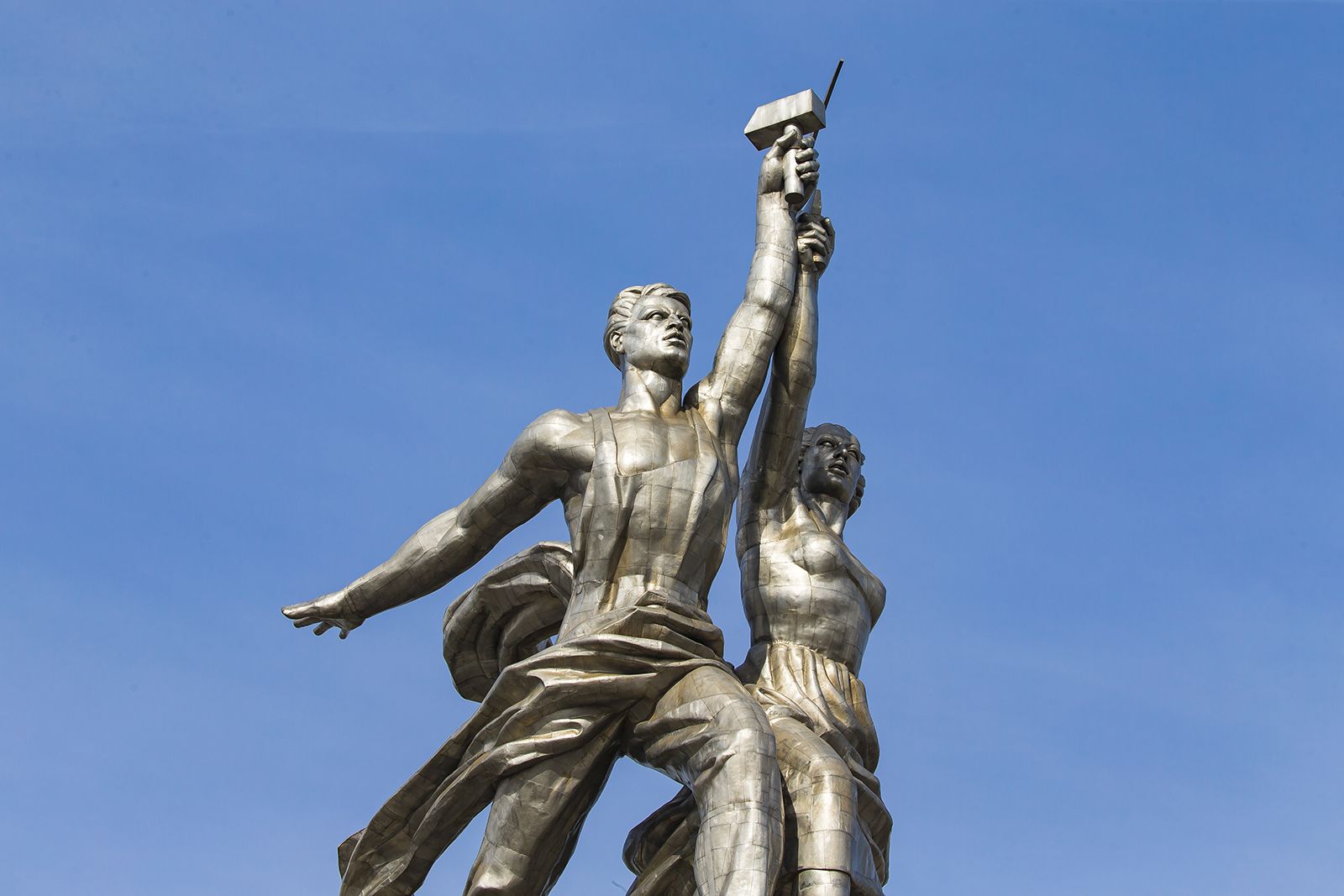
One of the most recognizable monuments of VDNKh is the Worker and Kolkhoz Woman statue towering in the pavilion of the same name. The composition reflects the image of a real Soviet man - a participant in socialist labor, the ideal and symbol of the Soviet era.
The artistic vision of the architect Boris Iofan was incarnated by the sculptor Vera Mukhina. The author has long been looking for a hero for the prototype of the worker. It is believed that she managed to find the male image during a rehearsal of a sports parade in the Gorky Park. The author met Sergei Kasner, an athlete and a metro builder, who was riding on a tall pedestal with a hammer and sickle in his hands. It was probably his figure that became the basis of the sculpture that glorified Vera Mukhina throughout the world.
VDNKh features other interesting images of workers, which are definitely worth seeing. Pavilion No. 67 is decorated with a wooden pediment featuring a subtle relief. Figured carving patterns are inspired by agriculture, forestry, animal husbandry, fishing and other branches of Soviet economy. The pediment has a wooden sculpture of a worker of the Karelo-Finnish Soviet Socialist Republic. The man wearing farmer clothes holds a wrench in his hand and confidently looks ahead.
Strong tractor driver
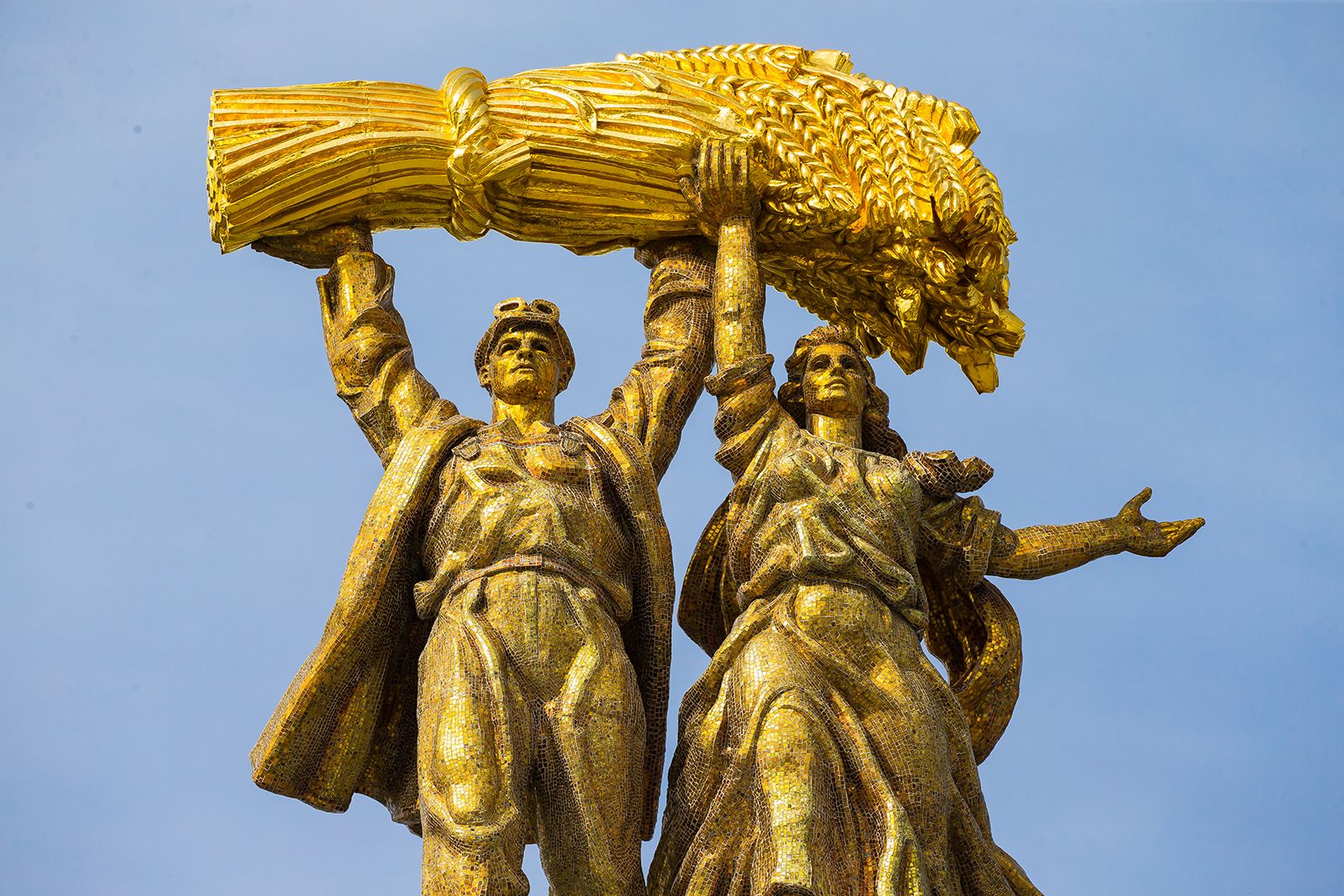
At the arch of the main entrance, guests are welcomed by another famous symbol of the exhibition - a deep-chested tractor driver and his collective farm companion. The man is wearing a heavy leather jacket and goggles on his headgear. He holds a heavy sheaf of wheat overhead, and the woman helps him hold it with one hand. Until 1954, the sculptural composition looked different: the tractor driver was called a collective farmer and shared the bunch of wheat with his girlfriend, while putting his other arm around the woman's waist.
Today, while walking around VDNKh, attentive visitors will meet several "colleagues" of the tractor driver. One of them, a pensive, well-built guy wearing work clothes, stands on the roof of Pavilion No. 34 Cosmos. The eight-meter monument was built by student architects under the guidance of the famous Stalin-era sculptor Sergei Merkurov in 1954.
Another tractor driver stands on the roof of Pavilion No. 71, where the Public Services Palace is now located. The man is dressed in work clothes, a wrench resting against a massive gear is in his right hand. Next to him is a kolkhoz woman with an open book. The composition embodies the prosperity of the worker-peasant class and the craving for work and knowledge.
Tough steelworker

Pavilion No. 11 of the Republic of Kazakhstan restored in 2021 is crowned with a statue of a four-meter steelworker. This profession has always been considered respected among hard-working men. The character was tested for strength, and the body for endurance.
Steelworker is one of the few male monuments at the exhibition made of composite material and recreated during the current restoration. The original monument was built by Khasbulat Askar-Saryji, the founder of the sculptural art of Dagestan, in 1954. However, in the 1960s, this and many elements of the façade were lost. The appearance of the man was recreated using archival drawings and photographs during the restoration. The monuments to Dzhambul Dzhabaev, a Kazakh singer, and Shyganak Bersiev, the innovator of agricultural production, are among the restored male images of the pavilion.
Brave soldier and sailor
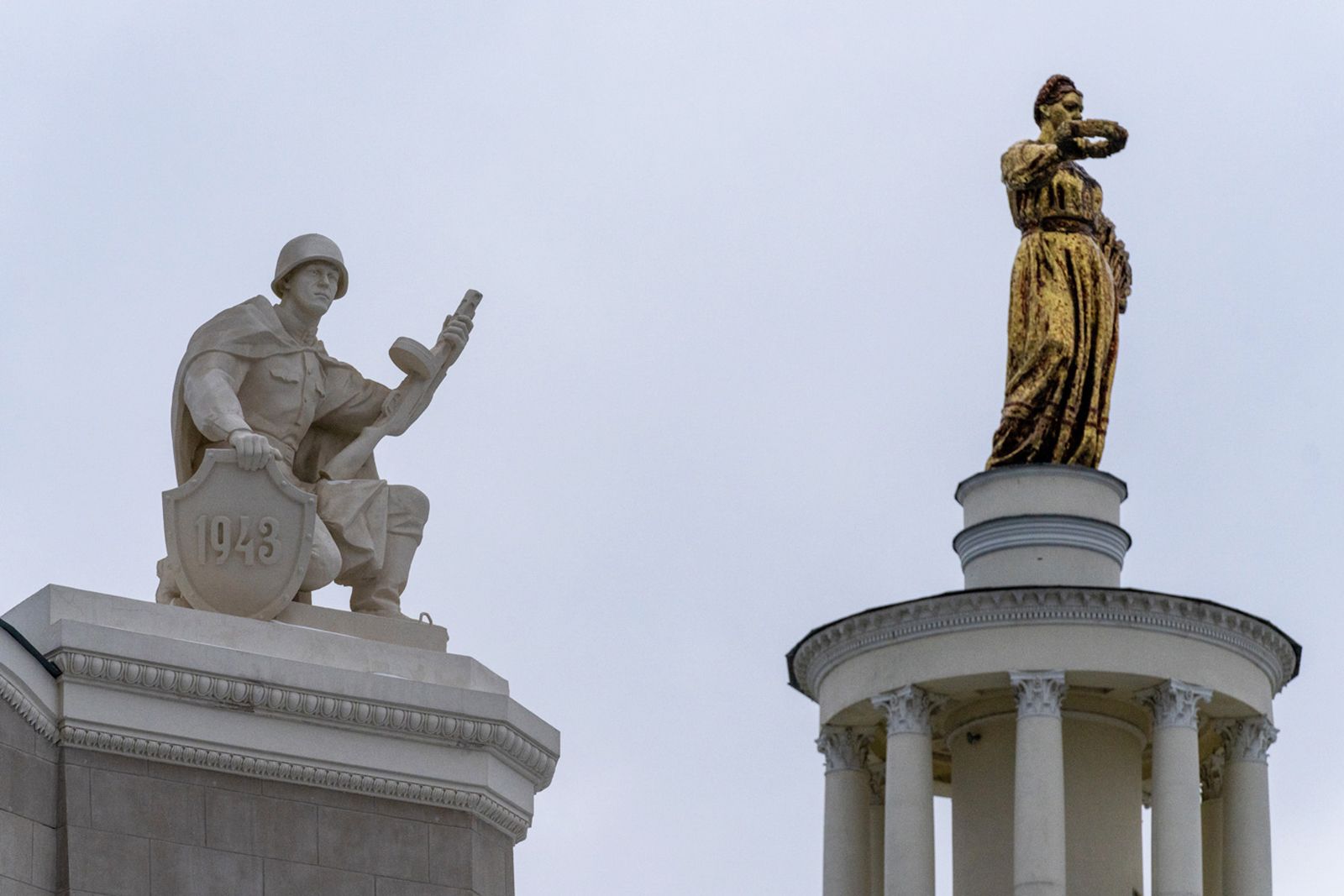
Pavilion No. 15 has sculptures of a soldier with the 1943 coat of arms (the year of victory in the Battle of Stalingrad) and a sailor with the 1918 shield (the year the Defense of Tsaritsyn began). These figures were lost in the 1960s, but last year they were recreated and installed on the historical sites. The height of the side sculptures is three meters.
Wise shepherd

A statue of a shepherd wearing national dress is next to the Exhibition and Trade Centre of the Republic of Azerbaijan (Pavilion No. 14). Its author is the Soviet Azerbaijani monumental sculptor Fuad Abdurahmanov. In the 1960s, the historical sculpture was lost; in 2019, it was recreated based on the author’s cast from the holdings of the Azerbaijan National Museum of Arts and returned to its historical site.
Die-hard mountain climber

The Male and Female Climber realistic composition appeared in 1954 thanks to the artist and sculptor Evgeny Abalakov. The concrete sculpture is located near Pavilion No. 27 Physical Culture and Sports. The author was professionally engaged in mountain climbing and knew firsthand how hardy and attentive a real mountainclimber should be. It was this image of a purposeful athlete that he reflected in his work.
For a long time, the unique sculptural composition was not repaired and was slowly destroyed. In 2012, they decided to put the figures in special boxes. In 2016, the statues were restored and returned to their original site. When recreating the lost fragments of the climber's appearance, volumes were used from the tombstone image on the Abalakov’s grave - an exact copy of one of the sculptures installed at VDNKh.
Intelligent Michurin

A bronze monument to the famous plant breeder Ivan Michurin has been erected at VDNKh. The figure rises on a pedestal of red granite. The famous biologist is dressed in a coat and hat, a cane is in his right hand, a notebook is in his left hand. The author of the monument is the sculptor Dmitry Zhilov. This image of Michurin is slightly different from his 1939 concrete predecessor. Previously, the breeder's gaze was fixed on the apple in his left hand.
Now the scientist looks ahead and hospitably welcomes the guests of the Michurinsky Garden. In the warm season, the monument is surrounded by fruit and berry trees, including those bred by the outstanding breeder. In total, over the years of work, Michurin has created more than 300 varieties that are resistant to the climate of central Russia, including new varieties of apple trees, pears, blackberries and currants.
Nimble boy with fish

The small fountain-water pool featuring the Boy with a Fish bronze sculpture is located behind Pavilion No. 64 Optics. Its second name is Fisherman. The idea of the composition is that the lucky guy firmly holds the catch with both hands. The same monument was erected in 1949 in Victory Park in Leningrad. The statue was a student work of the Soviet sculptor Boris Son.
The Boy with a Fish monument was installed at the VDNKh’s building for a reason. Indeed, in 1939-1941, Optics Pavilion was called Leningrad and the North-East of the RSFSR, and in 1954-1958, it was called Leningrad and the North-West of the RSFSR. The statue complemented the ideological concept of the site.
The Boy with a Fish fountain was erected only in the late 1970s. Then a single jet of water flew out from under the fish. During the reconstruction in 2014, the statue was put on a tall pedestal. Nowadays, the young fisherman is surrounded by a ring of water streams striving upwards in the fountain season.
Exemplary father of three

The figure of a father with many children is included in the Family bronze sculptural composition next to Pavilion No. 8 Young Naturalists. The father is standing, he is holding a baby on his shoulder, a little daughter and wife with a baby is next to him. The idealistic sculpture was made in bronze in 1954. Initially, it was located next to the Healthcare and Medical Industry Pavilion and complemented the main goal of the facility - to glorify the achievements of Soviet free medicine. However, in 1961, the family “moved” to the square near Pavilion No. 8, where they welcome guests of VDNKh to this day.