Russian Gatsby’s estate and Boris Godunov’s homestead: six Moscow estates you might never have heard about
History in Moscow is everywhere. Estates that used to belong to the old nobility are among the chief keepers of it. Secrets and legends of noble families who in many cases had defined the future of Russia hide behind their façades. You don’t need to know a lot about genealogy or architecture to take in their beauty and spirit: nice weather and a fancy to take a stroll would be enough.
Moscow has a lot of beautiful estates, less popular, of course, than everyone’s favorites Tsaritsyno, Kolomenskoye or Kuskovo. Mos.ru dives in the history and modern life of some Moscow estates.
Palladian architecture and Skhodnensky Dip


Bratsevo, an estate with a wealth of history, hides in the north-west of Moscow, in the middle of a park. The first mentions of that place go back to the 16th century, to the settlement of the same name. Bratsevo changed hands a lot since then. Some of its owners were Boyar Dmitry Godunov, Boris Godunov’s uncle, Bogdan Khitrovo, founder of Simbirsk (now Ulyanovsk). Count Alexander Stroganov, one of the wealthiest men in the Russian Empire, Prince Nikolai Shcherbatov, manager of the History Museum, and even Catherine II’s minion Ivan Rimsky-Korsakov.
In the Soviet times, the estate served lots of purposes, including being a school, a health resort and even a movie set. Lovers of cinema will recognize a lot of places there: Ryazanov made Say a Word for the Poor Hussar here, Sakharov – The Noble Peasant Girl.
Legends say the master house that tops the hill near the Skhodnya River was designed by Andrey Voronikhin, the architect who built the Kazan Cathedral in St. Petersburg. The style of the building is Palladian. That means it was made in the classicist style following the tenets of classical temple architecture. The building was restored in 2012. Now Muscovites can enjoy the open terrace with banisters, the roof colonnades and triple Italian windows.
The surrounding park near the turn of the Skhodnya river has an unusual natural phenomenon: a huge cup in the earth, about 75 hectares large and 40 meters deep, known as the Skhodnensky Dip nature park. How it came to be and why, no one knows for sure; one version is it’s a meteorite impact site. Another reason for its popularity is that its edge offers a nice view of the Seven Sisters and the Moscow City.
The lisping estate


The Sviblovo estate history also starts with a settlement of the same name. Legend says that in the 14th century, the land to the north of Moscow was the property of Fyodor Sviblo, one of Dmitry Donskoy’s warlords. The nickname Sviblo meant “lisping” or “speaking incoherently”.
Like Bratsevo, Sviblovo also had some famous tenants. Famous historian Nikolay Karamzin lived there in the early 19th century. In Sviblovo, he started working on his History of the Russian State. The last owner of the estate in pre-Revolutionary times was wealthy merchant Kozhevnikov. He bought it in 1821. There he set up a textile mill equipped with top-of-the-line machinery. Even Emperor Alexander I himself visited it one day.
The master house is a perfect specimen of Russian classicist style: a stocky two-storey house, restrained but elegant, with a porch surrounded by Roman-style pillars. The Naryshkin Baroque style Trinity Church right across from it is a complete opposite: its colorful towers with fancy mouldings seem to fly to the sky.
You should go to Sviblovo to visit its picturesque, beautifully landscaped and cozy park with multiple small ponds. In the middle of it, there’s a small island with a rotunda, surrounded with a channel. There, you can also see an underground spring that used to supply the estate with water. All the buildings at the estate were restored; the Trinity Church, the master house, the park and the service facility were declaredarchitectural landmarks.
Estate of Russian Gatsby


Initially, the Lyublino estate had another name. In the late 17th century, the property on the bank of Churilikha River was inherited by the last scion of the Godunov line, and was appropriately renamed to Godunovo. After that the estate came into the ownership of Prozorovsky princely line. The princes loved their new manor. According to one version, that’s why it got the name Lyublino (from Russian lyubit – to love).
But the most significant personality in the history of the estate is, by all rights, Nikolai Durasov, called the Russian Gatsby later because of his wealth, eccentricity and extravagant lifestyle. His idea was to make Lyublino into a place for amusements and parties, so he rebuilt the estate for that purpose. The property got stables, a greenhouse and a private theater with serf actors, one of the largest in the Russian Empire. A park with linden alleys and ponds was set up.
The master house, a veritable palace, looks unusual, with four wings expanding from the middle rotunda and circled by a colonnade. A legend says that Durasov chose that layout to commemorate himself being awarded with St. Anna’s Cross, one of the highest awards in the Russian Empire, that looked roughly like that.
In the 19th century, summer dachas were built in Lyublino; Fyodor Dostoevsky has once vacationed in one of them. He used the occasion to polish one of his most well-known novels: Crime and Punishment.
Lyublino today is a cultural heritage site of federal significance, a part of Kuzminki-Lyublino Museum Reserve. Both the park and the palace are open for visitors. The estate has a permanent exposition featuring antique classicist interiors; it’s also a venue for exhibitions, guided tours and music shows, even weddings. The theater school building is also open for visitors.
The fancy Windmill


The Kuzminki estate is located close to Lyublino, along the same Churilikha River. The Kuzminki windmill owned by the Nikolo-Ugreshsky Monastery was nearby. That’s why up until the early 20th century the estate has been called Melnitsa (Windmill).
In 1812, Kuzminki shared the fate most Moscow estates suffered: it was razed by French troops. To restore the property, the Golitsyns hired Ivan (Giovanni) Gilardi, an architect from Moscow, who designed, among others, the Mariinskaya Hospital. His son Domenico Gilardi was the one who mostly defined the estate’s architecture. However, in the early 20th century, the property took a hit again: the fire destroyed the main building. The house built in the Soviet times to imitate the original architecture still stands there.
These days the Kuzminki estate is a part of Kuzminki-Lyublino Museum Reserve. The former estate grounds still has the stables, the Church of Theotokos of Blachernae, the vestry with some church paraphernalia still surviving, a small house on the dam previously used as a watermill, along with the main courtyard facilities, the smithy, the Orange dacha, the Egyptian house, etc.
The park features a cascade of three ponds (Upper, Lower and Shibayevo ponds) and two grottoes. There’s also a white stone obelisk to Alexander II and a plinth for a monument to Peter I.
From a court minion’s estate to a farming academy

In the north-west of Moscow, there’s Petrovsko-Razumovskoye estate that also serves as the Russian State Agrarian University – Moscow Timiryazev Agricultural Academy. Initially, the area was occupied by Semchino village owned by Boyar Alexander Shuysky, Kirill Naryshkin, Peter I’s grandfather (they started calling the estate Petrovskoye at the time), and Kirill Razumovsky, one of Empress Elizabeth’s paramours. The latter one did two important things: built the master house and the French-style park, thus giving Petrovsko-Razumovskoye the other half of its name.
The Agriculture and Forestry Academy opened there in 1861. They totally dismantled the old building and erected a new facility that’s still in use today. In 2005 the Academy was renamed after natural scientist Konstantin Timiryazev.
The stylish Academy building is one of the estate’s main attractions. Its Baroque style is especially noticeable on the façade with its balconies framed with fancy cast iron railings and moulded cornices.
Unfortunately, not everyone can enter the university grounds: it’s allowed on weekends or holidays, or if you’re one of its students. From time to time, guided tours are offered there for free, introducing visitors to the architectural wonders of the main building, along with the historical garden.
Monte Carlo in Moscow

One of the versions of Khovrino village name is that it got it thanks to its owner Georgy Safarin, a wealthy merchant’s son. He used to be called a “khovra”, i.e. a messy, poorly groomed person. The nickname stuck and eventually became the family’s last name. The estate changed hands a lot: it went from the Sheremetev Boyars to the Golitsyn Princes, but in the early 18th century, thanks to Peter I’s generosity, it went back to one of Khovrin’s descendants, Field Marshall General Fyodor Golovin. He was the one to set up a park and a garden there.
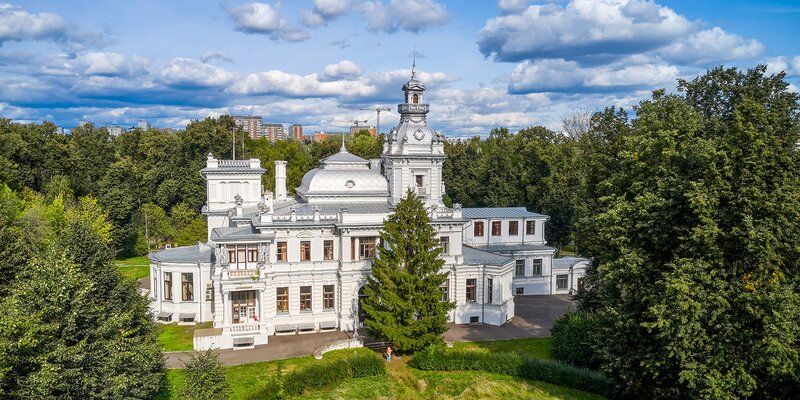
Wealthy merchant Mitrofan Grachyov bought the property in 1895. The master house that looks like an Italian nobleman’s residence, was built at the time. The estate also changed its name to the one it still has today: Grachyovka.
Its “untidy” name notwithstanding, Khovrino-Grachyovka has always been popular with artists and Moscow intellectuals. Pyotr Tchaikovsky, Vladimir Gilyarovsky and Alexei Tolstoy all loved to vacation there.
The estate’s main feature is an uncommon house designed by Lev Kekushev. Done in the eclectic modernist style, it looks like a Monte Carlo casino: a tower with a spire, rounded slopes of the roof, open stanzas, elaborate plaster mouldings and lion statues decorating the staircases. A well-tended to park with quiet linden alleys and rotundas is nearby, always open for visitors. There you can relax by a picturesque pond or take a ski walk in winter.