Pictures from the orbit. Looking at the Dzhanibekov Effect exhibition
(13).JPG)
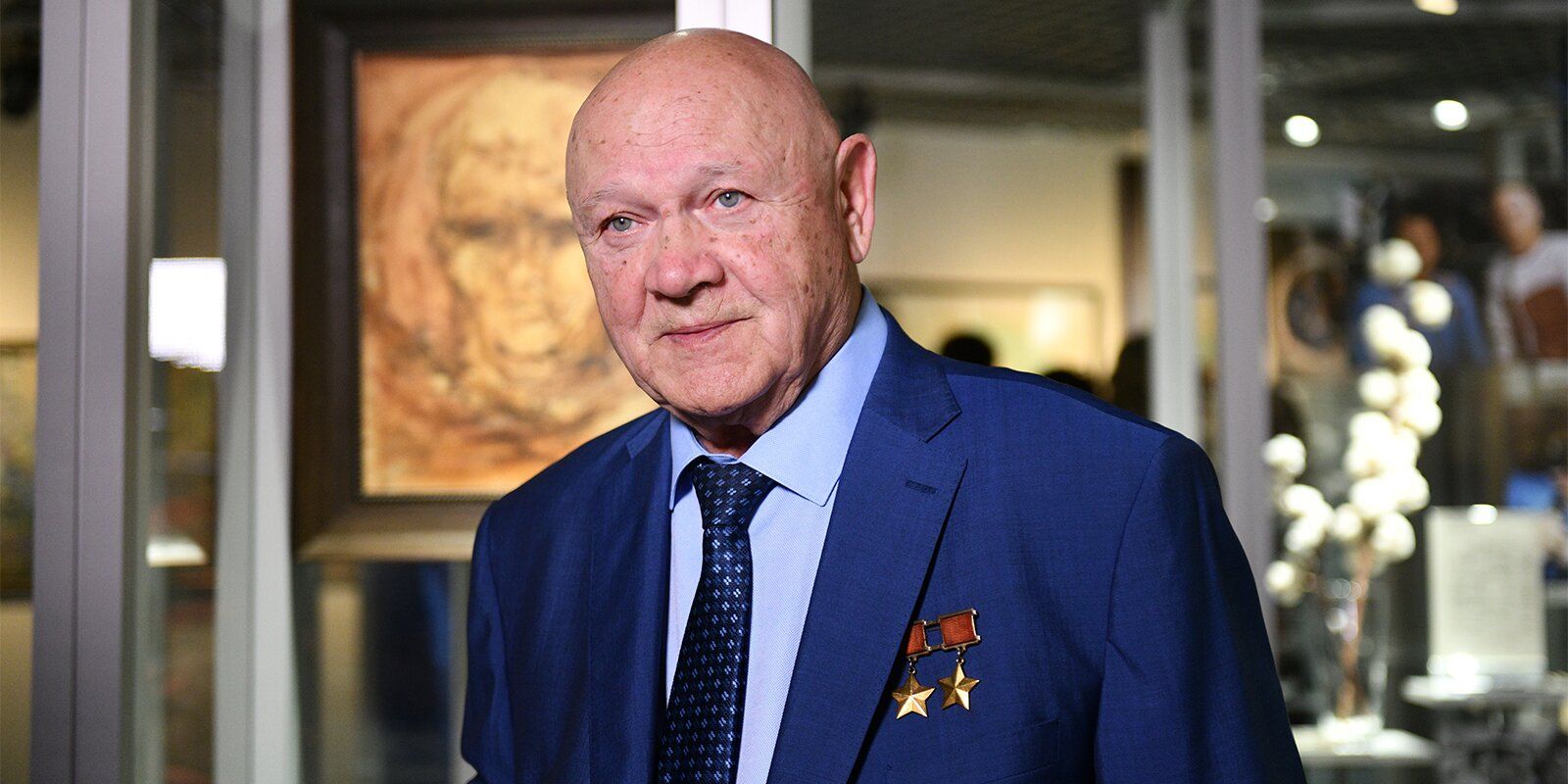
The Museum of Cosmonautics in Moscow opened the Dzhanibekov Effect exhibition to celebrate the 80th birthday of Vladimir Dzhanibekov, a Soviet space pilot, twice Hero of the Soviet Union and Major General of Air Force. Nine sections of the exhibition shed light on the life of a Russian space flight legend: from childhood to the present. Tatiana Gevorkian, Vladimir Dzhanibekov’s wife, acted as the exhibition curator. She oversaw collection of the heroic astronaut’s personal belongings, original documents, unique photographs, newspapers, postcards, medals, an array of author’s paintings and line art, lapel pins, and other items provided by the family, the Museum of Cosmonautics and other Russian museums.
Space as a dream
The exhibition centerpiece is a display case with Mr. Dzhanibekov’s medals. Stylized water streams are flowing toward it. It’s not just a design decision: Vladimir Dzhanibekov’s entire life has been tightly linked to the water element. For example, water played a role in awakening his drive to uncover the secrets of the Universe. One day, going home from Suvorov military school in Tashkent, cadet Dzhanibekov dropped his school bag into an aryk (as they call irrigation ditches in Middle Asia). Inside the bag, there was a book by Vladimir Tsesevich called “What To Observe In the Sky And How To Do That” that Dzhanibekov has borrowed from a library.

“Dzhanibekov and his mom spent that night drying the book with a clothes iron one page at a time. Still, the library refused to take the book back. They had to give them another one and keep Tsesevich’s book for themselves,” says Pavel Karavatsky, the Museum’s senior researcher.
That book, still kept in Dzhanibekov’s personal library, along with other favorite books of his childhood, like Ivan Efremov’s Andromeda Nebula and Konstantin Tsiolkovsky’s works, are now displayed in the Museum. Mr. Dzhanibekov himself says this exhibit is particularly dear to him.
The exhibition also has his scorecards from the Suvorov military school. It’s full of straight As. He used to have lots of hobbies back in those days, like radio, telescope building, foreign languages, visual arts, but the sky was his greatest love.
“I have always told my mom I was going to become a space pilot,” Mr. Dzhanibekov reminisces. “I still remember how our physics teacher told us about the first satellite launch in 1957. Things started going fast after that. All I had to do was to overcome my own shortcomings and move forward.”
He went on to study physics in the Leningrad State University, but dropped out after the first semester when he made a decision to become an army pilot. After that, Dzhanibekov enrolled to V. Komarov Air Force Academy. After graduating, he worked as a flight instructor for a while, and joined the cosmonaut team. His knowledge of English made him eligible for the Soviet-American Soyuz-Apollo space program.
Flights number one, two and three
Of particular note among all the decorations on the central display (there are about 200 of them, all told) are two Gold Star medals of the Hero of the Soviet Union, the highest number allowed to cosmonauts, and five Orders of Lenin, one for each space flight.


Vladimir Dzhanibekov was a crew captain for all of his flights: that’s a unique achievement not surpassed by anyone to date. The most valuable items on display are linked to his trips to space, such as space suits used at Salyut-6 and Salyut-7 orbital stations, an anti-g suit and some work records.
Mr. Dzhanibekov first went to orbit in 1978, together with flight engineer Oleg Makarov. That was the first ever space flight to Salyut-6 orbital station. Orbiting Earth, they set up a pilot-controlled research facility consisting of the orbital station and two spacecraft; the crew switched ships.
Dzhanibekov’s second flight was in 1981. His partner at the orbit was the first Mongolian cosmonaut, Jügderdemidiin Gürragchaa. Dzhanibekov used a Russo-Mongolian phrasebook compiled specifically for such a case, to communicate with his partner on board. There are also his “space hairbrush” and a bright orange Trout wetsuit cosmonauts wear when they leave the capsule. The pilot used it to prepare for his flight and practice water landing.
The third flight was in the company of Jean-Loup Chrétien, the first French cosmonaut, in 1982. That time, due to a breakdown in automated systems, Dzhanibekov had to do station approach and docking by hand. He didn’t inform Earth of that so as not to cause panic.


.JPG)
.JPG)

Flight number four and the bast space photograph in the world
The future cosmonaut’s loved photography since he was a little boy; the exhibition presents Fotokor-1, his first ever camera, and FED from when he attended Suvorov Military School, along with some pictures he’s brought back from his space flights. Pictures of Earth or Moon surface, scenes from life on orbit or group pictures taken with a remote cord are among them.
“By looking at those pictures, we can imagine the warm and friendly attitude that was common on board,” Mr. Karavatsky says. “To uphold it and to make people from different countries communicate with each other was one of crew captain’s responsibilities.”


Vladimir Dzhanibekov went to space for the fourth time in 1984, in the company of Svetlana Savitskaya, the first woman to go on a space walk. Ms. Savitskaya tested a universal handheld tool in vacuum conditions, also running experiments on metal plates welding, cutting, soldering and spray coating. That was what Mr. Dzhanibekov captured on his photograph which was declared the best space picture and received multiple rewards.
“The hardest thing was to steady the shot. I had photo and TV cameras with me. I was being jolted back and forth, so I couldn’t focus, but I did manage to get a couple of shots “from the hip”. Only one of them was any good,” Mr. Dzhanibekob described.
The picture on display is accompanied with the tool that Savitskaya used, pieces from the capsule’s parachutes signed by the whole crew, and blades of grass from the landing site that the cosmonauts brought with them as a memory.
Flight number five: a cap, a clap and floating crayons
Dzhanibekov’s fifth flight in 1985 is still considered the most technically challenging in the history of spacefaring. Together with Viktor Savinykh, his flight engineer, he restored functioning of the Salyut-7 station that had gone out of control due to a power outage.
“It was very cold at the station: zero Centigrade or even below. That’s why the cosmonauts had to use warm overall and fluffy caps that Mrs. Savinykh had knitted before the flight. Dzhanibekov’s original cap was lost, but Lilia Savinykh knitted another just like that, specially for the exhibition,” Mr. Karavatsky revealed.
In the display case dedicated to that mission visitors can see Viktor Savinykh’s book Notes From the Dead Station and the camera Vladimir Dzhanibekov used to make his famous series of shots called Salyut-7. There’s also the space cotton variety he’s bread on that flight. Its fiber length is 78 millimeters. Regular cotton plant with fiber length of just 45 millimeters is presented for comparison. Dzhanibekov planted cotton seeds he’s brought from Earth at the station, but they died quickly because it was so cold there. Still, some survived, and space radiation brought up a mutation in their DNA. The mutated plants were resilient to cold and salt-rich soil, and grew nearly twice as big.


During his school years, Mr. Dzhanibekov used to spend a lot of time in the field picking cotton, the Uzbek gold. That’s why he’s especially proud that the variety he’s bred went commercial in the national economy.
During the same mission, he discovered an unusual effect: unstable rotation of a solid body in zero G. When they were unloading the Progress shuttle, one of the nuts he’d unscrewed started floating around the cabin. The spacefarer noticed that after a while, the nut started doing 180-degree flips. Today, that phenomenon is known in classical mechanics as the Dzhanibekov effect.
Another memento of that extremely challenging mission is a box of crayons. Dzhanibekov lost it at the station; when it was time to go back to Earth, he just couldn’t find it. Suddenly, the coveted box floated to him as if on its own.
A multifaceted talent
Another section of the exhibition is dedicated to Mr. Dzhanibekov’s hobbies, the chief among which are painting and line art. His favorite subjects are space and the nature of Kazakhstan and Uzbekistan. The Memory of the Lost, a painting with three figures as if dissolving into the mist, is dedicated to Georgy Dobrovolsky, Viktor Patsayev and Vladislav Volkov, perished tragically in 1971. The Grandma Who Saved the World captures an elderly woman with her granddaughter’s globe. The diptych composed of Gagarin Before Takeoff and Earth’s Star Childhood depicts Gagarin’s flight and landing, where he was greeted by collective farm worker Anna Takhtarova and her granddaughter Rita. The Dreams of the Sky is about an astronaut and the Universe.
One of the display cases expounds on Dzhanibekov’s other hobbies: archery and aerostatics. In the early 1990s he made several attempts to make a non-stop air balloon flight around the globe. The next display showcases a wristwatch Dzhanibekov made in partnership with Roskosmos. He designed its structure and appearance.
Right next to it, post stamp drafts designed by the spacefarer. Miniature paintings were another hobby of his.
The Dzhanibekov Effect exhibition will stay open till September 11.