Landyshevaya, Veshnikh Vod and Raduzhnaya: the most "spring" streets in Moscow
In March, spring is just setting in, yet the sun is already shining more often, snowbanks are getting smaller, and birds are singing louder. Nevertheless, there are places in Moscow that remind you of spring all year round, as the Russian capital’s map has quite a few spring-related place names.
Georgy Makeev, a Moscow researcher and tour guide, shared with mos.ru how streets Vesennyaya (“Spring”) and Veshnikh Vod (“Spring Waters”), Tsvetochnaya (“Flower”), and 8 Marta (March 8th) got their names.
How Moscow streets were named
In the pre-revolutionary Moscow, streets most often were named after significant landmarks located there. They were mostly temples or monasteries, the first stone buildings in a wooden city. And while typical houses often burned and collapsed, the stone buildings stood for many years — people were guided by them, says Georgy Makeev. Even today, there are many streets in Moscow named after them: Varvarka, Ilyinka, Nikolskaya, and others.
Another principle is to name the street after the householder, the richest or most notable. "The street was named after the person whose house occupied the most prominent position on it, usually somewhere on the corner or at the intersection — to facilitate navigation," notes the Moscow researcher. The street could also be named after the occupation of its inhabitants — Plotnikov Pereulok (" Carpenters’ Lane"), Serebryanicheskaya Embankment ("Silversmiths’ Embankment"), or Povarskaya Street ("Cooks’ Street"), for example.


New times — new principles
With the advent of the Soviet regime, the principle of naming urban objects changed. It became a custom to name them after party figures, prominent people, or important events that rarely had anything to do with a particular place on the map.
In the 1930s, 8 Marta (“March 8th”) Street, one of the oldest toponyms reminding Muscovites of spring, appeared in northern Moscow. Later more streets with this name followed. You can still find 1st and 4th 8 Marta Streets in the Aeroport district today. It is believed that the 2nd and the 3rd disappeared from the city map after the neighborhood had been rebuilt there. Another 8 Marta Street is located in Troitsky and Novomoskovsky Administrative Districts — in the settlement of Vnukovo.

Most other names reminiscent of spring are quite young. They appeared in the 1960s after the territory of Moscow had more than doubled, from the current Third Ring Road to the Moscow Ring Road. The Russian capital then included the towns of Babushkin, Kuntsevo, Lyublino, Perovo, Tushino, as well as workers and dacha settlements, and rural communities near Moscow.
"It turned out that this new big Moscow had a lot of recurring place names — more than 800, with just about two dozen Sovetskaya (“Soviet”) and Uchitelskaya (“Teacher’s”) Streets each. That's why they urgently started renaming them," said Georgy Makeev.

According to him, the naming was based on different principles. The most common is by geographical location on the city map: Murmansky Proezd and Vyborgskaya Street in the north, Krasnodarskaya and Bakinskaya in the south, Minskaya, Tallinskaya in the west, Novosibirskaya in the east.
Optimistic choice
Since hundreds of toponyms had to be renamed, geographic options alone were not enough. Residents who preferred the most euphonious options could choose a name for their street. Thus, Mira Street in Degunino became Vesennyaya (“Spring”), so as not to repeat the name of the eponymous avenue. The former Institutskaya street in Babushkin, after joining Moscow, became Raduzhnaya (“Rainbow”) at the request of the residents, and at the same time, Sviblovo got Lazorevy ("Azure") Proyezd.

Most of the "warm" geographical names were in the south of Moscow: Kavkazsky and Chernomorsky boulevards, Sevastopolsky Prospekt and Simferopolskoye Motorway. There, the Tsaritsyno district has since then had Solnechnaya (“Sunny”) Street, one of the shortest in Moscow, less than 200 meters long.
Another "spring" toponym appeared in the 1960s in the Yaroslavl district.
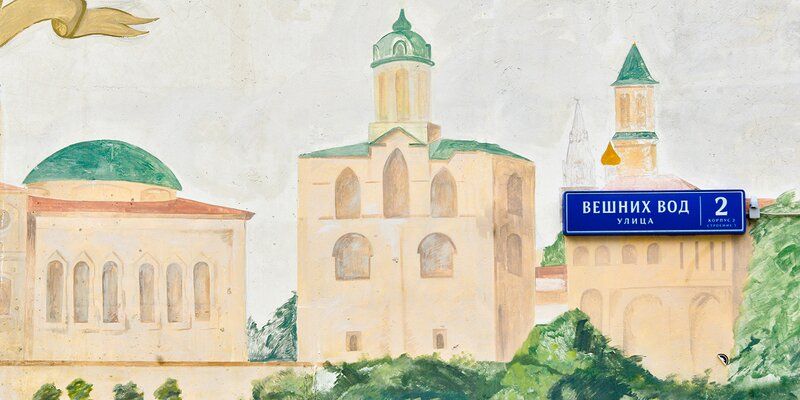
"A street with the beautiful name of Veshnikh Vod ("Spring torrents" ) was once named after the writer Ivan Turgenev and was located in the town of Babushkin. Moscow had Turgenev Square. Not to repeat, they decided to rename the street anyway, and gave it a name in honor of the classic's story," said Georgy Makeev.


Garden-City
After the elimination of the toponymic doubles, the map of Moscow not only "warmed up" but "blossomed." In the northwest of the city, thanks to the flower greenhouses there, Tsvetochny ("Flower") Proyezd appeared, and in the west, Tyulpannaya ("Tulip") Street.
Such names are typical of the suburbs. Here, even though there is no beautiful legend or ancient history, they lift your spirits. "Many Muscovites would like to live on Zelenaya ("Green"), Lazorevaya ("Azure"), and other streets with positive names. Tsvetochnaya, Tyulpannaya, Vesennyaya sound very nice," the expert stressed.

The tradition of choosing such names has survived into the 21st century. In 2002, residents of the Kurkino district chose the name Landyshevaya (“Lily-of-the-Valley”) for the new street of the neighborhood under construction, and the contest winner even received an apartment there. The name chosen is symbolic: lilies-of-the-valley are depicted on the coat of arms of Kurkino, as these flowers are a reminder of the pristine nature preserved in the area.
"There are still many unnamed passages in Moscow, which are designated simply by numbers. I would like them to get similar sweet-sounding names," added Georgy Makeev.