From there, fashions come to us, and authors, and muses. Kuznetsky Bridge as a magnet for dandies
.jpg)
The history of the street began in the 15th century with foundation of the Cannon Yard, where the Kuznetskaya Sloboda settlement spread out around it. Later, monastic possessions, gardens, vegetable gardens and much more appeared here. It got its name thanks to the bridge — first wooden, and then stone, that was built over the Neglinnaya River. And in the 18th century, the street was chosen by merchants. Details are in the mos.ru article.
Rights granted to foreigners
December 1762. Empress Catherine II, who ascended the throne just a few months before, signed a manifesto to grant foreigners the right to have free settlement in Russia, and those Russians who fled abroad could return home. The Empress hoped to increase population, as well as take care of those who had to leave their homeland against their wishes in the past. The manifesto spread not only in Russian, but also in French, English, Polish, Czech, German and Arabic.
On July 22, 1763, two more legal acts were issued: decree "Regarding Establishment of the Office of Guardianship of Foreign Colonists" and manifesto "Regarding Allowing All Foreigners Enter Russia to Settle in Provinces They Wish and the Rights Granted to Them." The manifesto applied not only to wealthy foreigners. If a person wishing to settle in Russia did not have money, the country bore the entirety of the expense for his relocation. All he had to do was to apply to Russian diplomats. Catherine II also took care of foreigners to earn a living in a new place: she granted them the right to enroll in the merchant class and trade freely.
Kuznetsky Most was by the time considered one of the main trading streets of Moscow — it was there that a huge number of various shops were concentrated. It was difficult to walk through Kuznetsky without ever taking out a wallet: products, clothes, furniture, musical instruments, books and much more were on sale here. French speech was more often heard here: most of the shops, mainly selling fashionable clothes, belonged to the French who had moved to Moscow.
This continued until the War of 1812: before Napoleon's army entered Moscow, many French merchants were expelled from the city, and those who remained were ordered to remove signs in their native language. However, during the fire their shops were not damaged since they were protected by the Napoleonic army. Soldiers considered Kuznetsky Bridge to be something like their colony. After the war, brisk trading resumed. The Russian Bulletin magazine wrote: “the former dominion of French fashions has settled down.”
And Famusov, a hero of Alexander Griboyedov's comedy Woe from Wit, was more acerbic in the 1820s — he saw a threat to morality in his daughter Sophia's fascination with French novels and fashion:
Reads tall tales all night long,
And here are the fruits of these books!
And all because of Kuznetsky Bridge, and the eternal French ,
From there, fashions come to us, and authors, and muses:
The destroyers of pockets and hearts!

In the second half of the 19th century, trading arcades began to appear in Kuznetsky, as well as in other central streets of Moscow, uniting various shops, photo and fashion ateliers, and pastry shops under one roof. In 1862, the Solodovnikovsky Trading Arcade was built that occupied the entire block — from Petrovka to Neglinnaya Streets. The trading arcade, which was a place of shopping, walking, interesting acquaintances and dates before the revolution, was partially rebuilt as residential apartments and partially occupied by stores of Mostorg trading authority in the Soviet times. The arcade can be seen today only on old photos — the building was destroyed in 1941.

But the Arcade of Popov built in 1877, can be admired even now. Its address is 12, Kuznetsky Most Street. People came here to buy jewelry, furs, books. In 1882, the first 800-number telephone exchange in Moscow appeared in the building of trading arcade, and a little later the first commercial lighting in the city appeared on its roof. During Soviet times, the building hosted various offices, and from 1958 to 2014 — the State Public Scientific and Technical Library.

Not far from the Arcade of Popov there was the San Galli Trading Arcade, its address now is 11, Kuznetsky Most Street. The trading arcade’ owner was Franz Karlovich San Galli, a Russian factory-owner and entrepreneur of Prussian-German origin. His St. Petersburg and Moscow-based iron foundries and mechanical plants produced fireplaces, safes, and various factory machines. In the San Galli’s Trading Arcade, one could buy products from the owner's factories, as well as porcelain, musical instruments and works of art. In 1917-1918, the trading arcade building hosted the famous Pittoresque cafe, where Alexander Blok and Vladimir Mayakovsky performed, later it was taken over by the Department of the People's Commissariat of Education to become the Red Rooster. During the New Economic Policy years trading was resumed here for a short while, and since the 1930s the building is used to house art exhibitions. Nowadays, the Moscow House of Artists is located here.

At ladies disposal — skilled milliners
Kuznetsky Bridge was a favorite place of Muscovites who followed new trends in the world of fashion. The street was full of signs that read “ready-to wear women's collections”, “made-to-order clothing for women”. One of the most popular workshops belonged to a Frenchwoman Victoria Lebour. The shop where she sold hats, costume jewelry, lace and much more was opened in 1804. She managed to keep her brainchild after the war. Here's how one customer wrote about it in 1813:
“It was locked from the outside and looked like an enchanted castle. Old Arkady, our faithful servant, having walked around the yard, reported to me that it was possible to enter from the yard. I followed him; we got into a dark corridor, where we ran into a person who asked us what we needed. I explained what the matter was, and he told me that all the things were packed, the store was moving to another place, in a few days it would be open, then I could go shopping”. (Extract from the book Fashion Shops and Milliners of Moscow in the Early 19th Century by Tatiana Rudenko.)
Madame Lebour had a brilliant career: by the 1840s she was a merchant of the first guild. The store of her competitor Adelaide Menne, which was opened in 1826 and operated for more than 20 years, was also widely known. Her dresses were hard to get. Another of their compatriots, Jeanette-Polina Geble, arrived in Moscow in 1823. She worked in the Dumancy trading company, located in the former building of the Yar hotel and restaurant. A regular customer of the fashion salon was Countess Anna Annenkova, who was often accompanied by her son, officer Ivan Annenkov. When he saw the young Frenchwoman, he immediately fell in love, fascinated by her beauty, modesty and manners. She reciprocated.
The story of their love — both happy and sad — formed the basis of the Fencing Master novel by Alexander Dumas. It was also included in the plot of Vladimir Motyl's film The Captivating Star of Happiness (1975), where Polish actress Eva Shikulska played the role. By December 14, 1825, when the Decembrist uprising took place, Jeanette-Polina and Ivan were not married yet. Therefore, when Annenkov was sentenced to exile in Siberia, his beloved could not follow him. She had to ask permission from the Emperor himself. In a letter to Nicholas I, she renounced her nationality. She was able to marry Annenkov in exile, in 1828. Jeanette-Polina Geble, who became Praskovya Egorovna Annenkova in marriage, spent 30 years with her husband in Siberia. Then the couple left for Nizhny Novgorod.
yrPolinaGebljenadekabristaIAAnnenkova.jpg)


In the early 20th century, there was a gloomy legend associated with the Kuznetsky Bridge in Moscow. It was spread by word of mouth by lovers of all sorts of devilry. Allegedly, famous entrepreneur and philanthropist Savva Morozov had a mistress named Josephine, or Juju, either a milliner, or a model who worked at Kuznetsky. Once, going outside, she heard the newsboys shouting hot news about Savva Morozov’s death (the manufacturer really tragically died in 1905). Having rushed for a newspaper, the woman ran out into the roadway and died under the wheels of a speeding carriage. And at night, the newsboy was allegedly found strangled in the same place. Popular rumor has decided that it is Zhuzhu who was taking revenge on those who brought her the terrible news. Suspicious townspeople claimed that they themselves saw the ghost of a woman wandering along the Kuznetsky Bridge at night, but the legend did not receive any more serious confirmation.
(1).jpg)
Non-existing bridge
The street’s history goes back to 15th century, when Tsar Ivan III founded a Cannon yard in a sparsely populated place called Neglinny Verh across the Neglinnaya River. The Kuznetskaya Sloboda settlement appeared around it to give the name to the bridge itself, which was subsequently built across the river, and then to the street that adjoined the bridge.
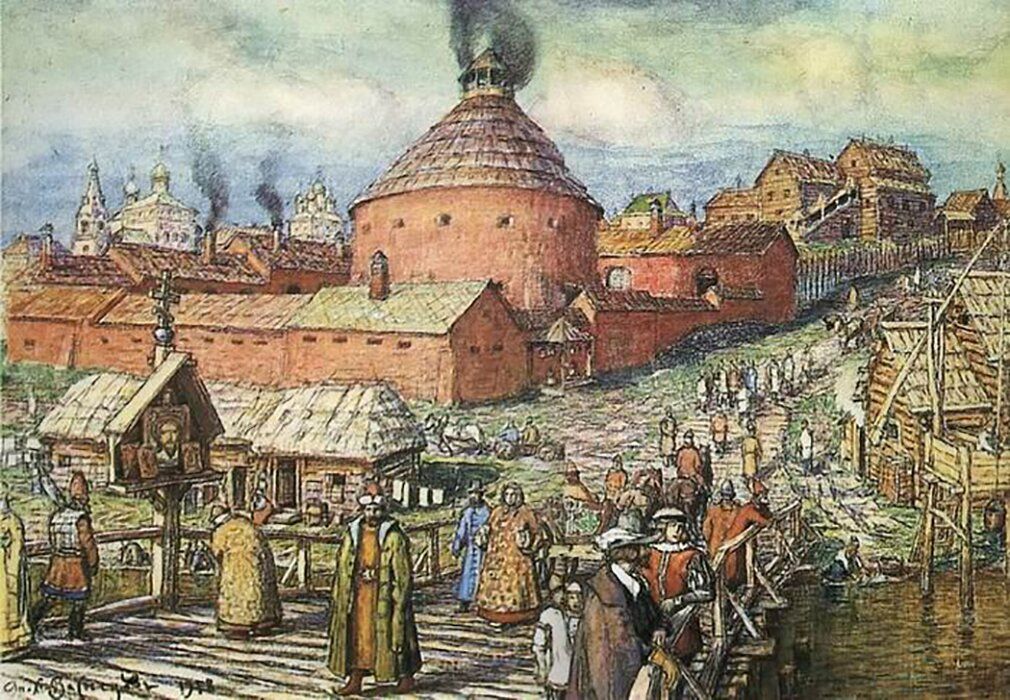
In1478, Novgorod joined the Moscow Principality, and Pskov — in 1510. Pskov and Novgorod nobility, as well as craftsmen, began to settle in the Kuznetskaya Sloboda. By 1620, this place was considered densely populated. Orchards and gardens were laid out here, large courtyards were built. A wooden bridge was constructed across the river, it suffered from flooding more than once and had to be restored over again.
In 1754, architect Dmitry Ukhtomsky proposed a project for a new construction — a three-span stone bridge. A 12 meters wide and 120 meters long bridge was built. In 1817-1819, Neglinka was enclosed in an underground pipe. The bridge was covered with soil, the parapets were removed, new buildings appeared in their place. Since then the Kuznetsky Bridge was called the street. Muscovites joked — “it's funny that they will say: I went to the Kuznetsky Bridge, but it is not in place, just like there is no green dog.”