Sergei Sobyanin: Moscow Longevity makes the lives of many senior Muscovites better
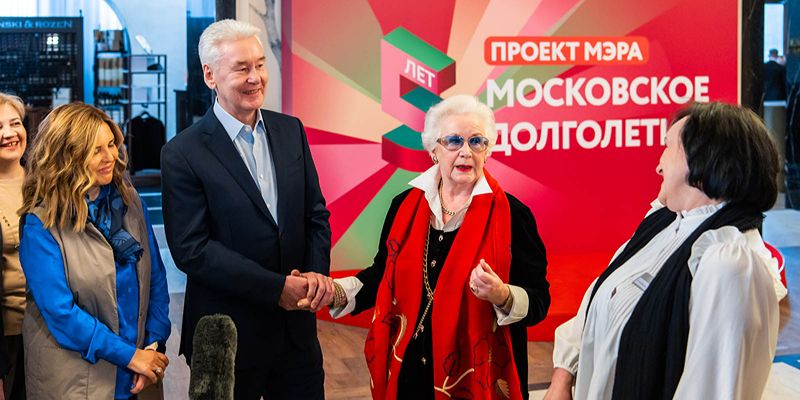
The Moscow Longevity project has turned five years. The anniversary ceremony was held in the Khudozhestvenny movie theater where the leaders of Moscow Longevity clubs, metropolitan/federal experts, and stars of Mission Longevity, a musical premiere dedicated to the anniversary, were able to meet with Sergei Sobyanin.
“The project is really pivotal for Moscow and Muscovites, but, in truth, five years ago when it did not exist, there were however many thousands of Muscovites who were active and eager to communicate and implement interesting projects,” said the Moscow Mayor.
Lots of people dream of ceasing to work and retiring, but feel alone in four walls when this really happens; yet, they still have a lot of energy and wish to live an active life. For such people, we decided to create the Moscow Longevity project. This is a project that helps not just live long, but live an active life for a long time, communicate for a long time, smile to each other for a long time, live wholeheartedly for a long time and enjoy an exciting life for a long time,” said Sergei Sobyanin.
The project embraces social security centers, cultural, sports and educational institutions, and even commercial companies. However, the most difficult thing was to make the participants and managers put their heart and soul into what they were doing, and the Moscow Longevity team have made it, emphasized Sergei Sobyanin.
“We calculated how many millions of kilometers you have walked during your classes and how many millions of songs you have sung in your clubs. But the most important thing is millions, and maybe, billions of smiles that you give each other every day. You are the best. Thank you very much and live long in Moscow, my friends!” he said addressing to the project participants.
Project achievements and records
Moscow Longevity is the largest wellness, educational and recreational project for elderly Muscovites created on March 1, 2018 on the initiative of the Moscow Mayor and aimed at women aged 55 years and older, men who are 60 years of age or older and those Muscovites who have taken early retirement.
For five years, the project has played a pivotal role in the capital by uniting more than half a million residents.
“Over these years, it has changed the lives of many senior Muscovites for the better as it has turned their dreams of youth into reality, helped them find friends and even the meaning of life, by dispelling the stereotypes about age. Today, the project unites more than 500,000 Muscovites; it began with 12 areas of activity, and now there are already 39 of them with 13,000 related groups in each neighborhood,” wrote Sergei Sobyanin on his telegram channel.
Source: Sergei Sobyanin's telegram channel @mos_sobyanin
The project covers a range of activities, such as gymnastics, general fitness training, Nordic walking, dancing, signing, drawing, computer sciences, lectures on history, arts, law and finance, foreign languages and cooking classes, etc. It also offers football and other sports games for men, horticulture and landscape architecture classes for garden owners, and Learning While Walking lectures or tours around the capital for those who like to combine walking and gaining new knowledge.
Moscow Longevity classes are regularly attended by more than 223,000 people, including about 20,000 who joined the clubs or groups in the early days of the project, Muscovite females aged 60 to 70 years being dominant participants.
One of the most significant achievements is the opening of Moscow Longevity centers and community halls for communication and creativity for golden agers to organize clubs, hold lessons or masterclasses and share experience.
The first center was inaugurated in Maryina Roshcha back in 2019, while now Moscow has 71 community halls with more than 3,000 clubs, which were visited one million times in 2022. Similar centers are to open in each of the capital’s districts.
Today, Moscow Longevity is a very large community of active Muscovites who are willing to change their lives for the better. They bust the stereotypes about age, help others, share their experience, engage in self-development and initiate city-oriented projects.


Moscow Longevity participants told Sergei Sobyanin that they were inspired by the project and feeling happy to lead others along. “I am happy that I was invited to this project as a headliner in its early days. We have held lots of meetings in parks and gardens in spring and summer,” says Anna Shatilova, a TV and radio announcer. “My key impression of the project is that it gives great positive emotions.”
Olga Tkacheva, the lead freelance geriatrician with the Russian Ministry of Health, emphasized that the project is really popular, with 223,000 people currently engaged in it at one time. Other regions would like to create longevity centers, too, she says.
The research run by the Russian Association of Gerontologists and Geriatricians proves that Moscow Longevity participants are healthier, more active, both physically and mentally, less prone to depression and risk of lacking self-care, as compared to their peers outside the project.
During the history of Moscow Longevity, the project participants set 20 national records, including the biggest Zamba Gold flash mob for elderly people (3,778 participants), the largest Nordic walking race among seniors (3,793 participants), and the most crowded twist campaign (787 participants). In addition, local golden agers have walked more than 108 million kilometers with Nordic sticks, sung billions of songs, danced all famous dances, staged hundreds of performances, created ten fashion collections and a music band.
The project was becoming more and more popular even amid the outbreak of the pandemic; although most of the clubs had classes online for almost two years, they were taken by about 70,000 people.
Moreover, the pandemic has stimulated development of various online formats, such as broadcasts with experts, musicians and athletes, or flash mobs. In addition, now one can apply for the project remotely.
In 2018, the city had only 135 project registration centers, whereas now there are more than 1,000 of them. Profiles for participation in the project can be filled out at all social services centers and My Documents offices. Applications are also accepted via the website.
Alternatively, seniors can enroll directly in classes that take place at public institutions, e.g., clinics, schools, libraries, recreational, cultural or sports centers, or in amusement parks.
Plans for spring/summer 2023
Today, meetings and classes are held face-to-face, outdoors or online. Remote sessions are especially popular with dacha owners in spring, summer and autumn; Moscow Longevity helps them diversify their leisure time in the countryside and keep fit, while up-to-date technologies make it possible for them to combine garden routines, creative classes and care for grandchildren who come to see them in the summer.
At the request of the project participants, the upcoming spring and summer season will be dedicated to Moscow, so the city-related theme will be a priority for Learning While Walking lectures, drawing, singing, literature workshop, dances, etc.
My Family. My Moscow. My Longevity is the theme of the creative festival called Paths That We Choose that started on February 13.
It is also planned to publish the book My Moscow. My Longevity, to incorporate pieces of literature written by project participants in literature workshops, and create a television show dedicated to Moscow and starring senior Muscovites.
Moscow Longevity ecosystem
The Moscow Longevity project has given rise to an ecosystem of organizations targeted at the older audience (aged 60+), thus, making the entire city infrastructure available to elderly people.
Over five years, the number of Moscow Longevity partners has increased up to 1,300, these includes 811 public institutions, such as universities, schools, parks, cultural centers, libraries and clinics, plus 513 commercial companies.
Classes are taught by about 8,000 professional teachers, including PHD holders, professional athletes, doctors, economists, dancers, musicians, artists, tour guides, lawyers and linguists, at 2,600 venues in residential neighborhoods.
Moscow Longevity special projects
The Moscow Longevity ecosystem includes five special projects.
The Silver University offers retraining courses in the fields that are in demand in the labor market; for example, Muscovites can master graphic design, tour guiding or online marketing, although there are also classes in basic computer technology, finance, history of arts, etc.
The special project involves the Moscow City Pedagogical University, Moscow City University of Management, and Synergy University, with over 23,000 people having graduated from the Silver University.
As part of the special project called Longevity Trainings, Muscovites take part in rehab programs at city clinics; referrals can be obtained from a physician, a general practitioner or a doctor in exercise therapy and sports medicine. Today, there are 112 groups attended by 1,650 people.
Active Moscow Longevity participants are eligible to avail themselves of the incentive program known as Good Bus, offering bus sightseeing tours around Moscow and Moscow region, with 11 buses running along 39 routes every day. The most visited locations include the Northern River Station, the Chekhov Moscow Art Theatre Museum, Svoboda cosmetics factory, Cosmonautics and Aviation Center (Pavilion No. 34) at VDNKh, Ermolova Museum, Moscow Cable Cars, Moscow Urban Economy Museum, Stanislavsky Museum, and water bus trips along the Moscow River, with the Good Bus tours taken by approx. 130,000 people.
At the Moscow Theatergoer classes, senior Muscovites plunge into the atmosphere of a theater school to learn acting, speech, stage movement, and theory of rhythm.
Today, there are 68 theater groups for 1,900 people, while, in total, almost 11,000 people have taken part in the special project since its early days.
Moscow Longevity participants can also demonstrate their talents at the Silver Aster theater festival. In 2021, film directors Anna Petrik and Vadim Vetrov shot a feature film Silver Aster that won the 11th We Will Live International Film Festival.
In 2022, the festival featured an indie theater performance, including five stories about finding oneself, about love, expectation, war, and victory, which was premiered at the open theater known as the Art Platform.
The special project called Route to Longevity helps Moscow golden agers visit their clubs easily; three free buses run between Moscow longevity centers, with more than 15,000 people having taken the advantage. In order to go to a club they like, activists need to apply for a bus trip with the nearest center.
Mission Longevity
On the project anniversary on March 1, 2023, the Moskino movie theater chain held a free premiere of the musical film called Mission Longevity.
Its main characters are ordinary elderly people in Moscow who managed to change their lives and now wish to promote their philosophy in the universe. It is a musical sci-fi time-traveling movie covering the future, the past and the present. It starts with a scene onboard a spacecraft in 2073 with Moscow Longevity participants flying to establish friendship with long-livers in another galaxy and recalling how it all began. Each next episode unveils different periods in the history of the project and its participants.
All songs are sung by member soloists together with famous film and pop artists, including Oleg Gazmanov, Ekaterina Guseva, Viktor Dobronravov, Alexander Serov, Alexei Goman, Samotsvety group, and others. For example, the combined Moscow Longevity choir sang The Sun of Monaco together with the hit’s author Lyusya Chebotina.
The dance performances were also created and performed by project participants; for many of them it was a debut.