Sergei Sobyanin announced BCL completion
.jpg)
The last section on the Metro Big Circle Line (BCL) has been commissioned with a test run without passengers between Kashirskaya and Nizhegorodskaya stations to assess the automatics, TMTC and train control systems, traction network, intercom and centralized radio control devices and check the life support system. The commissioning is done by the Moscow Metro staff, such as driving instructors who control BCL test runs.
After piloting, possible malfunctions will be addressed, and engineering systems and devices will be adjusted at stations and tunnels.
“I congratulate you on the completion of the last, 10-kilometer-long section of the Big Circle Line, the world’s biggest circle line project and the greatest project in the Moscow Metro history. Now we proceed to commissioning and start-up, and after a couple of months we’ll have a full circle, with trains running around it. It’s the most important project; although complex and difficult, it is really crucial,” said the Moscow Mayor.
He thanked the metro builders and congratulated them on the upcoming holidays. “Muscovites have received a good gift for the New Year,” said Sergei Sobyanin.
The new stations’ staff spoke about the conditions they would work in. “We would also like to congratulate you on the upcoming New Year and thank you because, we, metro workers, are provided with exclusive opportunities, unique rooms and workplaces equipped with the latest technology,” said Inna Yakovenko, Tekstilshchiki Station Manager.
Construction of the BCL eastern segment from Kashirskaya to Nizhegorodskay station began in 2018. The 10.7-kilometer long section includes four stations, such as Klenovy Boulevard, Nagatinsky Zaton, Pechatniki, and Tekstilshchiki, with Klenovy Boulevard-Tekstilshchiki trains running in a large double-track tunnel, 10 meters in diameter.
The newly-built stations will improve transport services for those who live or work in eight regions (Tekstilshchiki, Pechatniki, Lyublino, Nagatinsky Zaton, Moskvorechye-Saburovo, Nagatino-Sadovniki, Nizhegorodskiy, and Lefortovo) with the population of approx. 800,000 people, including 285,000 who live within an easy stroll from the new stations. The locals would save up to 80 per cent (or up to 45 minutes) on their daily trips around the city, and the Nagatinsky Zaton district will have its first metro station ever.
Tekstilshchiki and Pechatniki stations are transfer points for passengers to take a D2 train or transfer to Tekstilshchiki and Pechatniki stations on the Tagansko-Krasnopresnenskaya and Lyublinsko-Dmitrovskaya lines, while Klenovy Boulevard station will be a transfer point for the Biryulyovskaya metro line in the future.
After the launch, the new BCL stations are expected to serve 57,000+ people every day, or more than 166,000 people if transfer passengers are included, to significantly relieve traffic flows at the existing metro stations:
— Pechatniki of the Lyublinsko-Dmitrovskaya line — up to 27 per cent;
— Tekstilshchiki of the Tagansko-Krasnopresnenskaya line — up to 21 per cent;
— Aviamotornaya of the Kalininskaya line — up to 15 per cent;
— Kolomenskaya of the Zamoskvoretskaya line — up to 10 per cent.
The new stations will provide chord links between neighboring districts, thus increasing attractiveness of urban transport. For example, a trip from Nagatinsky Zaton to the Moskvich plant in Tekstilshchiki will be almost 8.5 times shorter (6 vs. 50 min). Passengers will be able to get University station from Klenovy Boulevard 2.5 times faster as it would take 25 instead of 60 minutes. Sokolniki station would be reached from Tekstilshchiki in double-quick time (15 vs. 30 min) and a Tekstilshchiki-Bitsevsky Forest trip would be 1.5 times faster than it is today (36 vs. 52 min).
This will decrease road traffic, with traffic flows decreased by 12 per cent on Lublinskaya Street, up to 9 per cent on Ryazansky Prospekt and up to 4 per cent on Volgogradsky Prospekt.
There will be new ground transport stops, pedestrian crossings, car/taxi parking, and kiss & ride areas (roadside locations for dropping off passengers) around the stations. Passengers will be able to enjoy convenient sidewalks, hardscape, lawns, flowerbeds, trees, and undergrowth.
Klenovy Boulevard station
Klenovy Boulevard station is located in Nagatinsky Zaton along Kolomenskaya Street at the adjacent Klenovy Boulevard. In the future, a transfer to the Biryulyovskaya metro line will be available here.
It is also in the immediate vicinity of the Kolomenskoye Museum-Reserve with the Church of the Ascension, Moscow’s pearl and one of the three Moscow monuments in the UNESCO World Heritage List. Minimizing the metro’s influence on the museum-reserve was a priority for those who designed the station. As a result, they have chosen a line layout so that Klenovy Boulevard station is located outside the park and the tunnels run under its fringes, without affecting the central part with the most valuable attractions. Still, passengers will be able to easily get to the park, which lies just 300 meters from the metro exits.
The station owes its architectural aspect to ARCHSLON, an architect firm who won the international competition. The calm and laconic design conveys brand image of the Kolomenskoye Museum-Reserve as the area’s key attraction. Visually doubling in the mirrored walls, a relief effect of the vaulted ceilings creates a recognizable silhouette, which is characteristic of Russian traditional architecture, with a black and white interior design of the underground lobby. The walls are decorated with marble and gabbro, with metal-paneled columns and arches and perforated ceiling panels.
The station serves the Nagatinsky Zaton district with the population of more than 120,000 people, including 35,000 of those who live within an easy stroll.
Passenger flows at Klenovy Boulevard hub (including the metro station and ground transport stops) are expected to exceed 32,000 passengers by 2025, including about 23,500 passengers using the BCL station.


Nagatinsky Zaton station
Nagatinsky Zaton station is located in Moscow’s Nagatinsky Zaton district along Kolomenskaya Street (next to buildings 3 and 5). As it stands on the Nagatinskaya floodplain promontory, passengers will be enjoying a beautiful view over the Moskva River when exiting the station.
Nagatinsky Zaton is a shallow station with two side platforms interconnected with transition bridges for passengers to reach the escalators leading down to the underground lobby.
Its only lobby exit leads to Kolomenskaya Street, ground transport stops, and residential neighborhoods.
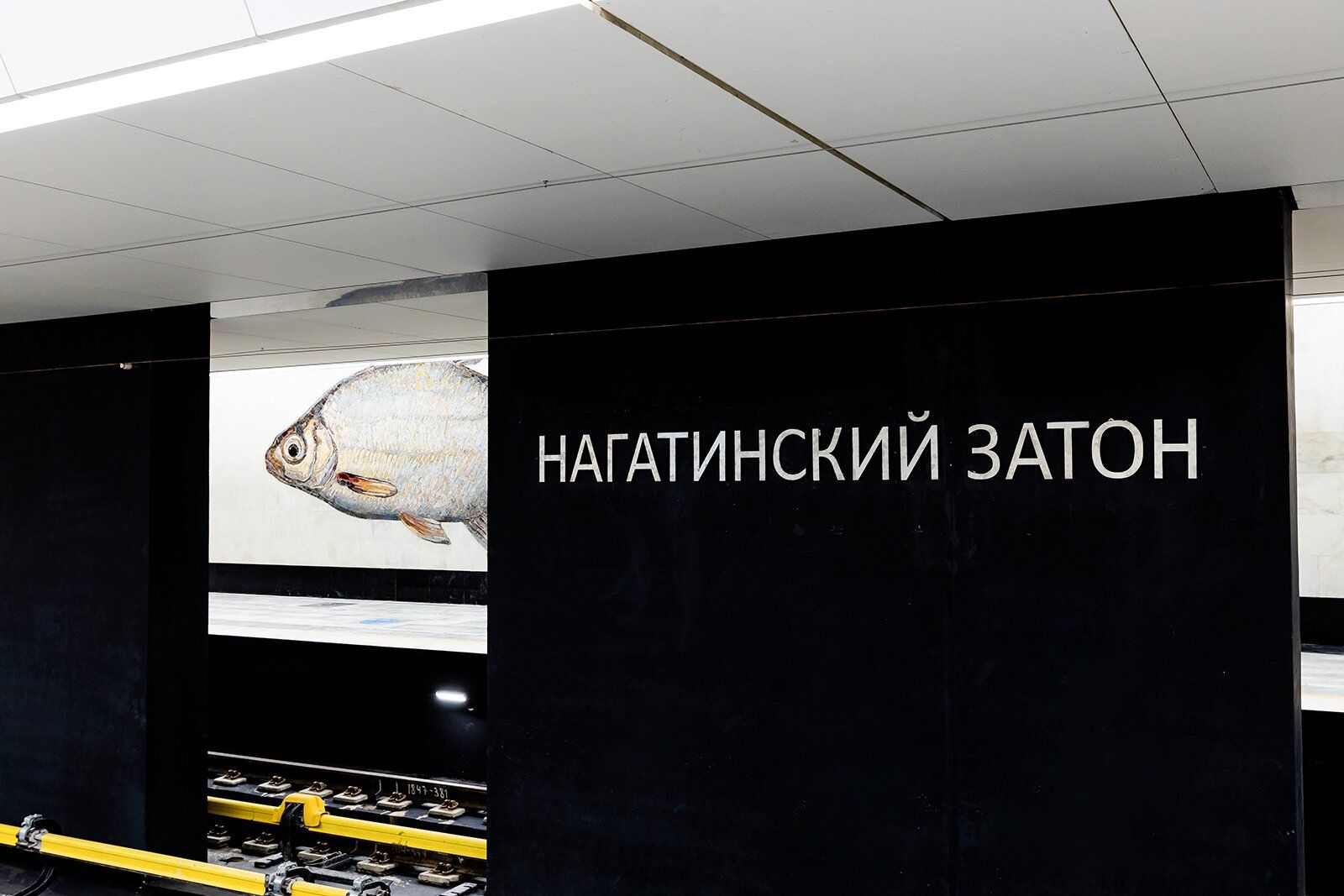
The station’s design was chosen at an open international competition, which was won by a Moscow-based architect firm called Za Bor Architects. The main idea of the interior design is an attempt to use the piece of transport infrastructure as a museum dedicated to wildlife of local rivers and the Nagatinsky Zaton, in particular. Large, realistic mosaic stonefish will create an unusual and memorable image without any auxiliary interior decorations thanks to the artistic expression of mosaics. The ceilings of the platform and ticket halls and the arches of the escalator tunnels are decorated with white aluminum composite panels. The walls are decorated with white marble and gabbro walls, and the floor is tiled with granite.
The launch of Nagatinsky Zaton BCL station will improve transport services for more than 120,000 residents, including 15,000 of those who live within a walking distance.
Passenger flows at Nagatinsky Zaton hub (including the metro station and ground stops) will be approx. 18,000 passengers by 2025, including about 16,700 passengers using the BCL station.



.jpg)
Pechatniki station
Pechatniki station is located in Pechatniki district in the southeast of Moscow, at the intersection of Guryanova and Shosseynaya streets. It can be used to transfer to the same-name stations on the Lyublinsko-Dmitrovskaya metro line and D2 along a 'clean feet' pedestrian walkway.
It is a shallow black-and-white interior design station with two lobbies for passengers to exit to Shosseynaya and Guryanova streets, residential or public buildings, and ground transport stops.
The escalators and stairs of the flying passage have Cyrillic letter П shape columns with similarly shaped benches at the ends.
The station will be used by residents in Pechatniki, Lyublino, and Tekstilshchiki districts accommodating 360,000+ people, including 49,000 living within a walking distance.
According to experts, passenger traffic at the Pechatniki hub, including two metro stations, D2 station and ground stops, will reach approx. 52,000 people by 2025, with the BCL station alone to service about 12,200 passengers.


Tekstilshchiki station
Tekstilshchiki station is located between Shosseynaya Street and D2 track and can be used to transfer to the same-name stations of the Tagansko-Krasnopresnenskaya line and D2.
This is a shallow station with two side platforms and two lobbies, with exits to Shosseynaya Street, D2 station, and ground stops.
In December 2023, an overpass is to be opened enabling transfers between Tagansko-Krasnopresnenskaya line and BCL stations. In 2024, they will open a new lobby for passengers to reach the D2 platforms, which will be connected to the existing cross-walk.
The station’s dominant decor element is a two-level ceiling visually resembling a knitting or weaving machine and alluding to the station name (in Russian Tekstilshchiki literally means ‘textile men’). The platform itself and the lobby are clad with natural materials with the light gray granite flooring and light marble and metal paneled walls, while the entrance pavilions are white, gray and blue.
The station serves Tekstilshchiki and Pechatniki districts with a population of over 190,000, including 49,000 who live within an easy stroll, and will be part of Moscow’s biggest transport hubs. It is estimated that by 2025 passenger flows at the hub (including two metro station, D2 station and ground stops) would reach almost 145,000 passengers, including about 20,800 passengers using the BCL station.

.jpg)
.jpg)
.jpg)
.jpg)
Big Circle Line
The Moscow Metro Big Circle Line is the biggest underground construction project in the world. It will be over 70 kilometers long, with 31 stations and three train depots, including the already operational Kakhovskaya – Kashirskaya section. For comparison: the already existing Moscow Metro Circle Line is 19.4 kilometers long and includes 12 stations (in other words, it’s 3.5 times shorter than the BCL).
The BCL will become the longest circle metro line in the world surpassing the current ‘record holder’, the second circle line of the Beijing metro (57 kilometers long). It will connect existing and projected radial Metro lines up to 10 kilometers away from the old Circle Line, taking the strain off the first transfer perimeter of the Moscow Metro (stations inside the Circle) and the second one (the Circle itself).
Launch of the BCL will improve the transport situation in 34 districts of Moscow with 3.3 million people of the total population, including 1.18 million who live within a walking distance of a Metro station.
At the same time, all passengers of the Moscow Metro will feel the effect of the BCL launch through reduced traffic at other Metro lines and multiple alternative routes that are going to be set up. On many of such routes, time saved on daily trips will total to as much as 35 to 45 minutes. The load on the Circle Line will be reduced up to 25 per cent, on radial lines – up to 22 per cent.
Passenger traffic on the Third Ring Road and outbound routes is also expected to be relieved by up to 15 per cent on average, since it will be more convenient for Muscovites to use public transport instead of personal cars.
About 100 modern Russia-made Moscow-2020 trains will run around the BCL to maintain regular time intervals. The new trains meet the highest standards to ensure comfortable traveling: they have wide doors, inter-car walkways (1.6 m), USB charging ports at each seat, large information displays, illumination corresponding to the line color, and air disinfection systems.
They will be maintained, repaired and garaged at Nizhegorodskoye and Aminyevskoye motive power depots that are under construction now and that will become Moscow’s major depots and create around 1,900 new jobs.
The Big Circle Line has in-built solutions that will allow for its connections to the new Metro radii, including Rublyovo-Arkhangelskaya line (Narodnoye Opolcheniye station), Troitskaya line (Novatorskaya station) and the projected Biryulyovo line (Klenovy Boulevard station).
Right after the BCL launch, passengers will be able to use it as a transfer point to 20 other stations of 11 Metro lines, three stations of the Moscow Central Circle (MCC), eight stations of MCDs, like Belorussko-Savyolovsky (Odintsovo-Lobnya) and Kursko-Rizhsky (Nakhabino-Podolsk), as well as to 13 suburban train routes. The largest transport hubs on the Big Circle Line will be Delovoy Tsentr, Savyolovskaya, Nizhegorodskaya, and some others.
The first ideas of BCL date back to 1985; however, lack or resources and some other issues have prevented the start of construction for 25 years. The decision to launch BCL construction was made by Sergei Sobyanin.
The construction was divided into sections, including:
— the Northwestern section: from Delovoy Tsentr to Savyolovskaya station. Stages: Delovoy Tsentr – Petrovsky Park (opened for traffic on February 26, 2018); Petrovsky Park – Savyolovskaya (opened for traffic on December 30, 2018);
— the Northeastern section: from Savyolovskaya to Nizhegorodskaya station. Stages: Nizhegorodskaya – Lefortovo (opened for traffic on March 27, 2020); Lefortovo – Elektrozavodskaya) (opened for traffic on December 31, 2020); Elektrozavodskaya – Savyolovskaya (opened for traffic on November 30, 2022);
— the Western section: from Khoroshevskaya to Kuntsevskaya station. Stages: Khoroshevskaya – Mnevniki (opened for traffic on April 1, 2021); Mnevniki – Kuntsevskaya (opened for traffic on December 7, 2021);
— the Southwestern section: from Kuntsevskaya to Prospekt Vernadskogo station (opened for traffic in its entirety on December 7, 2021);
— the Southern section: from Prospekt Vernadskogo to Kashirskaya station. Stages: Prospekt Vernadskogo – Kakhovskaya, including Kakhovskaya station reconstruction (opened for traffic on December 7, 2021); Kakhovskaya – Kashirskaya, including reconstruction of Kashirskaya and Varshavskaya stations (pilot launch on December 14, 2022);
— the Eastern section: from Kashirskaya to Nizhegorodskaya station (pilot launch on December 30, 2022).
22 stations had been launched by the end of 2021 to connect 47 kilometers of train tracks (90+ km of a single-track line), with over 500,000 passengers using the new stations every day.
BCL construction was completed in December 2022, while traffic around the full circle is expected to open in 2023.
The BCL construction created 6,000 new jobs in the Metro structures. The demand is high for professions such as station operator, track assembler, train driver, electrical equipment service electrician, power equipment maintenance technician, workplace safety inspector, etc. The future employees are trained at the transport complex corporate university.
On top of that, 391,000 new jobs will be created around the new BCL stations. Investments in new office and shopping centers, sports and public service facilities construction, as well as residential development will total to about RUB 5.2 trillion, bringing the city additional revenues of about RUB 3.4 trillion until 2035.
223 kilometers of lines, 109 stations, four extra lobbies, 11 Metro and MCC train depots have been built or renovated in the Russian capital since 2011, while the Moscow Metro network has increased 1.5 times, with D1 and D2 lines, including 132-km tracks and 61 stations, being launched in cooperation with Russian Railways.