Sergei Sobyanin opens Pinnipeds pavilion at Moscow Zoo after comprehensive reconstruction
(4).JPG)
The Pinnipeds pavilion opened at the Moscow Zoo after a comprehensive reconstruction. “The Moscow Zoo, one of the most popular locations both for Muscovites and tourists, keeps developing. We’re renovating it step by step, setting up new nice sites, playgrounds for kids, children’s zoo and new facilities, including the ones for unique animals," Mr. Sobyanin said at the pavilion's opening ceremony.
Construction of several facilities was a new stage of the Zoo development. They included an additional entrance, an overpass and a pavilion for pinnipeds.
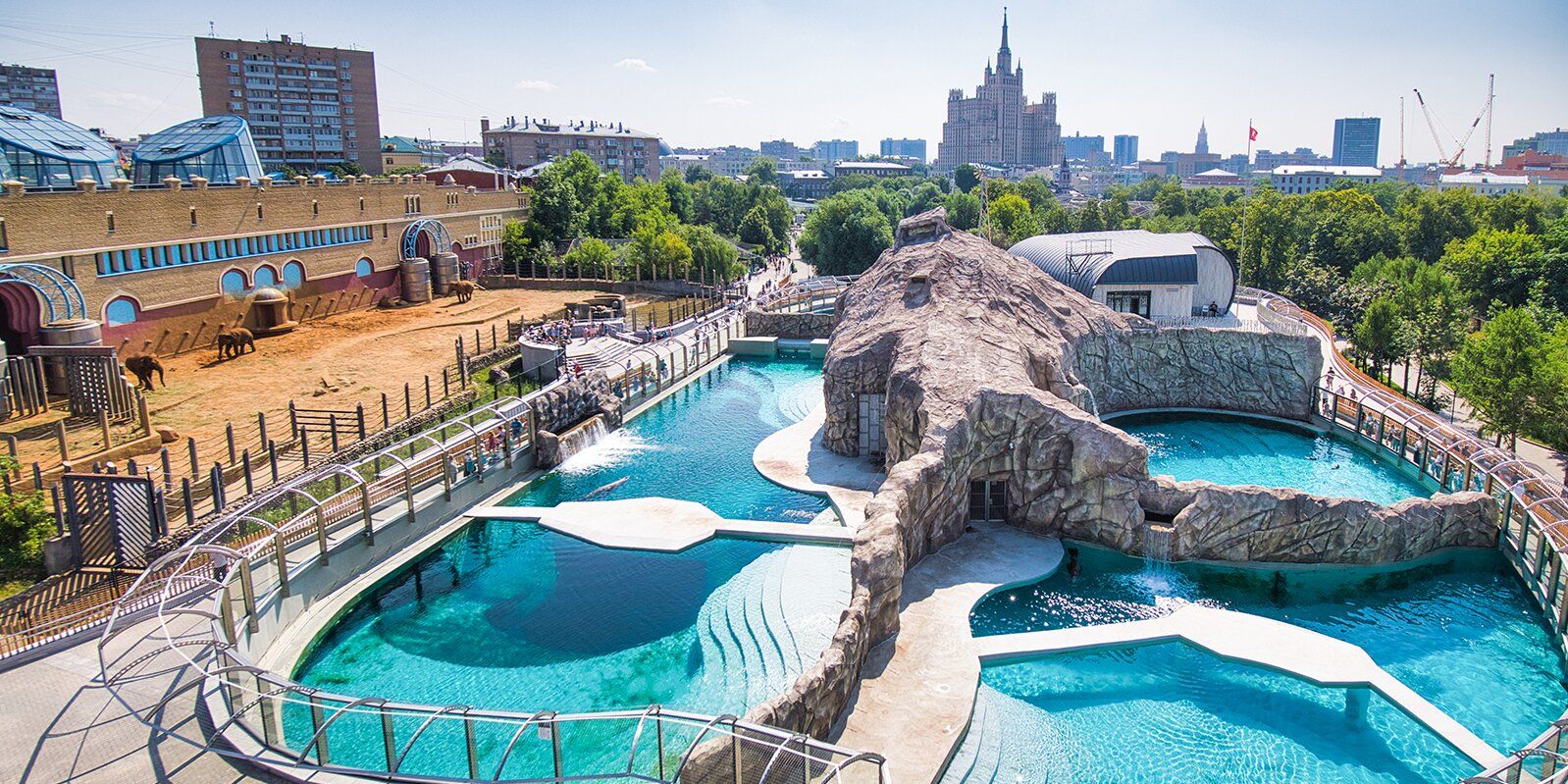
"The Pinnipeds pavilion is such a utilitarian name, but it is, in fact, a number of sea water pools that provide an environment as close as possible to the natural habitat of those unique animals: sea lions, seals, etc. There are only 16 of them here today, but by the end of the year, I hope, there will be more than 30. In other words, it’s a whole aquatic wonderland where you can see the animals not only from the surface, as before, but from underwater as well. It’s a completely different feeling of involvement with nature and with the lives of those animals. I think this will make the Zoo even more popular," Mr. Sobyanin said.
The Moscow Mayor talked to the Zoo visitors who shared their impressions from the new pavilion. "It's great to visit the sea in the center of Moscow, to see unique animals," the Moscow Mayor added.
The concept for the updated pavilion was developed in accordance with the international animal welfare standards. Construction there has been going on for 30 months.
“We have been mulling over this project for a while, seeking advice from researchers and experts, because we needed that unique water composition, the purification technology, the additives. So that the water is 100 per cent compliant with the requirements scientists set for those animals. Today, it’s not just pools where you could watch the animals, but an entire rehabilitation center for animals coming from other Russian cities, so it has a social and medical purpose as well. It’s also vital for other zoos and circuses in the country,” the Moscow Mayor told us.
Recently, a new entrance near Barrikadnaya Metro station and an expanded pedestrian bridge for transit between the old and the new parts of the Zoo were also opened.
According to Svetlana Akulova, Director General of the Moscow Zoo, the Polar World enclosure for polar bears and penguins is being designed right now. We’re happy to be able to grow not only through new project, but through animal rehabilitation centers such as this one, to help animals and save them from circuses or dolphinariums. Now, they’re getting their best lives and grow old with dignity. They have never seen such large pools before; some of them used to live in holes two by two meters or have not seen water at all. They were even scared to go down there, because they have never seen water that deep,” Ms. Akulova revealed.


Pinnipeds: rare animals and comfortable enclosures
The Pinnipeds pavilion is located in the old part of the Zoo. Its comprehensive reconstruction started in January 2020. In essence, it was built anew from the ground up. As a result, its total area grew more than three times: from 1,800 to 6,000 square meters.
The new Pinnipeds pavilion is a unique three-level building, fully in line with the modern animal welfare standards, comfortable for visitors and staff.
Ms. Akulova added that all the pinnipeds in the pavilion are native to Russia. “You can see them at any time of the year. They don’t need indoor enclosures. They can safely remain outdoors throughout the year. The water temperature can be controlled and it’s quite comfortable. It’s the real sea water. We even have artificial waves there,” she revealed.
The old pavilion had four pools with total volume of 4,700 cubic meters. Only one of them was filled with sea water. The new one has five enclosures (pools) with total volume over 9,500 cubic meters. Some rare specimens like sea hares, walruses, sea lions and fur seals are already living there. The pavilion can accommodate up to 36 sea mammals in total.
Now, the pinnipeds live in comfortable pools, 3.5 to 7.8 meters deep, with waterfalls, islands and elevations where they can rest, and the appropriate temperature maintained throughout the year. The pools are full of sea water treated with modern filtration systems every day. It keeps all its beneficial properties. The banks have a heating system so they don’t ice over in winter.
An artificial wave system has been installed in the pools to make their environment as close as possible to nature. Fur seals and Baikal seals can play in them now.
The pavilion’s indoor facilities look as if they’re covered by an artificial rock: it gives the structure its distinctive appearance and hides the spaces where animals can hide from prying eyes, for example, when they give birth or nurture their little ones. The rock also hides ten service facilities: the old pavilion used to have only three of them, and they were much less comfortable. On top of that, the new pavilion has the space where animals can be kept if their contact with water has to be limited, for example, after a surgery.
Visitors can watch walruses and seals virtually from a touching distance. The observation platform is level with the water. Windows with an automated heating system are located around the perimeter, giving visitors a nice look in even when it’s cold outside.
The Pinnipeds pavilion opening was a long-awaited event for millions of Moscow Zoo visitors.
Japanese garden, research library and wave-shaped bridge
A new entrance pavilion near Barrikadnaya Metro station also opened in the Moscow Zoo this year (8/3 Bolshaya Gruzinskaya Street), making the path from the Metro station to the children’s zoo shorter and more convenient.
A two-storey building with over 1,200 square meters of space features ticket offices and machines, a cafe, a souvenir shop and the first public zoology library in Russia. Its large all-purpose reading room (237 square meters) has stools and chairs for up to 100 visitors. There they can read, use computers, relax on couches, listen to audio talks or watch movies. You can also get a reader’s card there, because integrated reader’s cards don’t work in the library.
The library holds over 16,000 zoology books, including collections on fauna and flora, diets for various animal species. Among them is a monumental book printed in 1801: Natural History by Georges-Louis Leclerc De Buffon in 10 volumes, and a full collection of works by ornithologist Vladimir Flint.
The pavilion meets all the accessibility requirements to help visitors with reduced mobility: it has an elevator, travelators, ramps, dedicated WCs and lighting fixtures that help people with eyesight issues navigate the facility.
The surrounding grounds have been landscaped. Next to the entrance, there’s a pergola with swings, a dry fountain, a pulpit for public talks and speeches, benches, etc.
Earlier, the pedestrian bridge that crossed Bolshaya Gruzinskaya Street and connected the old part of the Zoo with the new one, was rebuilt. Another span was constructed at the west side of the old bridge. As a result, the overpass got more than twice as wide, expanding from four meters to nine. Now it looks like a swirling sea wave thanks to ornamental safety railings made of aluminum alloys.
Thanks to the bridge expansion, visitors do not crowd in front of the bridge anymore; counterflows don’t run into each other now. People with reduced mobility now have no problem crossing the bridge. On top of that, there are new observation platforms on the bridge now, giving a nice view of the entire Zoo.
The new Japanese Garden bird pavilion is located in the old part of the Zoo, by the foot of the bridge. It is occupied by Japanese cranes, a species on the Russian Red List. The stylish birds already feel at home in their new enclosure. They greet visitors who came in from the new part or are just starting their tour around the Zoo, with friendly nods.
The media panel over the main entrance (1/99 Bolshalya Gruzinskaya Street) uses the naked eye technology that makes us see 3D images without special headsets. The modern 3D screen (14.4 x 4.8 meters) shows the Amur tiger video all day long (10:00 a.m. to 10:00 p.m.). Videos about Polar bear, Pallas cat and giant panda are planned to be made. A reduced brightness, soundless and static image occupies the screen at night.
A comprehensive reconstruction of the children’s zoo was done in 2017-2019. The main objective was to set up a modern recreation and education center where pre-school and school children could spend time with domestic animals.
Moscow Zoo is one of the oldest and largest in the world
Moscow Zoo as a research and education institution opened in 1864. The Imperial Society for Plant and Animal Acclimation spearheaded the initiative. At the moment of its opening, the Zoo was accommodating 134 domestic animals, 153 wild animals and birds, 7 reptiles. The animals included two lions, two tigers, a jaguar, a leopard, a rhino and an alligator.
Today, the Moscow Zoo animal collection is one of the most comprehensive in the world. The Zoo is a member of WAZA, EAZA and EARAZA (the World, European and Eurasian Associations of Zoos and Aquariums).
Before the COVID-19 pandemic, over 3 million people visited the Moscow Zoo every year. According to Svetlana Akulova, their visitor throughput this year is 29 per cent more than in 2019, before the pandemic. Sergei Sobyanin expressed hope that the Zoo is going to break all previously set records and invited Muscovites and tourists to visit its new facilities.
Today, its collection includes 14,243 animals of 1,243 species. More than a half of them are classified as rare or endangered: Amur tigers and leopards, various cranes or rare viper species. 60 species are on the Russian Red List, 50 – in European herd books. The Moscow Zoo collection of poisonous reptiles is the largest in the world. The Zoo staff were the first to get some of the species to procreate.
In the last 10 years, their collection got expanded with many rare, unique and endangered species, such as tayras, binturongs, fossas , bongos, vulturine parrots, Blakiston's fish owls, clouded leopards, kea parrots, giant anteaters, lesser anteaters, bush dogs, giant pandas, sea hares, Poitou donkeys, rare goat and sheep breeds, including Welsh Mountain sheep, Loaghtan sheep, and Belgian Fawn goats, Belgian horses, golden lion tamarins, pottos, slender loris, bearded vultures, various chameleon, snake and turtle species, walruses, sea lions, grey-winged trumpeter, Rothschild's mynah, earless monitor lizards, common flat-tail geckos (new and uncatalogued species that gave offspring in the Moscow Zoo for the first time), koklass pheasants, white-faced sakis and pygmy hippos.
The Zoo saved four Polar bears, one tiger and one Amur leopard. Rosprirodnadzor set up a task force that rehabilitates orphaned Polar bears. They developed an algorithm that helps save bear cubs or leave them in the wild.
Moscow Zoo researchers participated in creation of national preservation programs for Polar bears, Blakiston's fish owls and Oriental storks. The program for European bison is currently in development. On top of that, the Zoo staff coordinated EAZA programs for Polar bears, bush dogs, kiangs and argus pheasants.