Vladimir Putin and Sergei Sobyanin open Big Circle Line
(31).JPG)
Russian President Vladimir Putin and Moscow Mayor Sergei Sobyanin opened the full-fledged train traffic along the entire Big Circle Line (BCL) of the Moscow Metro. The commissioning of nine new stations of BCL’s northeastern, eastern and southern sections has become the final stage in the world's largest metro construction project.
“Today, we are launching nine stations on the Moscow Metro’s Big Circle Line. This is the final stage in this large construction project. Sergei Sobyanin updated me regularly on its progress. Now the new circle line is fully operational, and it has become available for passengers at all its stations. I would like to congratulate people from Moscow and Moscow region on this marvelous occasion,” Vladimir Putin said at the opening ceremony.
Plans to build a larger circle line took shape in the Soviet era. Today, the major project, which the city needs so much, has been completed. The President of Russia thanked those who were involved in the large construction project for their readiness to perform the most challenging technological tasks in a short time. He added that the BCL has become the largest metro circle line, overtaking the Beijing circle line.
“But the main thing is that the BCL will fundamentally change the entire transport system of Moscow. It will reduce traffic on many motorways, stimulate the development and improvement of adjacent districts, and make the life of the city and its residents and visitors more comfortable and dynamic. I believe that the passengers who use the sections of the new line that are already in operation appreciate its benefits, including shorter travel time,” the President of Russia noted.
The Moscow Mayor thanked him for his appreciation of the hard work done by builders and of the city’s efforts to develop the transport system. He considers the opening of the BCL a historic event for the Russian capital.
“This is the largest and most challenging project in the history of metro construction. This is the new heart of Moscow's transport system, which brings the MCD, the MCC, and metro lines together into a single transport system and connects new metro lines, shaping the future of the transport system,” said Sergei Sobyanin.
The entire city worked to deliver such a gargantuan project. “And today, I am conveying words of gratitude to every Muscovite, because in one way or another, they have all contributed to this project. Of course, many thanks to the metro builders. What they accomplished was a feat, no less. Their effort was heroic, as they worked in the most challenging conditions. I am grateful to the companies that supplied materials, equipment and, as you rightly said, the most up-to-date trains built over the period of construction,” said the Moscow Mayor.
Vladimir Putin signed an updated map of the Moscow Metro, which already has new stations of the Big Circle Line. After that, trains were launched along the entire circle line.
_1-01.jpg)
The commissioning of the BCL has improved transport services for 15 million residents of Moscow and Moscow region.
Passengers can save up to 35–45 minutes on daily trips. For example, the time to get from Rizhskaya to Sokolniki was cut down 5.5 times (from 17 to 3 minutes). The travel from Varshavskaya to Vnukovo airport became half as long as before (40 minutes instead of 80). Passengers can now get twice as fast from Aviamotornaya to CSKA (in 22 minutes instead of 48) and 1.5 times as fast from Kashirskaya to Universitet (in 26 minutes instead of 45).
Moreover, all passengers of the Moscow Metro will feel the effect of the BCL launch through reduced traffic at other Metro lines.
Today, the BCL serves as a transfer point to 20 other stations of 11 Metro lines, three stations of the Moscow Central Circle (MCC), eight stations of Moscow Central Diameters (MCD) including Belorussko-Savyolovsky (Odintsovo-Lobnya) and Kursko-Rizhsky (Nakhabino-Podolsk), as well as to 13 suburban train routes. The largest transport hubs on the Big Circle Line will be Delovoy Tsentr, Savyolovskaya, Nizhegorodskaya and others.
In addition, the Big Circle Line has in-built solutions that will allow for its connections to the new Metro radii, including Rublyovo-Arkhangelskaya line (Narodnoye Opolcheniye station), Troitskaya line (Novatorskaya station) and the projected Biryulyovo line (Klenovy Bulvar station).
“Today, the Big Circle Line is being launched, which makes the metro more modern and convenient for each of us. Thank you very much for your patience and contribution. Every Muscovite has contributed to this project. It was built by builders with the whole city involved. I would like to congratulate you on these achievements,” said Sergei Sobyanin in the Telescope social network.
Up to 25 per cent of the load will be taken off the Circle Line, up to 22 per cent - off the radii, up to 20 per cent - off the Moscow Central Circle and 10 per cent off MCD-1 and MCD-2. Traffic on MKAD, the Third Transport Ring and outbound highways will be reduced by 5-15 per cent, as some of the drivers will forego their personal cars in favor of public transport.
The surface public transport routes are being optimized to make them more convenient for the BCL passengers. 255 routes are already servicing the Big Circle Line stations, including 4 new and 149 adjusted ones. 88 public transport stops have already been moved closer to the BCL.
Station architecture
Seven architect firms and more than 30 architects took part in the development of the projects for the new stations. The design of six stations (Mnevniki, Terekhovo, Klenovy Bulvar, Nagatinsky Zaton, Rizhskaya, Maryina Roshcha) was selected as part of international architectural competitions. Three architectural solutions (CSKA, Mnevniki, Nizhegorodskaya) won Moscow awards.
“Given the history of our metro and the fact that the Moscow Metro has earned a reputation as the most beautiful metro in the world, we came up with the idea of developing the major construction project using the best traditions of the earlier metro construction. That is why specialists started developing unique stations with unique architecture, decoration, design and high-quality materials. We have engaged the best Russian and international architects. We agreed on the design using the Active Citizen project,” Sergei Sobyanin said in an interview with the Rossiya 24 TV channel.
As a result, each of the 31 BCL stations has its own unique look. For example, Mnevniki was designed in the avant-garde style: the art object in the platform’s center was inspired by the works of Kazimir Malevich. Terekhovo station was decorated with the silhouettes of human figures, which were applied to the columns using digital concrete printing technology. The ceiling of Aminyevskaya station is made in the form of light waves-dunes with clouds of spotlights on the top of them. Michurinsky Prospekt was designed using Chinese motifs; the ceiling was decorated with hieroglyphs symbolizing friendship. Five-meter-high bronze sculptures of basketball, hockey, and football players and a skier were installed on the platform of CSKA station.
New finishing materials and technologies were used at many stations for the first time. Cast-iron tubing has become a key element In the interiors of Savyolovskaya, Maryina Roshcha and Rizhskaya deep stations. Glass was used as a finishing ceiling material at Novatorskaya station for the first time. Its optical properties such as reflection, refraction, color and transparency are associated with the images of the sun, fire and the innovation energy. Engineered quartz was used to decorate some stations. This material is more durable and wear-resistant than natural stone; it does not crack from impacts.
The design of Maryina Roshcha station is based on porcelain aesthetics. Rizhskaya station is decorated with 16 stainless steel arches up to four meters tall with built-in lighting. Sokolniki’s artistic solution was based on posters inspired by the construction of the first Moscow Metro stations. The compositions were placed on reflective ceiling panels, and track walls were turned into a large decorative panel. Nagatinsky Zaton is decorated with large mosaic panels depicting fish, the largest one is The Pike (14.0m x 3.6 m). The shape of Klenovy Bulvar station’s lobby resembles the vaults of the Kolomenskoye royal palace. Spot lighting was developed based on the textile pottery of Dyakovo settlement.
Nine new stations
On March 1, the last nine stations of the Big Circle Line were launched. A total of 20.8 kilometers of tracks were commissioned, including the northeastern section from Elektrozavodskaya to Savyolovskaya (3 stations, 7.2 kilometers), the southeastern section from Kakhovskaya to Nizhegorodskaya (six stations, 13.6 kilometers).
Maryina Roshcha
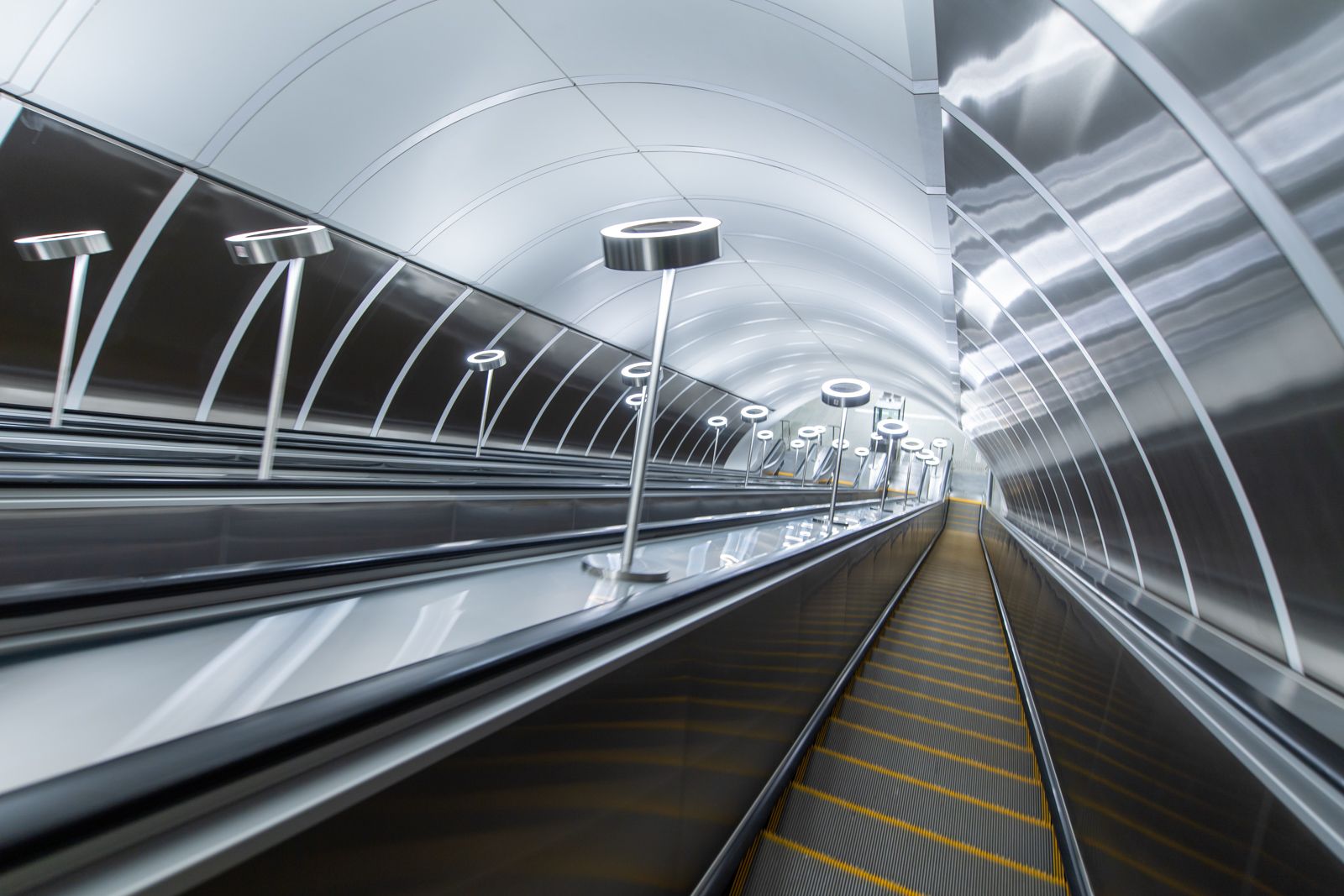
Maryina Roshcha station is located in Maryina Roshcha district, along 5th Maryina Roshcha Proyezd. The station, which is 70 meters deep, will be included in the top 3 of the deepest stations of the Moscow Metro with the longest escalator (130 meters).
It was built in a closed way, one of the most challenging metro construction methods. All work was carried out underground. Specialists used shafts with vertical conveyors, cages and buckets to transport soil, deliver materials, structures and equipment, lower and lift people.
Passengers can get to Sheremetyevskaya Street and 2nd Maryina Roshcha Street, to residential buildings, public facilities and surface transport stops from the only lobby of the station. Maryina Roshcha will become part of a large transport hub. It will connect the Lyublinsko-Dmitrovskaya and the Big Circle metro lines, MCD-2, promising MCD-4, as well as surface transport.
The station owes its architectural aspect to AI Architects, an architect firm who won the international competition. The station’s design is based on porcelain aesthetics. The convex columns resemble potbellied porcelain teapots. Marble slabs seem to be covered with small cracks, giving an antiquity feel. The station’s floor is paved with granite. The arched ceiling was made from the most seamless panels. Hidden architectural lighting makes it look endless.
The ceilings of the entrance pavilion are made from perforated panels, which facilitated the installation of ventilation, air conditioning and heat supply systems. The lobby was decorated with balls with a diameter of 2.5 meters. Polished stainless steel was the main material, and panoramic glass was used instead of walls.
A functional recreation area with new small architecture, lawns, trees and shrubs will appear next to the station.


Rizhskaya
Rizhskaya BCL station is a deep station with one island-type platform; it was built using tunneling at a depth of 62 meters, located under Prospekt Mira. Passengers can get to Rizhskaya Square and also change to the station of the same name on the Kaluzhsko-Rizhskaya line.
After the opening, Rizhskaya will become part of one of the largest interchange hubs in Moscow. It will connect the stations of the Big Circle and Kaluzhsko-Rizhskaya metro lines, as well as Kursko-Rizhsky D-2. In the future, the Leningradsko-Kazansky D-3 and Kaluzhsko-Nizhegorodsky D-4 lines will be built. Thus, a transfer hub will appear in Moscow, connecting two lines of the metro and three diameters of the surface metro.
The design of Rizhskaya station was selected following the results of an international architectural competition. The project’s author was an architect firm Blank Architects. The project was approved by Muscovites who participated in the Active Citizen project voting.
Arched stainless steel portals became the main architectural element of the station. The platform is decorated with 16 metal arches up to four meters tall with built-in lighting. Granite typical of the Moscow Metro was used for decoration. The vault over the tracks and an unlined track wall with the station name and line map placed on it give the finishing touch to the composition. Benches were installed along the pylons of the central hall.
A renovated city square will appear next to the station. The concept included landscaping, granite paving and the installation of hardscape. Besides, the fountain will operate again on Rizhskaya Square. Travel along the station will be provided only for public transport.


Sokolniki
Sokolniki station is located at the main entrance of Sokolniki Park on Sokolnicheskaya Square between Rusakovskaya and Sokolnichesky Val streets. It was built as a columned station at a depth of about 30 meters. The work was carried out in dense urban areas with a large number of underground engineering networks.
The main line tunnels towards Elektrozavodskaya were built under difficult hydrogeological conditions, just six meters from the operating Sokolniki station of the Sokolnicheskaya line. The builders also managed to build tunnel sections under the Moscow Railway’s Yaroslavl Line.
The artistic solution of the station was based on posters inspired by the construction of the first Moscow Metro stations. Artistic compositions were placed on reflective ceiling panels, and track walls were turned into a large decorative panel. Gray marble and gray and black granite were used in the decoration. The suspended ceiling was made from aluminum three-layer panels and lath structures, while fixture parts, barriers, railings and handrails were made of stainless steel.
The new station has two lobbies that are the transfer points to the station of the same name on the Sokolnicheskaya line or to Pesochny and Sokolnichesky lanes, Sokolniki Park and Rusakovskaya Street. There are two interchanges between stations: in the lobby and at the end of the operating station’s platform.
After the improvement, Sokolnicheskaya Square, under which the new station is located, will become a city park with paths paved with red clinker bricks, flowerbeds, benches and trees.


.JPG)


Tekstilshchiki
Tekstilshchiki station is located between Shosseynaya Street and D-2 tracks. Passengers can transfer to the stations of the same name on the Tagansko-Krasnopresnenskaya line and the second Moscow Central Diameter. This is a shallow station with two side platforms and two lobbies, with exits to Shosseynaya Street, a D2 station, and surface transport stops.
In December 2023, an overpass is to be opened enabling transfers between Tagansko-Krasnopresnenskaya line and BCL stations. In 2024, a new lobby will be commissioned to provide access to the D-2 platforms and to the Metro. It will also be integrated with the existing overpass.
The station’s dominant decor element is a two-level ceiling visually resembling a knitting or weaving machine and alluding to the station name (in Russian Tekstilshchiki literally means ‘textile men’). The platform itself and the lobby are clad with natural materials. The floors are paved with light gray granite. The walls are decorated with light-colored marble and metal panels. The entrance pavilions are white, gray and blue.
The station serves Tekstilshchiki and Pechatniki districts with a population of over 190,000, including 49,000 citizens who live within an easy stroll. In the future, Tekstilshchiki will become a megahub, one of the largest transportation hubs in the city. According to experts, passenger traffic at the hub (two metro stations, the D-2 station and surface transport routes) will reach approx. 145,000 people by 2025, including about 20,800 people using the BCL station.


Pechatniki
Pechatniki station is located in Pechatniki district at the intersection of Guryanova and Shosseynaya streets. Passengers can transfer to the stations of the Lyublinsko-Dmitrovskaya metro line and D-2 (transfer through a pedestrian gallery built on a clean shoe basis).
Pechatniki is a shallow station with two lobbies for passengers to exit to Shosseynaya and Guryanova streets, residential or public buildings, and surface transport stops.
The interior of the station is black and white. The columns at the escalators and stairs of the transitional bridge are U-shaped. Benches in the form of the same inverted letters are installed at the ends of the station.
The station serves Pechatniki, Lyublino and Tekstilshchiki districts with a population of over 360,000, including more than 49,000 Muscovites who live within an easy stroll. According to experts, passenger traffic at the Pechatniki hub (two metro stations, the D-2 station and surface transport routes) will reach approx. 52,000 people by 2025, including about 12,200 people using the BCL station.


.jpg)
Nagatinsky Zaton
Nagatinsky Zaton station is located in Moscow’s Nagatinsky Zaton district along Kolomenskaya Street (next to buildings 3 and 5 on the cape of the Nagatinskaya floodplain). Due to this passengers can a magnificent view of the Moscow River when exiting the station.
It is a shallow station with two side platforms interconnected with transition bridges for passengers to reach the escalators leading down to the underground lobby. You can get to Kolomenskaya Street, to surface transport stops and residential buildings from there.
The station’s design was chosen at an open international competition won by a Moscow-based architect firm called Za Bor Architects. The main idea of the interior design is an attempt to use the piece of transport infrastructure as a museum dedicated to wildlife of local rivers and the Nagatinsky Zaton, in particular. Large, realistic mosaic stonefish create an unusual and memorable image of the station. Their artistic expression made it possible not to use any additional decorative elements.
The ceilings of the platform and ticket halls and the arches of the escalator tunnels are decorated with white aluminum composite panels. White marble and gabbro were used for wall lining. The floors are covered with granite.
The launch of the Nagatinsky Zaton station will improve transport services for more than 120,000 residents, including 15,000 of those who live within a walking distance. According to experts, passenger traffic at the Nagatinsky Zaton hub (metro station and surface transport routes) is expected to exceed 18,000 passengers by 2025, including about 16,700 passengers using the BCL station.


Klenovy Bulvar
Klenovy Bulvar station is also located in the Nagatinsky Zaton area. It is located along Kolomenskaya Street at the intersection with Klenovy Boulevard. In the future, this station will provide an interchange to the Biryulyovskaya metro line.
It is also in the immediate vicinity of the Kolomenskoye Museum-Reserve with the Church of the Ascension, one of the three Moscow monuments in the UNESCO World Heritage List. Minimizing the metro’s influence on the museum-reserve was a priority for those who designed the station. As a result, specialists have chosen a line layout so that Klenovy Bulvar station is located outside the park and the tunnels run under its fringes, without affecting the central part with the most valuable sites. Still, passengers will be able to easily get to the park, which lies just 300 meters from the metro exits.
The station owes its architectural aspect to Archslon, an architect firm who won the international competition. The calm and laconic design conveys brand image of the Kolomenskoye Museum-Reserve as the area’s key attraction. Visually doubling in the mirrored walls, a relief effect of the vaulted ceilings creates a recognizable silhouette, which is characteristic of Russian traditional architecture, with a black and white interior design of the underground lobby. The walls are decorated with marble and gabbro, with metal-paneled columns and arches and perforated ceiling panels.
More than 120,000 people live in the Nagatinsky Zaton area (35,000 of them live within a walking distance from the station). According to experts, passenger traffic at the Klenovy Bulvar hub (metro station and surface transport routes) is expected to exceed 32,000 passengers by 2025, including about 23,500 passengers using the BCL station.




Kashirskaya
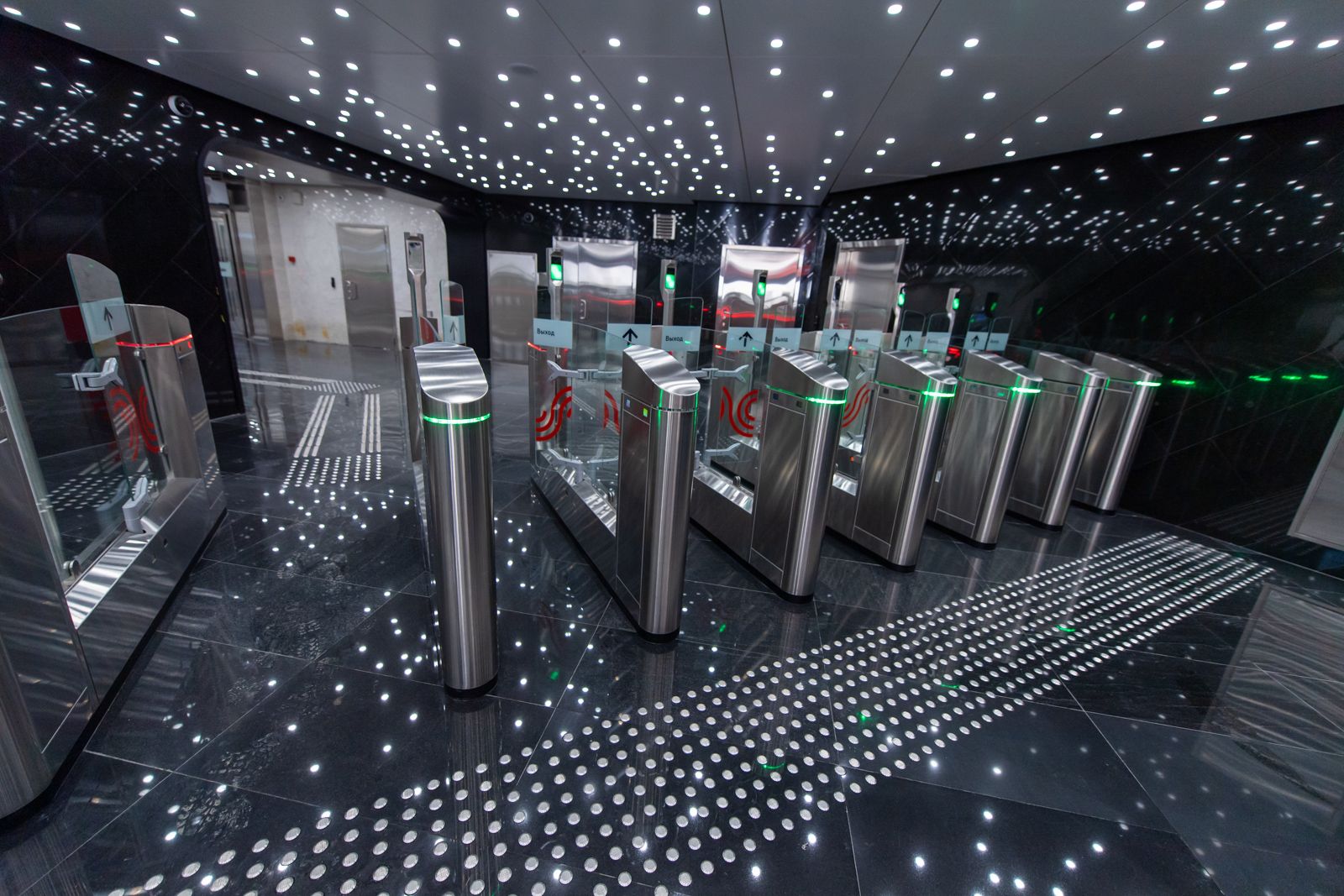
Kashirskaya BCL station is located at the intersection of Marshala Shestopalova Street and Kashirskoye Motorway. This shallow, columned and three-span station provides a cross-platform transfer to the station of the same name on the Zamoskvoretskaya line. It was initially built following a standard design popular in the 1960s and 1970s.
The station was reconstructed to be included in the BCL. During the reconstruction, specialists tried to preserve the station’s historical appearance as much as possible, including the eight original relief sculpture panels made by sculptor Zoya Vetrova, including Power Line, Planets and a Satellite, Houses and Metro, Hydro Power Plant, etc.
The station’s infrastructure has been upgraded: specialists have replaced engineering networks, tracks, tunnel wall and platform lining. In fact, the station was dismantled and reassembled, completely upgrading the main structures and equipment using advanced engineering technologies.
The lining on platform walls are Sayan marble and labradorite. The floor is paved with Siberian granite and gabbro stone. Sayan marble was used for wall lining, Siberian granite for the wall base.
The service area of the station includes the Moskvorechye-Saburovo, Nagatino-Sadovniki and Nagatinsky Zaton districts with a total population of 284,000 people, including 9,000 Muscovites living within a walking distance from Kashirskaya. According to experts, passenger traffic at the Kashirskaya hub (two metro stations and surface transport routes) is expected to exceed 90,000 passengers by 2025, including about 22,500 passengers using the BCL station.
.JPG)


Varshavskaya
The Varshavskaya station of the Big Circle Line is located at the intersection of Chongarsky Boulevard with Varshavskoye Motorway. It is a shallow, columned and three-span station. It provides for passenger transfer to surface public transport and the eponymous station of the Moscow Railway’s Paveletskaya Line.
Varshavskaya station was built using a standard design of the 1960s–1970s; it has been reconstructed to be included in the new line. The specialists tried to preserve historical appearance of the station as much as possible. The walls feature chased panels depicting views of Warsaw (by Chaim Rysin, Arturs Lapiņš and James Bodniek). The images from the panels were used in lobby pillar lining. The station’s infrastructure, on the other hand, has been upgraded: they have replaced engineering networks, tracks, tunnel wall and platform lining. Both Kashirskaya and Varshavskaya were reassembled, updating structures and equipment.
The lobby floor has been paved with light-gray Shimanovo granite, walls lined with white Sayan marble, labradoritite and dark gabbro stone. The entrance pavilions were also modernized during the reconstruction. One of them is glass; the second one (near the shopping center) is lined with galvanized steel panels. A stained-glass window and a ventilation grill made of perforated panels imitating the city lights were installed here, as well as an elevator for people with disabilities.
The station will serve Nagatino-Sadovniki, Moskvorechye-Saburovo and Nagorny districts with a total population of 243,600 people, including 76,100 of them living within a walking distance from Varshavskaya. The passenger traffic of the Varshavskaya hub is expected to exceed 69,000 people, including about 42,000 using the BCL station by 2030.