Putin and Sobyanin launch southern MHSD
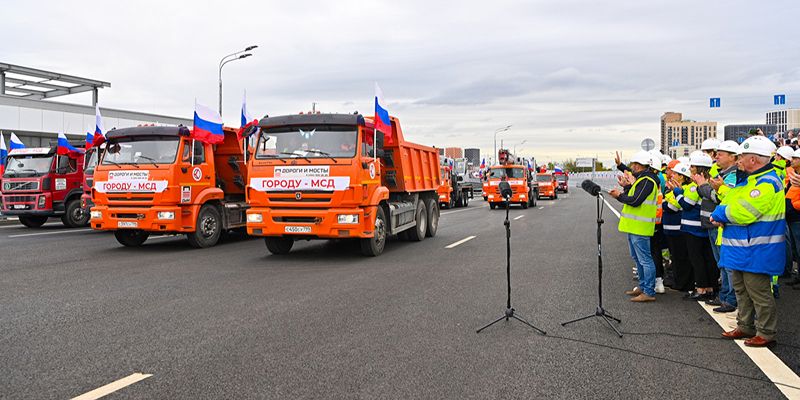
Russian President Vladimir Putin and Moscow Mayor Sergei Sobyanin have inaugurated the capital’s largest transport infrastructure project.
“Today another very big step has been taken in the development of the Moscow transport hub. Everything that has been done today is for benefit of Moscow, the Moscow Region and all the people who live or come here. I am talking about millions of people-this is not an exaggeration-about millions of people who will get improved logistics and better living conditions, and this is a serious step forward for the economy, too,” said Vladimir Putin.
The transport facilities they have started off include, in particular, the southern Moscow High-Speed Diameter (MHSD).
“The segment is quite long — spanning 28 kilometers, and most of this route is above-ground, running along overpasses and bridges — a very sophisticated structure. So, together with the main section it will be 68 kilometers long, and 4.5 million residents will see an improvement in the transport situation,” said Sergei Sobyanin.
Creation of the new city highway — MHSD — involved a few phases. The 40-kilometer main section, from the Businovskaya interchange to the Kosinskaya overpass, was launched in 2022, while on September 8, 2023, it was docked with the M-12 Vostok federal highway. On Saturday, September 9, 2023, the authorities inaugurated the MHSD southern section.
Southern MHSD
The southern MHSD, with primary straight traverse of approximately 28 kilometers long, starts at the Entuziastov Motorway junction to cross the Moscow River over a new bridge in the Kashirskoye Motorway area to enter the Moscow Ring Road (MKAD) near Varshavskoye Motorway and the M-2 Crimea federal highway.
The launch has certainly improved transport accessibility in 22 Moscow districts with a total population of 2.5 million people. “110 thousand cars per day will pass through this section alone,” emphasized Sergei Sobyanin.
In 2024, the municipality will complete the construction of a road that will connect the southern MHSD with the M-2 Crimea highway and — in the future — with the new Solntsevo — Butovo — Varshavskoye Motorway road. In addition, they are going to build a flattening of the southern section along Kaspiyskaya Street from Kantemirovskaya Street to the Paveletsky line of the Moscow Railway, so the route is expected to include 97 kilometers of roads, 55 artificial transport structures and 12 off-street pedestrian crossings, most of the route running above-ground — along overpasses and viaducts.
Alexey Krapivin, Director General of JSC Roads and Bridges, thanked Vladimir Putin and Sergei Sobyanin for the opportunity to contribute to the enhancement and construction of Moscow’s transport infrastructure.
“We are happy that today we have completed a new section of the Moscow High-Speed Diameter ahead of the Moscow Day. At the peak, it involved more than 15 thousand workers of various specialties and more than two thousand machines. The construction was done in extremely difficult cramped urban conditions. Many artificial structures are built, tens of kilometers of new roads and utilities are laid though. A project of such complexity would have been impossible to implement in such a short time without the well-orchestrated efforts of the customer, namely, the municipal providers, and all the builders who were involved in the construction,” said Alexey Krapivin.
Moscow High-Speed Diameter
The Moscow High-Speed Diameter, as a new city route, has connected the largest outbound roads, such as Dmitrovskoye, Altufyevskoye, Yaroslavskoye and Shchyolkovskoye Motorways, Entuziastov Motorway, Ryazansky Prospekt and Volgogradsky Prospekt, Kashirskoye and Varshavskoye Motorways, as well as the Third Ring Road (TRR), Moscow Ring Road (MKAD), etc. The MHSD is 68 kilometers long and has three lanes running in each direction.


Counting exits and reconstructed adjacent road network, the highway will span 220 kilometers of new roads, including 140 60-kilometer artificial facilities and 34 pedestrian crossings.
The MHSD expands into M-11 Neva federal highway in the north, M-12 Vostok in the east and M-2 Crimea in the south, with the Solntsevo — Butovo — Varshavskoye Motorway, the main road in the Troitsky and Novomoskovsky Administrative Districts, to be added in the future.
The MHSD connects 48 Moscow’s districts, which are home to five million people.
New transport reality
Millions of drivers will enjoy new traffic realities of faster and more convenient travels from one side of the city to another.
Rides have become twofold or threefold faster for motorists to save from 30 minutes to 1.5 hours, depending on the distance and time of day. So, now one can travel from the north of Moscow (M-11) to the south (to M-2 and Varshavskoye Motorway) in just 40 minutes. The same route along the Moscow Ring Road (MKAD) takes 60 minutes, or 1.5 hours through the Third Ring Road.
For Perovo residents, it will take 14 minutes to get the Moskvich plant (vs. 41 min) and 26 minutes to the Northern River Station (vs. 40 min).
The adjacent road sections have been relieved, thus significantly improving traffic of ground public transport, around 210,000 passengers saving more than 15 per cent of travel time on 62 routes.
In addition, transport services to Sheremetyevo and Domodedovo airports, Vostochny Terminal and other critical urban infrastructure have become much better.
The MHSD is a great contribution to improving the local environment, as with reduction in excess mileage, harmful emissions produced by vehicles will be less 20 per cent, the Moscow Mayor says.
Today’s MHSD
Currently, the main MHSD section is the second route with the heaviest traffic after the Moscow Ring Road as approximately 350,000 motorists use it every day, the vast majority of them (273,000) are Muscovites, and after the opening of the southern MHSD, the car flow is expected to increase up to 460,000 per day.
Today, the MHSD is also the fastest highway in Moscow, with the average speed of 69 kilometers per hour even during rush hours, while it is 32 kilometers per hour on the Moscow Ring Road and 30 kilometers per hour on the Third Ring Road.
On top of that, the MHSD is the safest of Moscow’s major roads as the number of accidents per kilometer is more than seven times lower there than on the Moscow Ring Road.
“The southern section connects with the Southern Lateral Road and the North-Western Lateral Road to form a kind of the fourth transport ring. In addition to lateral outbound routes, it can also be used as an extra ring road,” emphasized Sergei Sobyanin.
Economic benefits for the city
The opening of the main and southern MHSD will significantly reduce traffic in the adjacent sections of Moscow’s largest highways, namely, the Moscow Ring Road (- 30 per cent), the Third Ring Road (- 20 per cent), the Garden Ring (- 10 per cent), Varshavskoye Motorway (- 12 per cent), Andropov Prospekt (- 13 per cent), and Lyublinskaya Street (- 16 per cent).
Even today, redistribution of traffic flows enables a 15–17% rise in the average speed on certain sections of the Moscow Ring Road and the Third Ring Road.
Moreover, the MHSD will boost Moscow’s economic growth; approximately 200,000 new jobs are to emerge in its area, with RUB 3.7 trillion of private investment to be raised in order to boost residential and commercial development projects.
A more intense business activity in the MHSD area will increase tax revenues to the local budget, making it possible to fully recoup the construction costs, which are estimated at RUB 760 billion, as soon as in 2027. In total, RUB 2,152 billion of additional revenues will be paid to the Moscow budget and RUB 2,509 billion to the federal budget in 2012–2035; the efficiency will therefore amount to RUB 7.7 of additional tax revenue per ruble of construction costs.
The Moscow High-Speed Diameter is intended for residents of Moscow and Moscow Region in the first place, though it can also attract transit transport arriving in the metropolitan area, which largely levels the positive effects of creating the new motorway. In this regard, it was decided to introduce a MHSD toll for transit vehicles starting from January 2, 2023, which guaranteed that the new route would be used for its original purpose as an intraregional highway; in fact, due to the lack of transit, 99.8 per cent of vehicles use the MHSD without any payment.