Sergei Sobyanin opens flagship center of O.M. Filatov City Clinical Hospital No. 15
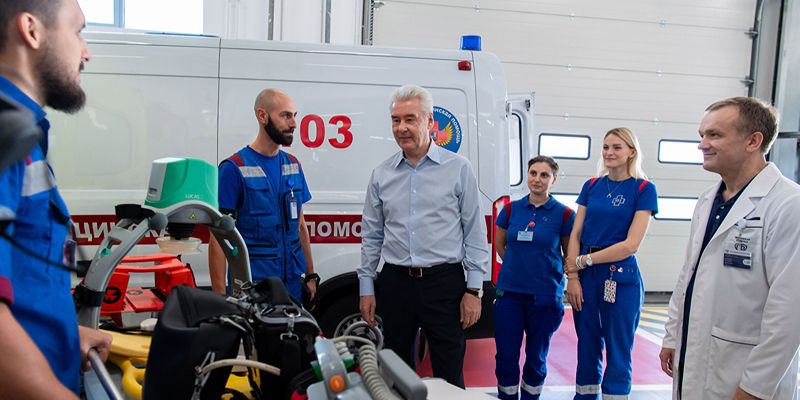
The flagship center of O.M. Filatov City Clinical Hospital No. 15 on Veshnyakovskaya Street has opened its doors. It is the third new class emergency care center in Moscow.
“Filatov Hospital is opening a new flagship center. In essence, it is the new high-tech heart of your famous clinic, one of the best in Moscow. With this new center, you get the latest diagnostic features, the most modern operating rooms and facilities to provide quality care and offer improved patient experience from the first minutes of stay in the hospital. I hope that, first, this is also a comfortable environment for you, and second, there is every opportunity to use your knowledge and skills,” said Sergei Sobyanin, addressing the staff of O.M. Filatov City Clinical Hospital No. 15.
Flagship center of O.M. Filatov Hospital
Construction of the four-story building to house the flagship center of O.M. Filatov City Clinical Hospital No. 15 began in June 2020 and was completed in August 2023. It takes up 15,000 square meters.
The building is designed to accept up to 200 emergency patients per day, who will be able to receive a full range of necessary care, including diagnosis, surgery and intensive care within the first 24 hours. Depending on their condition, they are either discharged or transferred to specialized hospital's units to continue treatment, or are given recommendations and referred to outpatient treatment. The center has nine operating rooms, including a unique hybrid operating room with an angiography system.
The flagship center’s admission unit on the first floor accepts patients using the triage (selecting, sorting) system. Depending on their condition, patients are categorized as red (patients requiring intensive care or surgery), yellow (patients requiring immediate care) and green (relatively stable patients).
Red category patients are instantly transferred to the diagnostics unit or to the operating room.
Yellow and green category patients are serviced according to the "doctor-to-patient" principle. After the fastest possible admission, these patients are, for the most part, examined and treated at bed.


Doctors provide a comprehensive diagnosis on the spot, including tests, bandaging or electrocardiogram. For complex diagnostic tests (CT, MRI) or surgery, the patient, supervised by medical personnel, is transported to an adjacent room.
Patients with suspected infectious diseases are transferred to isolation and diagnostic boxes.
The first floor also features a diagnostic unit with CT and X-ray rooms, ultrasound and functional diagnostic laboratories, a small operating room and first-aid rooms. Due to this, the patient transportation time has been significantly reduced.
A small operating room, an endoscopy unit, a laboratory research unit and a second diagnostic unit with CT, ultrasound and X-ray rooms are located on the second floor. A regional vascular center fitted with the recent equipment will also operate there. This will reduce the care time for patients with serious vascular injuries - heart attacks and strokes.
There are six operating rooms, including a hybrid operating room with an angiography system, as well as an intensive care unit on the third floor.
The diagnostic ward unit with 30 beds is on the fourth floor.
The new building of O.M. Filatov City Clinical Hospital No. 15 has been fitted with state-of-the-art equipment, including an MRI and two CT scans, two X-ray complexes, two angiographic units, four C-arm X-ray units, 13 ultrasound machines, endoscopic and laboratory equipment. The computers are connected to the Unified Medical Information and Analysis System. The building features call systems, fire alarms, video surveillance, ventilation and air conditioning.
The flagship center has introduced the digital clinic principles, including electronic medical records. This provides joint round-the-clock online access to patients’ medical data, including through mobile devices - tablet PCs for doctors and nurses. Automated medical processes help doctors focus on the patient since they no longer waste time filling out paperwork.
The center offers a comfortable environment for patients’ families and friends. They can wait in special family rooms during surgery.
Thanks to its helicopter landing site, the center can receive patients transported by air ambulance.
Ambulances can approach the building using a one-way driveway. A heated vestibule has been arranged to move patients from the car to the admission unit. In addition, there are areas in which the ambulance can be parked and waiting areas for the ambulance crew.
The area near the building has been landscaped.
Muscovites were invited to take a tour of the new flagship center on September 2–3. They took part in the admission unit “triage” process, went into the operating room, saw modern equipment, an ambulance and a medical helicopter. Over two days, more than 11,000 people visited the center.
The first patients were admitted to the flagship center of O.M. Filatov City Clinical Hospital No. 15 on September 5, 2023.
New emergency care standard
The construction of flagship centers at city hospitals is a key component of the program to improve the efficiency and quality of care for emergency patients.
Flagship centers will be available in six city hospitals. Three of them, N.V. Sklifosofsky Research Institute for Emergency Medicine, the Botkin Hospital and City Clinical Hospital No.1 named after N.I. Pirogov, are in the center of the city. Three more are located in the following districts: O.M. Filatov City Clinical Hospital No. 15 (Eastern Administrative District), Buyanov City Clinic Hospital (Southern Administrative District), Veresaev City Clinic Hospital (Northern Administrative District). In total, there will be more than 600 modern emergency room beds, a significant portion of which will become available in 2023.
The flagship centers at Veresaev City Clinic Hospital, N.V. Sklifosofsky Research Institute for Emergency Medicine and O.M. Filatov City Clinical Hospital No. 15 are already accepting patients.
The facilities were chosen so as to minimize the time of emergency patients delivery from any district of Moscow.
The hospitals where the flagship centers are being built either already have helicopter landing sites for air ambulance or will have them built soon.
Each center is a full-blow hospital with an admission unit, ORs, ICUs and a vast array of state-of-the-art devices. Patients will spend no more than 24 hours there to have medical examination, to be diagnosed and to get first aid, including surgery where necessary; afterwards, depending on their condition, they may be either taken to a specialized ward or discharged.
According to experts, the new centers will provide effective and timely care to more than 500,000 people a year (or one in two emergency patients).
Flagship centers are custom-built. Specialists take into account the current architectural appearance of the hospitals. However, emergency care provided there will be in line with a single current standard.
As part of the second stage of emergency care modernization, admission units in 11 city hospitals are to be reconstructed. The program includes Konchalovsky City Clinical Hospital, hospitals No. 13, No. 24 and No. 29 - the latter named after N. E. Bauman, Zhadkevich City Clinical Hospital, Inozemtsev City Clinical Hospital, Bashlyaeva Children’s City Clinical Hospital, Morozov Children’s City Clinical Hospital, Emergency Children’s Surgery and Traumatology Research Institute, O.M. Filatov City Clinical Hospital, Children’s Hospital No. 9 named after G.N. Speransky.
Some hospitals, such as Kommunarka Multi-Purpose Clinical Center, Yudin City Clinical Hospital, Vorokhobov City Clinical Hospital No. 67, Eramishantsev City Clinical Hospital, Davydovsky City Clinical Hospital and Savelyeva City Clinical Hospital No. 31, will implement the new standard with existing infrastructure.
After construction of flagship centers and transformation of existing admission units, the new standard will cover about 85 per cent of emergency cases, which will be a big step towards better treatment of Muscovites.
The new emergency care standard includes general patient admission principles.
It is based on unified medical diagnostic algorithms. Practitioners and experts have developed 87 special algorithms covering more than 90 per cent of emergency cases.
The algorithms refer to the roles of each member of the ambulance crew from the moment the patient is delivered to the admission unit until the start of emergency surgery, including the timing and sequence of diagnostics and emergency procedures.
Unified algorithms will enable employees to join in the work of any emergency team as soon as possible.
Medical workers at flagship centers are top-ranking specialists with excellent teamwork skills. They have to meet the highest standards.
In addition, the training standards will include development and improvement of teamwork skills, as well as communication skills in relation to patients, their family members and colleagues. Mutual assistance and support are the key to the successful work of each ambulance crew.
All centers have been equipped in line with a single standard. The buildings will get over 10,000 units of the latest medical equipment, including CT and MRI scans, angiography systems, hybrid complexes designed for operating rooms, expert-class ultrasound systems, navigation systems, endoscopic and laboratory equipment, intensive care unit equipment.
There will be about 60 high-tech surgery rooms in the centers, some of which are unique hybrid surgery rooms unrivaled in Russia. Capacities for most complex traumatological, surgical, neuro- and cardiac surgical interventions will grow several times.
Current healthcare standards include patient routing based on the “triage” principle. Patients are divided into three categories: red category patients require intensive care, yellow category patients require immediate care and green category patients have no life-threatening symptoms.
Red category patients are immediately transferred to the intensive care unit or operating room. Yellow and green category patients are serviced according to the "doctor-to-patient" principle. After the fastest possible admission, these patients are examined and treated at bed. Comprehensive diagnostics will be performed on the spot, tests will be completed, a dressing will be done or an electrocardiogram will be taken.
For complex diagnostic tests (CT, MRI) or surgery, the patient, supervised by medical personnel, will be transported to an adjacent room.
The "doctor-to-patient" care has been piloted in admission units of a number of city hospitals, showing very good results. No more walking from office to office, let alone waiting at the door, as it often happened before.
A convenient and friendly navigation system will help ambulance crews, patients, their family members and staff to navigate easily.
The new emergency care standard includes advanced digital solutions. Doctors will work in a paperless environment. Specialists will have access to patients' medical records in electronic form even before the ambulance crew arrives.
To make clinical decisions, it will be possible to use the digital assistant of a doctor, a system based on artificial intelligence technologies. Using ambulance data, laboratory and instrumental emergency examinations and examination reports, the service will help doctors accurately diagnose the patient while still in the admission unit to further transfer them to a specialized treatment unit.
For complicated cases, a telemedicine consultation with leading resuscitators invited can be organized by the center for critical conditions of the Puchkov Ambulance and Emergency Medical Care Station. To get a consultation, the doctor, being next to the patient, puts on a special AR headset that creates a participation effect. Consultants see the patient as if with their own eyes and can remotely assist their colleagues. These technologies have also been tested in the Moscow healthcare system, including in COVID-19 hospitals during the recent pandemic.
The flagship center has adopted a patient-centric approach. Emergency hospital admission is very stressful for a patient and their family members. Hence minimizing the patient’s pain, anxiety and fear is as important for getting better soon as qualified medical care.
While being in the flagship center, patients at all stages will be provided with anesthesia in line with the most modern protocols.
For the first time ever, social coordinators will become part of an inpatient facility team. They will take care of non-medical issues that previously were concern of doctors and nurses. They will engage in finding solutions for some patient’s problems: picking up children from school or calling the near relatives at work. Also, coordinators will collect all required information about a patient (place of residence, phone numbers of relatives) and determine if there is a need in social care after discharge. This support is essential for homeless, single, elderly, disabled, large families, single mothers, foreigners and other vulnerable social groups. If necessary, information of such patients will be transmitted to Glinka Social Adaptation Center, Pension Fund, social welfare authorities, embassies of foreign countries, as well as other authorities and bodies that take care of these people’s issues.
Social coordinators will call a taxi on the day of discharge from an inpatient facility, if necessary, as well as provide moral support in the most psychologically traumatizing situations that a patient and their relatives are facing. If needed, professional psychologists, social service specialists, will come to help.
In addition, employees of public service centers will deal with many non-medical issues. They will register and route patients and their relatives, organize initial consultations with doctors to determine if a patient requires hospitalization. They will also help patients solve non-standard problems.
With its spacious and airy rooms, diffused light, colors bringing a sense of peace and landscaping, the flagship centers create a comfortable environment. Every design element makes stay in the flagship centers more comfortable for stressed patients.
For the first time, Moscow healthcare practice will have special conditions created for patients’ family members and friends: comfortable waiting rooms, psychological support offices and cafes.
Family members will be able to get the fullest information concerning a patient’s condition, scheduled interventions, prognosed discharge or transfer to other wards anytime. Social welfare authorities will undertake the functions of special contact centers’ operators.
Eventually, the new flagship centers will become the patient routing center and the heart of their hospitals. With the opening of the flagship centers, the emergency and routine care will reach new heights.
O.M. Filatov City Clinical Hospital No. 15 is one of Moscow's best hospitals
O.M. Filatov City Clinical Hospital No. 15 was founded in 1981. The institution was named after Russian honored doctor and trauma surgeon Oleg Filatov in 2003. Oleg Filatov worked at the hospital for almost 20 years, since it opened, he was the head of the third trauma unit, and since 1986, he was the chief physician.
Today, O.M. Filatov City Clinical Hospital No. 15 includes a multi-purpose hospital with intensive care units, two birth centers with maternity units, a diagnostic service, a consultative and diagnostic center, as well as short-stay hospitals and day hospitals.
Hospital's treatment sections are housed in five buildings with a total area of 112,800 square meters.
Patients receive high-tech emergency and pre-arranged care in 15 specialties of medicine, including cardiology, cardiac surgery, vascular surgery, surgery, urology, coloproctology, neurology, neurosurgery, traumatology, obstetrics, gynecology, neonatology, therapy, eye microsurgery, palliative care.
The hospital capacity is over 1,400 beds, including intensive care, short-stay and day hospital beds.
The hospital employs 3,246 people, including 946 doctors and 1,382 mid-level health professionals. Among them are 28 habilitation holders and 129 PhD holders in medicine. 29 doctors have obtained Moscow Doctor status, while five nurses enjoy Moscow Nurse status.
In 2022, 79,000 people were treated. 47,600 of them underwent surgery. 3,600 patients received high-tech care.
Since the beginning of 2023, 52,500 people have been treated, 31,700 patients have undergone surgery, and 2,300 patients have received high-tech care.
The unique hospital units include:
- one of the largest regional vascular centers in Moscow, opened in 2011. In 2022, 12,800 patients were admitted to the center, and since the beginning of 2023, 9,800 people have been treated there;
- Moscow Glaucoma Center, which opened in 1995 on the premises of the laser eye microsurgery unit in collaboration with Pirogov Russian National Research Medical University. In 2022, 14,800 patients were admitted to the center, and since the beginning of 2023, 9,300 people have been treated there;
- a center providing specialized care for pregnant women with vision problems and diseases of the brain vessels and the heart, opened in 2012. In 2022, 3,800 patients were admitted to the center, and since the beginning of 2023, 7,100 women have been treated there.
The hospital is also a university clinic with 13 departments of Moscow’s leading medical universities operating there.