Sergei Sobyanin inaugurates pedestrian bridge in downtown Moscow
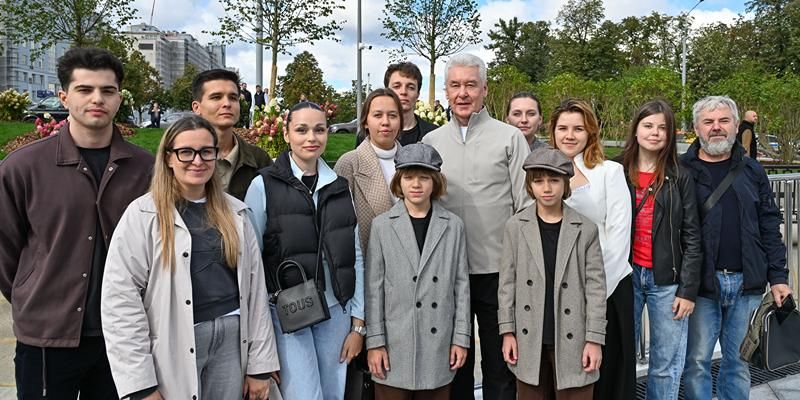
Sergei Sobyanin has inaugurated the pedestrian bridge on Bolotnaya Embankment situated beneath the Maly Kamenny Bridge.
“We got an idea to connect Bolotnaya Square, Bolotnaya Embankment, and the square in front of the Udarnik Cinema Theater and GES-2 into a seamless walking space for people to avoid crossing the Maly Kamenny Bridge by instead passing beneath via a pedestrian bridge. From that point there is a way towards Yakimanskaya Embankment, Gorky Park, Vorobyovy Gory, and so on. In other words, we have a vast, good and fascinating space,” Sergei Sobyanin says.
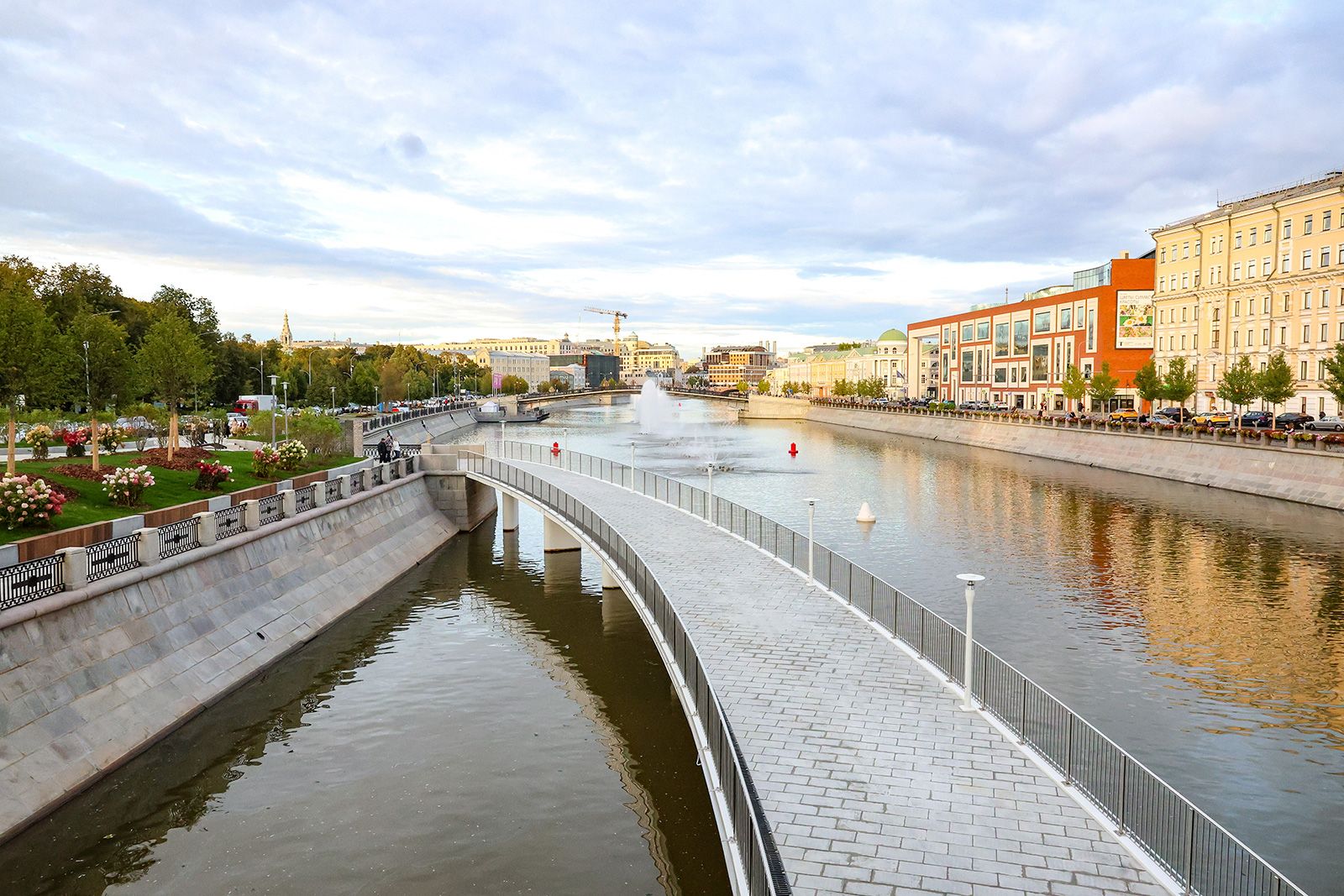
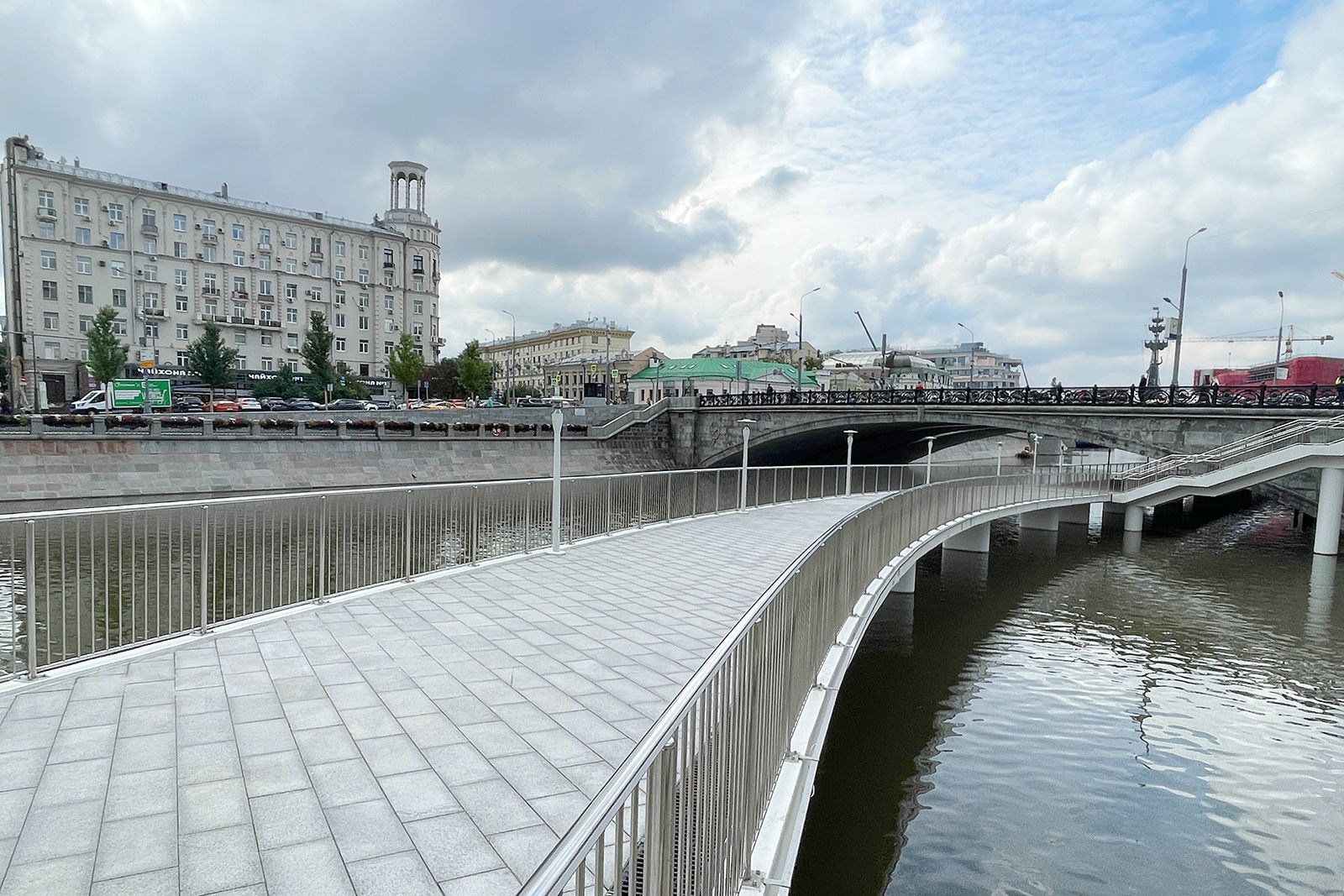
Built across the Vodootvodny Canal (‘drainage canal’ in Russian), the 170-meter-long and 5.4-meter-wide pedestrian bridge connects the sections of Bolotnaya Embankment separated by Serafimovich Street. As a result, the walk time from Bolotnaya Square to the Udarnik Cinema Theater and GES-2 Culture Center will be almost halved-150–230 meters versus 300–375 meters.
“Walking in downtown will be even more convenient. Crossing the bridge will take about a minute and a half, that is faster than using the old roundabout route. We expect that during peak hours the new bridge will be used by over 1,500 people per hour,” Sergei Sobyanin writes on Max.
Source: Moscow Mayor’s Max channel
The construction project wraps up a continuous pedestrian route along the right Moskva River bank spanning from Taras Shevchenko Embankment through Vorobyovy Gory and Gorky Park to proceed along Krymskaya Embankment to the Balchug Island.
The name for the new pedestrian bridge passing beneath the Maly Kamenny Bridge will be chosen by Muscovites via the Active Citizen project. Residents will be invited to link the name either to the Russian artist Ilya Repin whose monument can be found in a nearby public garden (Repin Bridge) or to the historic Udarnik Cinema Theater (Udarnik Bridge); they will be able to vote for one of the options or delegate the choice.
You can descend from the embankment to the bridge via two ramps, which makes it convenient for people with reduced mobility and parents with strollers. Alternatively, there are two staircases downward to the Maly Kamenny Bridge.
The bridge has railings of stainless steel, and its supports and railings are illuminated by decorative lighting at night. Therefore, central Moscow has got another unique art installation on the water.




Bridge construction project
The project’s distinctive feature was the need to employ a wet construction and installation method, i.e., working from the water, which is rarely used in Moscow. To this end, engineers gathered a temporary fleet, including small and large ice-class tugs and barges of varying load capacities to carry construction materials, as well as wheeled and tracked machinery such as cranes, excavators, concrete pumps, and vibratory rollers. The former were needed to break the ice and move barges to the construction site, while the latter were to be involved in the actual construction operations; the vessels’ dimensions allowed for construction in the confined space beneath the bridge.
At Stage I, they built a 150-meter enclosure within the Vodootvodny Canal using interlocking steel piles known as Larssen sheet piles, or just Larssens, and big sandbags;
the Larssens were driven using an excavator equipped with a vibratory pile driver. The operations were performed on board a barge with a carrying capacity of 200 tons. In areas near utility corridors, the enclosure was built by divers used sandbags, which were lowered with a barge-based excavator or with a 50-ton crane from the bank. They used 170 Larssens and approximately 1,500 sandbags in all.
As the enclosure took shape, they constructed an artificial dam along the Vodootvodny Canal, stretching from the Repin Public Garden to GES-2 House of Culture, and beneath the Maly Kamenny Bridge, having used more than 12,000 cubic meters of sand to that end.
“In fact, that made it possible to work in a confined space, minimizing the size of the construction site and avoiding closing traffic along the embankment,” Sergei Sobyanin explained on his Max channel.
Source: Moscow Mayor’s Max channel
After that, they started installing bored piles. In accordance with the method, a casing pipe was inserted into a pre-drilled borehole. A reinforcement cage was then lowered into the pipe and filled with concrete. Afterwards, they installed pile caps and foundation slabs for twenty supports; sixteen of them were placed on pile caps and four on foundation slabs. At the final stage, they were assembling spans for the future bridge.
On top of that, the area adjacent to the Repin Public Garden was landscaped as they renewed a small section of paving, arranged some seats along the retaining wall and planted some linden and lilac trees alongside hydrangea shrubs.
Landscaping the Balchug Island
In recent years, the Moscow Government has run an extensive landscaping project on the Balchug Island covering the Repin Public Garden (Bolotnaya Square), Sofiyskaya, Raushskaya, Sadovnicheskaya and Kosmodamianskaya Embankments, Sadovnicheskaya Street in addition to 1 st and 2 nd Raushsky, Faleevsky, Komissariatsky and Sadovnichesky Pereuloks — more than 35 hectares in all, with the length of the landscaped streets totaling 8.9 kilometers.
Although Balchug is just a stone’s throw away from the Kremlin and Zaryadye Park, the island was in dire need of urban improvements as it lacked greenery and its narrow, sometimes broken, sidewalks made things inconvenient for pedestrians. It in fact was uncomfortable for everyone, including locals, hotel guests, white collars, and music lovers attending concerts at the Moscow International House of Music.
The core idea behind the Balchug improvement project was to conceptually divide the urban space into historical and present-day parts.
The sidewalks within the island, on Sadovnicheskaya Street, in the side streets and along the buildings on the embankments, are used primarily by local people and office workers. They were spruced up and provided with seating areas featuring classic Moscow-style benches.
The embankments are full of promenading, scootering and cycling Muscovites and tourists, the location now featuring a more vibrant and classy design.
In particular, some of the new streetlights are designed in a trendy minimalist style, others resembling old-fashioned gas lamps, while the embankment parapets are highlighted by fancy illumination.
The island has got greener with around 600 new trees, 11,500 shrubs, lawns and flowerbeds, the highlights including Tilia europaea Pallida ( a variety of linden), red maples, Lobel elm trees, ornamental apple trees, false spirea, cotoneaster, and white dogwood shrubs.
Special attention was however paid to landscaping the Repin Public Garden, a large green space in the Balchug area created to mark Moscow’s 800 th anniversary. The existing trees were preserved to the greatest extent possible; they also added greenery as a historical landscape restoration based on archival site plans. The renewed streetlights, benches and trash bins are designed in the style of the late 1940s.
The jewel in the crown of the revitalized Balchug Island is however GES-2 House of Culture on Bolotnaya Embankment, which was relaunched by President Vladimir Putin in December 2021.
Next to the historic GES-2 building, they set a pedestrian area connecting the Cathedral of Christ the Saviour with Yakimanka Street, so you can walk from the Patriarshy Bridge right down to the water at Bolotnaya Embankment.
In July 2024, the authorities officially opened a pedestrian bridge across the Moskva River’s Vodootvodny Canal connecting the spit of the Balchug Island and Krymskaya Embankment.
Meanwhile, in September 2026, Sergei Sobyanin launched an under-bridge passageway on Bolotnaya Embankment to add a pedestrian space beneath the Maly Kamenny Bridge.
To add another touch, they are restoring the Udarnik Cinema Theater situated on the island and are repairing the façades of the historic House on the Embankment.
The Balchug Island is a major redevelopment project aimed at creating a wonderful comfy space in downtown Moscow.
Moscow’s new pedestrian bridges
In 2022–2025, Moscow got six pedestrian bridges, namely:
— across the Yauza River within the Elektrozavodskaya transport hub project (111 meters), near Bauman University (243 meters) and in the area of Budayskaya Street (78 meters);
— across the Tsyganka River as part of the Voskresenskoye — Karakashevo — Shcherbinka road construction project (14 meters);
— across the Moskva River’s Vodootvodny Canal (‘drainage canal’), connecting the spit of Balchug Island and Krymskaya Embankment (58 meters);
— through the Nagatinsky Backwater (219 meters).
In 2026–2028, Moscow will get two more pedestrian bridges:
— across the Moskva River towards Ostrovnaya Street, to connect the Mnyovniki floodplain and Krylatskoye (225 meters), and
— across the Moskva River towards Fili Park to connect the park and the Mnevniki Floodplain (200 meters).
Moscow Mayor on building Mnevnikovskaya Floodplain pedestrian bridges