Vladimir Putin and Sergei Sobyanin open Serp I Molot Moscow city station
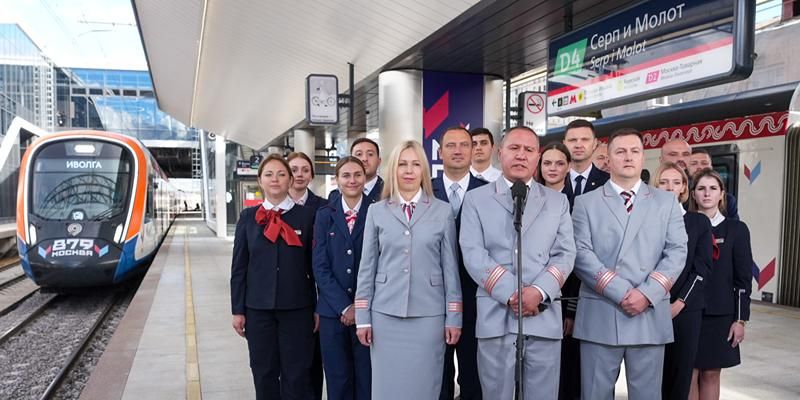
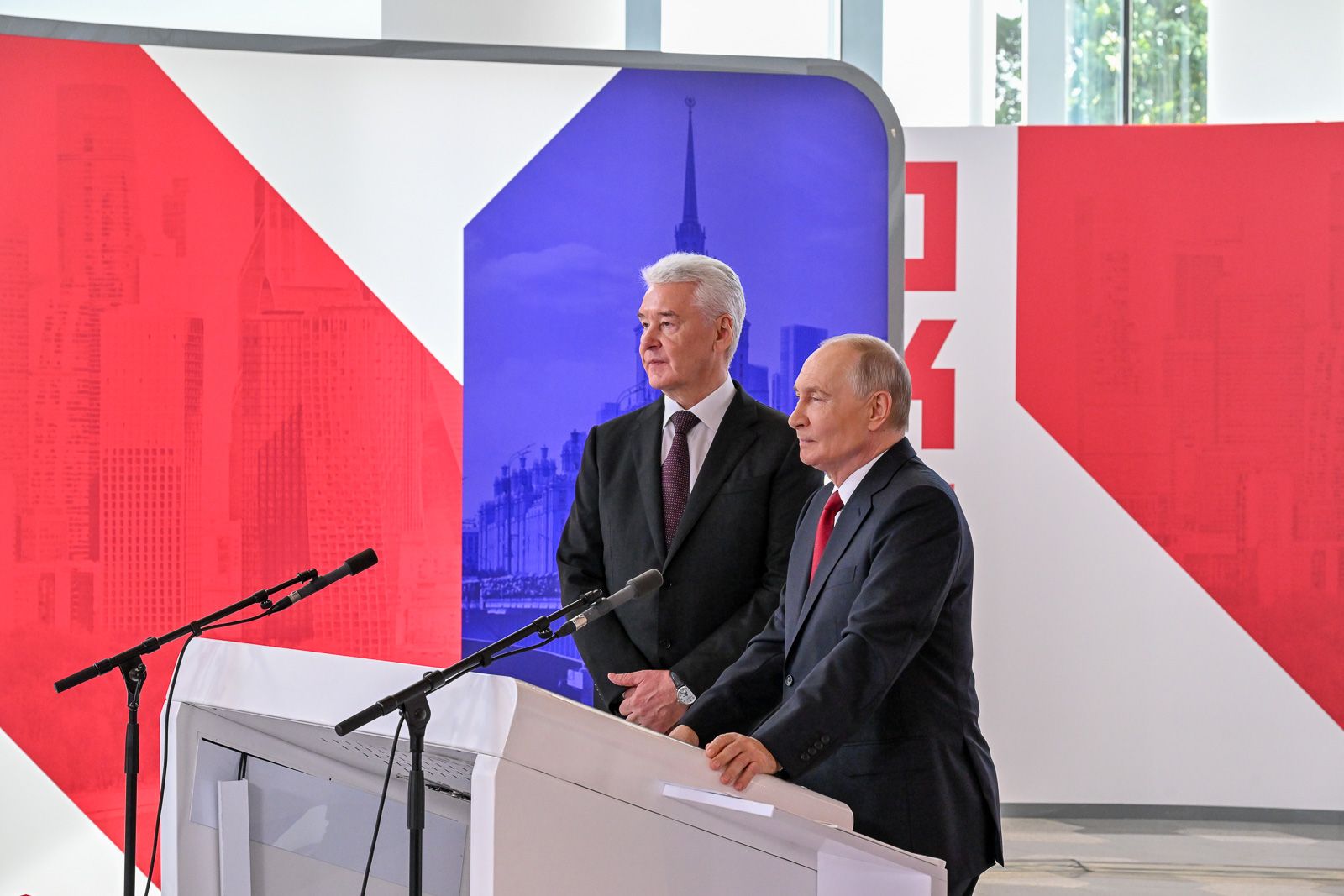
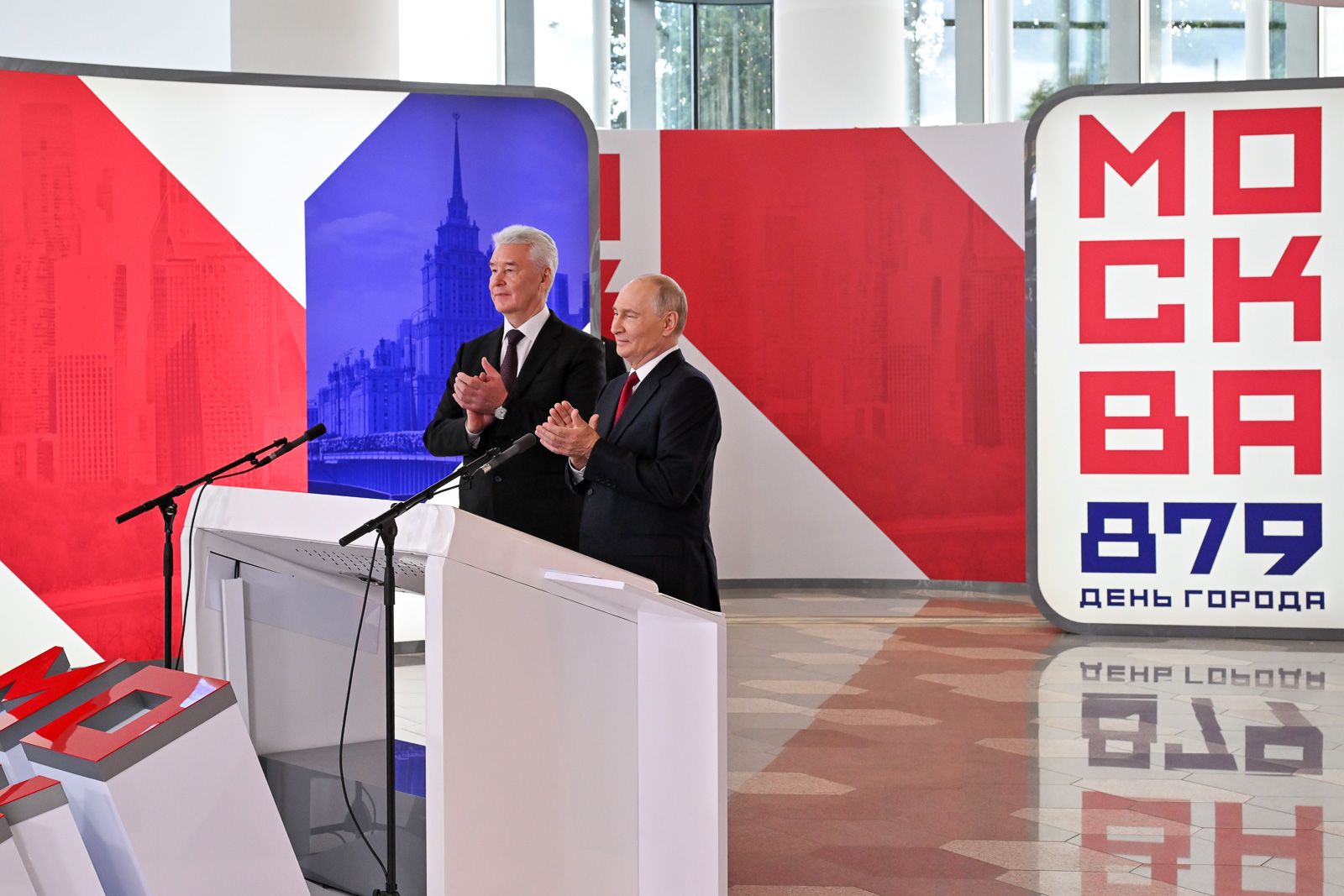
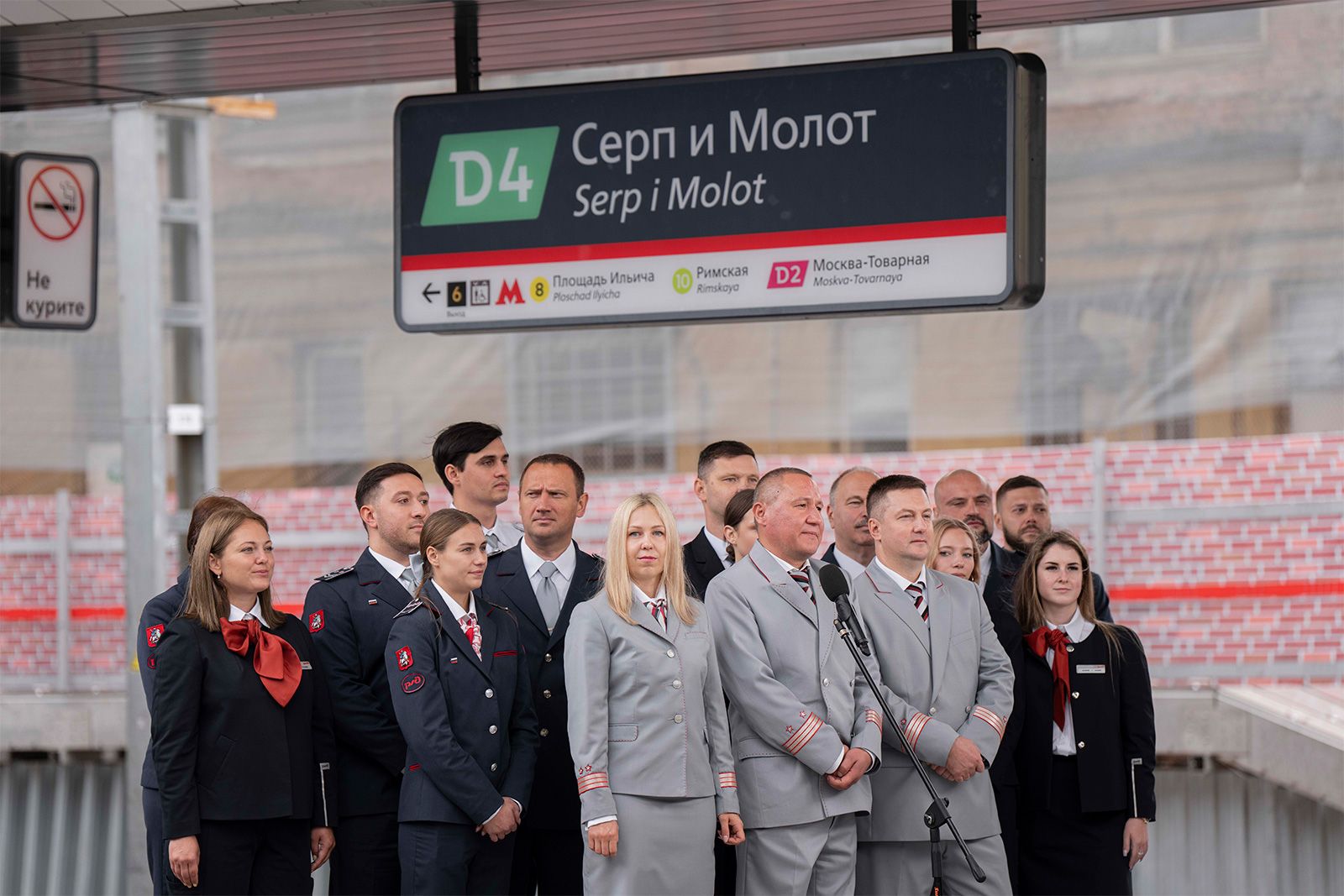
On City Day, Russian President Vladimir Putin and Moscow Mayor Sergei Sobyanin opened a new Moscow city station, Serp I Molot, on the fourth Moscow Central Diameter (MCD-4). The event marked a major milestone for the country’s transport system. Serp I Molot is Moscow’s 90 th city station.
“Together, we have been opening one line after another, one diameter after another. In recent years, passengers have made more than three billion journeys on the rail transport that has been reopened and reconstructed. The figure sounds astronomical. But it is very important not only to lay tracks and launch trains; it is also essential to provide convenient transfers from one mode of transport to another so that passengers can travel comfortably. Over these years, we have built 90 Moscow city stations whose passenger traffic is entirely comparable with that of major federal railway stations,” the Moscow Mayor said.
The Serp I Molot railway platform was built in the mid-1930s. For decades, it had been one of the main entry points into Moscow for workers from the Serp I Molot Factory and other industrial enterprises in the area. In recent decades, they have been replaced by employees of numerous offices and service-sector businesses. In 2023, the station became part of MCD-4.
Serp I Molot city station
“Serp I Molot is one of the largest transport hubs in eastern Moscow. In addition to MCD-4, it connects the Lyublinsko-Dmitrovskaya and Kalininskaya metro lines, surface public transport routes and tram services. Back in 2010, 20,000 people used the hub every day; the figure has reached 70,000 today,” the Moscow Mayor shares on his Max channel..”
Source: Sergei Sobyanin’s Max channel
Several factors contributed to the growth in ridership. These include the launch of Ivolga and other comfortable trains, a reduction in the average fare, which has fallen almost threefold from 292 to 102 rubles, and convenient payment and navigation systems. While 20,000 people a day used the Serp I Molot transport hub, including the metro, railway and surface transport, in 2010, the figure has now risen to 70,000 passengers daily.
Back then, Serp I Molot Station did not meet modern Moscow transport infrastructure standards. It had narrow platforms without canopies, a cramped ticket office and an inconvenient pedestrian bridge.
.jpg)
.jpg)
.jpg)
.jpg)
.jpg)
For this reason, a new Serp I Molot Station was built as jointly decided by Moscow Mayor Sergei Sobyanin and Russian Railways CEO and Board Chairman Oleg Belozerov. It became a full-fledged Moscow city station covering more than 7,300 square meters.
The Serp I Molot Moscow city station complex includes:
— two modern platforms. They have full-length 276-meter canopies protecting passengers from the sun and precipitation, information boards, benches and SOS desks;
— a passenger concourse and a new station building covering about 3,000 square meters. Its design references the Serp I Molot Factory, after which the railway station was named, with white façade pylons, stained-glass glazing and brickwork. There is an art installation shaped like a foundry ladle installed inside;
— a southern passenger entrance hall with turnstiles, ticket offices and restrooms, also equipped with a dynamic navigation system.
The station provides a barrier-free environment for older people, parents with strollers and passengers with reduced mobility. It includes escalators and elevators.
Transfers take three minutes
As part of the project, the underground pedestrian passage was reconstructed and extended. It will enable passengers to cross the railway tracks comfortably and safely.
The square and Gzhelsky Pereulok next to the station were landscaped, with the latter having become car-free.
A new surface public transport stop was also created. The transport hub is currently served by 10 bus and electric bus routes and four tram routes, including the new No. 2 route from Kursky Railway Station to 3 rd Vladimirskaya Street.
With the new infrastructure, the transfer time between Serp I Molot MCD-4 Moscow city station and Rimskaya Station on the Lyublinsko-Dmitrovskaya Line and Ploshchad Ilyicha Station on the Kalininskaya Line has been cut fivefold, from 15 to three minutes.
The opening of Serp I Molot city station has made journeys to Moscow more comfortable for residents of cities in the Moscow and Vladimir regions, including Reutov, Balashikha, Kupavna, Elektrogli, Pavlovsky Posad, Orekhovo-Zuyevo, Pokrov and Petushki, as well as surrounding areas with a combined population of about two million.
Transport services have also improved for more than 200,000 residents of Lefortovo and Tagansky District. They now have additional options for comfortable rail journeys.
“Serp I Molot Moscow city station will soon have a direct connection with Ivanovskoye District. To achieve this, we are extending the tram line along Entuziastov Motorway to the Moscow Ring Road. We plan to complete the construction this year,” Sergei Sobyanin wrote on his Max channel.
Source: Sergei Sobyanin’s Max channel
.jpg)
.jpg)
.jpg)
.jpg)
.jpg)
.jpg)
.jpg)
.jpg)
.jpg)
.jpg)
Moscow city stations: a new standard for the capital and the regions
Today, 90 Moscow city stations created over the past 10 years operate on the Moscow Central Diameters, the Moscow Central Circle (MCC) and the Paveletskoye and Yaroslavskoye directions of the Moscow Railway. Of these, 57 are part of the first, second, third and fourth Moscow Central Diameters, 31 are on the MCC and two on the Yaroslavskoye and Paveletskoye directions (Rostokino and Verkhniye Kotly). More than 60% of all MCD and MCC passengers use modern city stations.
Their number is planned to reach 125 by 2035. In addition, the number of MCD stations will grow to 144.
Moscow city stations set a new standard and level of comfort for rail transport not only in Moscow but throughout Russia.
Each Moscow city station is a full-fledged transport hub with heated passageways, escalators, elevators, platform canopies and related passenger services.
Moscow city stations provide convenient transfers, connect areas on either side of railway lines and become focal points for the development of adjacent districts. Within 500 meters of new transport hubs, the number of cash registers increases six-fold on average. This indicates growth in small businesses, services and retail, including the creation of new jobs.
Growth of the Central Transport Hub
All 90 Moscow city stations have been created over the past 10 years as part of a large-scale project to develop the Central Transport Hub, the largest in the country. It covers 11 Russia’s constituent entities — Moscow, the Moscow Region and neighboring regions — with a combined population of more than 31.6 million. The Central Transport Hub accounts for almost 75% of all suburban rail journeys in Russia, or 3.1 million passengers a day.
Its development is being carried out under a joint program of the Russian Government, the Moscow Government and Russian Railways through 2035. The program aims to significantly improve rail links between the regions of the Central Transport Hub, as well as connectivity within those regions.
The transformation of the Central Transport Hub began almost 10 years ago, when Russian President Vladimir Putin and Moscow Mayor Sergei Sobyanin, together with Russian Railways, launched the Moscow Central Circle. Four Moscow Central Diameters were launched in 2019 and 2023.
Today, the MCD network comprises 303 kilometers of track and 138 stations. It provides direct and fast connections between dozens of Moscow districts and urban districts outside the capital. The Moscow Central Diameters use Moscow’s unified public transport fares and offer free transfers to the Metro and MCC, while trains operate at regular intervals.
Development of the Moscow Central Diameters continues. New stations are being built and existing ones reconstructed, modern Moscow city stations are being created and track infrastructure is being improved. The project has set standards for the entire country. Thanks to a comprehensive approach encompassing everything from fares and transfers to rolling stock and station architecture, a new model of urban mobility has emerged that will shape the development of Russian cities for years to come.
Key Results of MCD Development:
— multiple growth in passenger numbers: today, MCD trains carry 1.7 million passengers a day. Over the seven years since the diameters were launched, total passenger traffic within Moscow has increased 30-fold, while two billion journeys have been made across all four diameters;
— urban mobility: the number of journeys made within Moscow on MCD routes has grown since 2010 and now reaches 500,000 a day. There are dozens of interchange points on the Moscow Central Diameters. They allow passengers to transfer free of charge to the Metro and MCC;
— increased service frequency: commuter trains now run 1.5 times more frequently during peak hours, while minimum intervals have been reduced to 5.5 minutes.
Modern Comfortable Trains
In 2010, the Central Transport Hub’s rolling stock fleet consisted primarily of outdated electric commuter trains. They were hot in summer and cold in winter, had uncomfortable seats and lacked navigation systems and sound insulation.
Between 2011 and 2026, 496 new trainsets were purchased, including a complete renewal of the Moscow Central Diameters fleet in 2025. The Central Transport Hub has the fastest rate of rolling stock renewal in the world.
The new trains are equipped with climate control and air disinfection systems, clear navigation and media screens. The carriages feature ergonomic seats and charging points for electronic devices. The trains run smoothly, while noise levels inside the carriages have fallen by 35%.
The capacity of the new trains has increased by 1.5 times. Modern seats also provide passengers with significantly more personal space than those on older trains. The flagship model of the Central Transport Hub is the Ivolga. Its production is 97% localized in Russia. New trains are purchased under life-cycle contracts providing long-term maintenance for 40 years.
The development of the Central Transport Hub has generated enormous demand for Russian industry. The Moscow Government accounts for about 90% of orders for electric trains placed with Russia’s transport engineering industry. More than 1,000 enterprises and 120,000 workers across the country are involved in the production of commuter trains and trams, with localization reaching 97%.
Further development plans for the Central Transport Hub include continued rolling stock renewal. They provide for the purchase of about 100 trains between 2027 and 2030:55 for the Yaroslavskoye direction and 45 for the Central Transport Hub. About 73 trains will be purchased between 2031 and 2035:43 for the Paveletskoye direction and 30 for the Central Transport Hub.
As a result, the fleets on the Yaroslavskoye and Paveletskoye directions will be completely renewed. Modern trains will also be purchased for routes connecting Moscow with neighboring regions.
Regular-interval timetables, with trains every 30–60 minutes, will be introduced for services between the regions and the capital. Trains will depart every half hour to one hour throughout the day. Currently, trains to Moscow run once every three hours. Waiting times will be reduced more than threefold, making it easier for passengers to plan their journeys.
The project will increase carrying capacity 2.5-fold, from 204,000 to 500,000 passenger places per day.
As part of the first phase, the project will be implemented in the Yaroslavl, Kaluga, Tula, Vladimir and Smolensk regions by 2030. It will be implemented in the second-phase regions of Tver, Kostroma, Ivanovo and Ryazan by 2035.
Key figures
|
Indicator |
Value |
|
Serp I Molot: the ordinal number among Moscow city stations in Moscow and the Moscow Region |
90 th |
|
Total passenger traffic at the Serp I Molot transport hub in 2026 |
More than 70,000 passengers a day |
|
Growth in passenger traffic at Serp I Molot since 2010 |
3.5-fold |
|
Residents of Lefortovo and Tagansky District with direct access to the Moscow city station |
More than 200,000 people |
|
Station area |
More than 7,300 square meters |
|
MCD-to-Metro transfer time |
Reduced fivefold: from 15 to three minutes |
|
Journeys made on all four MCDs since their launch |
Two billion |
|
Daily MCD journeys within Moscow |
Up to 500,000 (a 30-fold increase since 2010) |
|
New trainsets purchased in 2011–2026 |
496 trainsets |
|
Localization of the Ivolga train |
100% |
|
MCD rolling stock renewal |
100% (completed in 2025) |
|
Train life-cycle contracts |
40 years |
|
Enterprises and workers involved in production for the Central Transport Hub |
More than 1,000 enterprises and 120,000 people |