Vladimir Putin and Sergei Sobyanin inaugurate five initial stations on Rublyovo-Arkhangelskaya metro line

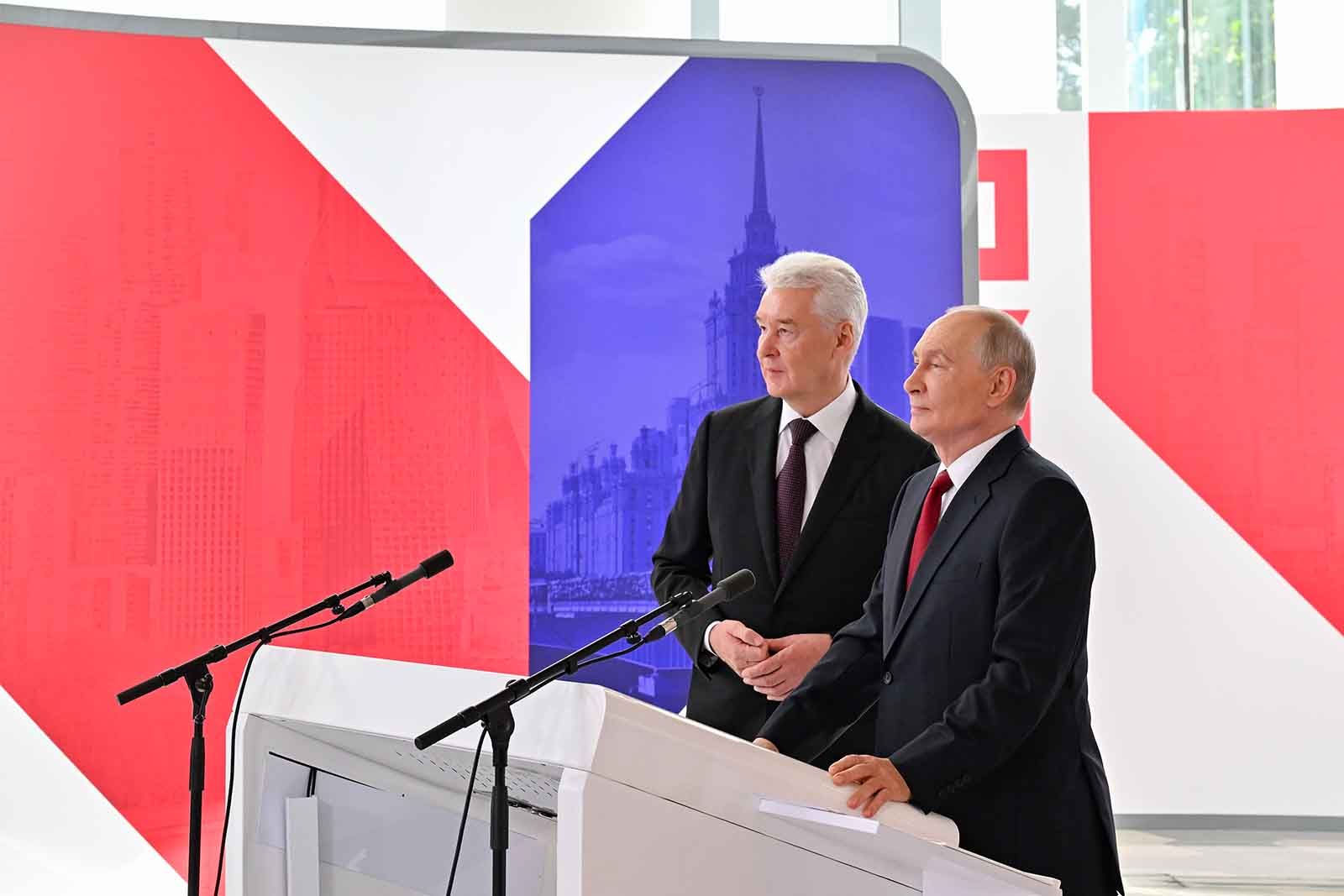
President of Russia Vladimir Putin and Moscow Mayor Sergei Sobyanin inaugurated the Moscow Metro’s Rublyovo-Arkhangelskaya line spanning from the Delovoy Tsentr station to the Bulvar Generala Karbysheva station.
“Today we are launching the new Rublyovo-Arkhangelskaya line — the seventeenth metro line including its first five stations. The next five stations will follow as early as next year, and Moscow’s business center will therefore be connected to SberCity, another rapidly growing hub,” said Sergei Sobyanin.
They have built 130 new stations to date, the Moscow Mayor said, with another 30 stations, three train depots, and 75 kilometers of lines to be ready before 2030.
“We are continuing extensive construction, at times extending beyond the Moscow Ring Road and moving into the Moscow Region, because we, in fact, are one agglomeration — one really big city,” noted Sergei Sobyanin.
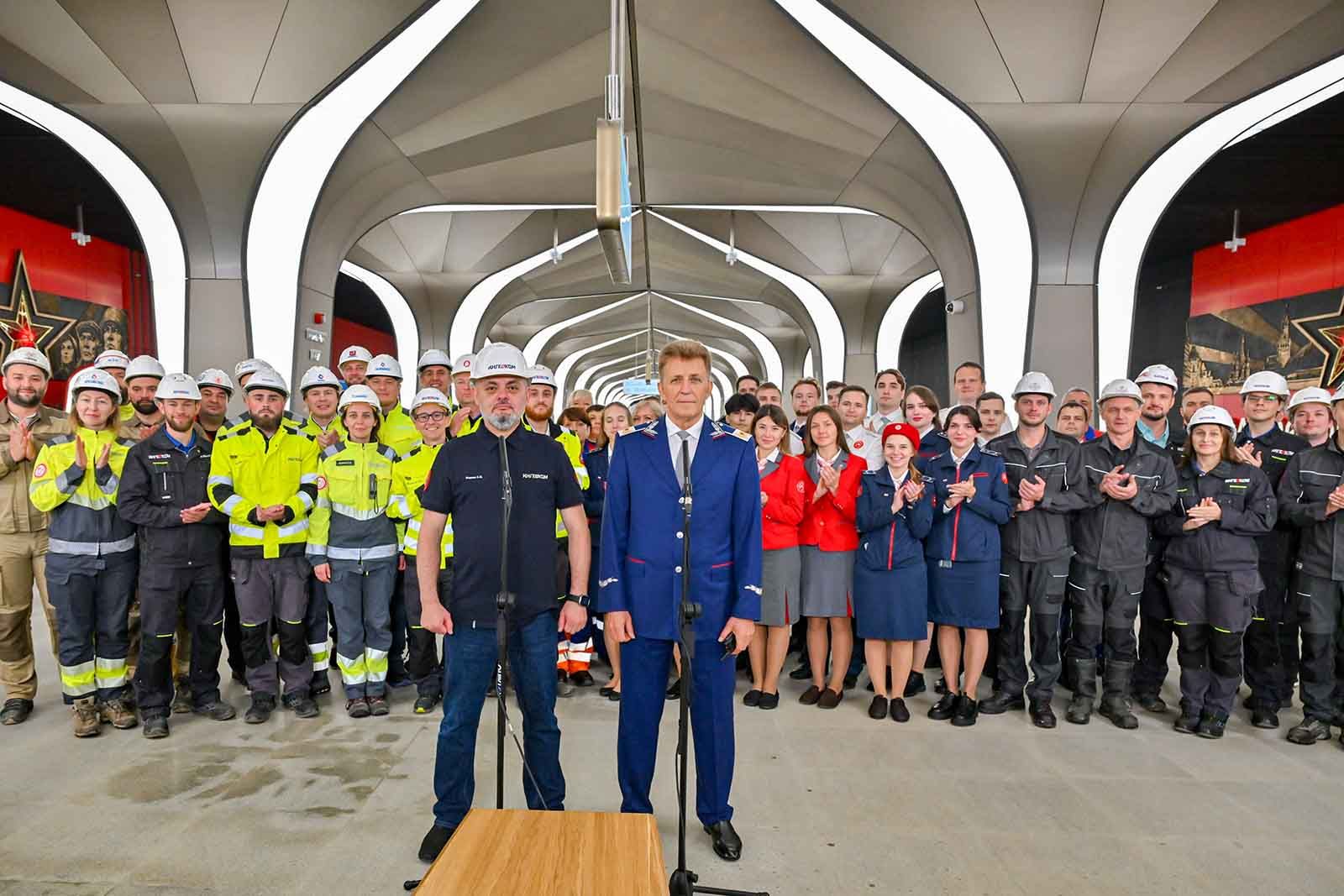
Spanning 8.7 kilometers, the first section consists of five stations, namely, Delovoy Tsentr, Shelepikha, Zvenigorodskaya, Narodnoye Opolcheniye, and Bulvar Generala Karbysheva. The Rublyovo-Arkhangelskaya line is Moscow Metro’s seventeenth line, coming in graphite on the Moscow transport map.
“This line makes it possible for over 550,000 residents of Presnensky, Khoroshyovo-Mnyovniki, Shchukino, Dorogomilovo, and Filyovsky Park Districts to be able to get around the city faster. They have access to transfers to the MCC and three metro lines such as Solntsevskaya, Filyovskaya, and BCL. The commute to central Moscow now takes a third of the time,” the Moscow Mayor writes on his Max channel.
Source: Sergei Sobyanin’s Max channel
It is expected that residents will make over 90,000 rides per day on the open section; the figure will increase by nearly 50 percent, exceeding 130,000 by 2030. More than 65,000 passengers per day will use transfers to other lines.
All of the five stations are designed to provide the highest degree of passenger experience. The lobbies feature ticket machines and Moscow-made turnstiles supporting all available payment methods, including FacePay. Passengers can take advantage of a high-speed 4G mobile network right on the platforms and in the tunnels. In addition, the stations of the Rublyovo-Arkhangelskaya line feature 160 digital signage and exclusively the state-of-the-art Russia-made Moskva-2026 trains.
The line is serviced by twelve trains running with adequate time intervals. Their advantages include open gangways, extra-wide doors, around 400 charging ports, media screens, adaptive lighting, powerful climate control systems, updated seats without metal joints, and increased carriage capacity.
Prior to opening of the initial section of the Rublyovo-Arkhangelskaya line, Moscow Metro engineers carried a series of rigorous inspections. In parallel, utility providers improved the adjacent neighborhoods in order to enhance pedestrian accessibility and arrange convenient access to the stations. At the moment, they are optimizing the surface transport routes.
The new section has created over 330 jobs offering stable income and social benefits guaranteed by the Moscow Government. Meanwhile, the next section — from Bulvar Generala Karbysheva to Novorizhskaya — is scheduled for 2027, and the section between Novorizhskaya and Izumrudnye Kholmy will be completed in 2030. Passenger traffic is expected to increase by threefold to exceed 250,000 people per day by 2030.
“The new line will be maintained by the Solntsevo train depot and later by the Novorizhskoye depot, to be built next year,” the Moscow Mayor wrote on his Max channel.
Source: Sergei Sobyanin’s Max channel
Delovoy Tsentr
The Delovoy Tsentr station on the Rublyovo-Arkhangelskaya line is set in the heart of the Moscow International Business Center (MIBC) commonly known as Moscow-City, at the intersection of Testovskaya Street and Presnenskaya Embankment. Part of the Big Circle Line 2018–2024, it has been connected to one of Moscow’s largest transport hubs, with the confluence of six lines of the rail network, such as Filyovskaya, Solntsevskaya and Rublyovo-Arkhangelskaya metro lines, MCC, plus the first and fourth Moscow Central Diameters (MCDs).
-5.jpg)
The Delovoy Tsentr station is 24.5 meters deep. Its two underground lobbies exit to the Moscow-City, with two elevators serving passengers with reduced mobility. The design is dominated by light tones, utilizing primarily metal and glass.
After opening, the Delovoy Tsentr station on the Rublyovo-Arkhangelskaya metro line is expected to serve more than 21,000 passengers daily, with over 33,000 by 2030. Meanwhile, the passenger flow of the entire transport hub in the Moscow-City area already exceeds 100,000 people per day, the figure to surpass 170,000 by 2030.
-3_.jpg)
Passengers are carried to and from the transport hub via eight surface routes that are used by more than 50,000 people every day. The route network will be modified to improve access to the Delovoy Tsentr and Moscow-City hubs.
Shelepikha
The Shelepikha station on the Rublyovo-Arkhangelskaya line is located within the Moscow-City Business Center, near the intersection of Shmitovsky Proyezd and Shelepikhinskoye Highway. Like Delovoy Tsentr, it was part of the Big Circle Line in 2018–2024. Today, it provides a less-than-two-minute transfer to the same-name MCC station, to be used by over 6,000 people daily.
-13.jpg)
-17.jpg)
-18.jpg)
Built at a depth of twenty meters, the station has two underground lobbies exiting to Shmitovsky Proyezd and Shelepikhinskoye Highway, with two elevators for passengers with reduced mobility. Designed predominantly in light tones with yellow accents, the station features a black ceiling and black vaults above the columns to expand the space visually.
After opening, the Shelepikha station on the Rublyovo-Arkhangelskaya metro line is expected to serve more than 18,000 passengers daily, with over 28,000 by 2030. They will be brought to the station through six convenient surface routes.
Zvenigorodskaya station
The Zvenigorodskaya station on the Rublyovo-Arkhangelskaya line is set next to the intersection of Shenogin Street, Shelepikhinskoye Highway, and 1 st Silikatny Proyezd. Nearby, there is the Heart of the Capital berth, which is part of the first route providing scheduled electric boat services.
The 28.4-meter-deep station has two underground lobbies, with exits to existing and future residential quarters, along with eight elevators for passengers with reduced mobility.
-7.jpg)
The station’s architectural features are defined by the light, airy platform space, the dynamic column design visually enhancing the sense of airiness. Designers used a monochrome palette featuring predominantly bright, light tones and contrasting dark and light shades on the track walls. The ceiling and columns are clad in three-layer aluminum panels, while the floors and walls of the lobbies are finished with natural granite. The bronze and brass panels featuring landmarks of Zvenigorod, one of the oldest cities in the Moscow Region, are the centerpiece of the track walls and ticket halls.
The above-ground pavilions are of a minimalist trapezoidal shape with slanted entrance portals coated with white metal panels as a key feature.
-10.jpg)
-5_.jpg)
-9_.jpg)
-3_.jpg)
More than 55,000 residents of newly built residential quarters located along Shelepikhinskoye Highway now have a metro station within walking distance. Zvenigorodskaya is expected to serve more than 15,000 passengers daily and over 30,000 by 2030.
The station has significantly shortened travel times for residents of the nearby neighborhoods as the journey to the BCL now takes about five minutes instead of twenty-five, i.e., five times faster, with five minutes instead of thirty, i.e., six times faster, to reach Moscow-City.
Upon landscaping, it has been provided with new convenient access routes, bus stops, and pedestrian crossings. Four surface transport routes will run nearby, facilitating passenger access.
Narodnoye Opolcheniye
The Narodnoye Opolcheniye station on the Rublyovo-Arkhangelskaya line with a transfer to the same-name BCL station is located along Demyan Bedny Street at the intersection with Marshal Zhukov Prospekt. In close vicinity, there is Vorokhobov City Clinical Hospital No. 67, Moscow’s largest inpatient medical facility.
Built at a depth of twenty-four meters, the station has two underground lobbies with exits leading to both sides of Demyan Bedny Street and Marshal Zhukov Prospekt, while residents with reduced mobility can make use of any of its six elevators.
-13_.jpg)
-11_.jpg)
-14.jpg)
The central element of the architectural design consists of two rows of brightly illuminated fancily shaped columns that transition smoothly into the vaults of the station hall. The floor is clad in light-gray granite, the bases of the track walls are of black granite and the track walls are covered with black and red aluminum honeycomb panels. Steel was used for the column cladding.
The floors and walls of the lobbies are finished in light tones and clad in granite slabs, while the suspended ceiling consists of white three-layer aluminum honeycomb panels and black aluminum slats with integrated LED light strips. Rectangular decorative metal panels dedicated to the heroes of the people’s militia featuring a red star in the center ornate the trackside walls. Opposite the turnstiles, on the lobby wall, one can see a thematic bas-relief featuring backlighting and built-in screens, with photographs of militia members and facts about the Great Patriotic War of 1941–1945.
-8_.jpg)
-6_.jpg)
-17.jpg)
It is expected that, once opened, the Narodnoye Opolcheniye station will be used by more than 12,000 passengers per day. The figure will rise up to 14,000 by 2030. For those living in the nearby neighborhoods, travel times have been cut by two-thirds as Moscow-City can now be reached in 10 minutes (down from 30). According to estimates, 40,000 passengers will take the two-minute transfer between the Rublyovo-Arkhangelskaya line and the BCL every day, the passenger flow to double by 2030.
Utility providers landscaped the adjacent area to provide the station with convenient access routes, stops, and pedestrian crossings. Eleven surface services will be available around the corner to shuttle passengers.
Bulvar Generala Karbysheva
The 18.6-meter-deep Bulvar Generala Karbysheva station on the Rublyovo-Arkhangelskaya metro line is set along Marshal Tukhachevsky Street at the intersection with General Karbyshev Boulevard. It has two underground lobbies with exits leading to both sides of Marshal Tukhachevsky Street and General Karbyshev Boulevard, while residents with reduced mobility can avail themselves of any of its six elevators.
The station’s design is dominated by light grey and white tones. Light plays a key role as LED structures highlight individual interior details and provide calm lighting. The platform columns bear bas-reliefs dedicated to military engineers, and the track walls are decorated with the Gold Star of the Hero of the Soviet Union model placed to the left of the first letter in the station name. The title was posthumously awarded back in 1946 to Lieutenant General of the Engineering Troops Dmitry Karbyshev (1880–1945) who died in the Mauthausen concentration camp and whose life became a model of courage and heroism for many generations of Russians.
-3_.jpg)
-4.jpg)
-15.jpg)
-11.jpg)
-1.jpg)
The glazed entrance pavilions are trapezoidal in shape and clad in white metal panels, their design alluding to various combat operations of the engineer troops.
The new station has improved transport services for 300,000 residents in Shchukino and Khoroshyovo-Mnyovniki Districts. It will also be used by staff from major scientific and educational institutions, such as Karpinsky Russian Geological Research Institute, Kurchatov Institute, Moscow Pedagogical University, Moscow Technical University of Communications and Informatics, and Police College.
Following the launch, the Bulvar Generala Karbysheva station is expected to serve 24,000 passengers daily, with the figure amounting to 25,000 by 2030. Local residents can reach Moscow-City three times faster — just in 15 minutes instead of 45 before the launch. In addition, the travel time to the BCL for those living near the station has become 10 minutes shorter.
Upon landscaping, it has been provided with new access routes, bus stops, and pedestrian crossings. Twelve surface services will be available around the corner.
|
Impacts of the first Rublyovo-Arkhangelskaya section |
1 st Rublyovo-Arkhangelskaya section in figures |
|
The 1 st section of the new 17 th metro line |
8.7 kilometers, five stations |
|
Transport services improved for five districts in Moscow |
>550,000 residents have a metro station close to home |
|
Trips to central Moscow are three |
times faster on average |
|
Projected passenger flow |
>90,000 rides per day |
|
Passenger traffic growth of nearly 50 percent by 2030 |
130,000 rides per day by 2030 |
|
Dozens of route options with convenient and easy transfers |
>65,000 pax per day to change between the MCC and three metro lines (Solntsevskaya, Filyovskaya, and BCL) |
|
New employment opportunities |
>330 jobs with Moscow Government’s social benefits |
|
Convenient service intervals and state-of-the-art fleet |
12 cutting-edge Russia-made Moskva-2026 trains |
From Delovoy Tsentr to Bulvar Generala Karbysheva: the new section shaping the transport framework for northwestern and western Moscow
|
Station of Rublyovo-Arkhangelskaya line |
Key effect |
At launch, unique daily passengers |
2030, unique daily passengers |
|
Delovoy Tsentr |
Connection to Moscow-City and transfers to the rail network |
21,000 |
33,000 |
|
Shelepikha |
Transfer to the MCC through covered passageways — no more than 2 min |
18,000 |
28,000 |
|
Zvenigorodskaya |
Vicinity to a developing area |
15,000 |
30,000 |
|
Narodnoye Opolcheniye |
BCL transfer and improved services for the Khoroshyovo-Mnyovniki District |
12,000 |
14,000 |
|
Bulvar Generala Karbysheva |
Access to the BCL and MCC for Shchukino and Khoroshyovo-Mnyovniki Districts |
24,000 |
25,000 |
Rublyovo-Arkhangelskaya metro line
The 12-station Rublyovo-Arkhangelskaya metro line will span 28.6 kilometers, running from Moscow-City to Rublyovo-Arkhangelskoye, beyond the Moscow Ring Road and eventually to Krasnogorsk. Its stations boast the state-of-the-art passenger amenities, new high-tech Moskva-2026 trains — among the best in the world — running along the line even today.
It will directly connect the two largest business districts, namely, the Moscow International Business Center, commonly known as Moscow-City, and SberCity in newly built Rublyovo-Arkhangelskoye; it will take you just 30 minutes to ride between the destinations.
The Rublyovo-Arkhangelskaya metro line will:
— improve transport services for more than a million existing and future residents of seven central, western, and northwestern districts, such as Presnensky, Dorogomilovo, Filyovsky Park, Shchukino, Strogino, Khoroshyovo-Mnyovniki, Kuntsevo, plus Krasnogorsk, Moscow Region, including areas under the renovation program and comprehensive development sites;
— create new route options for convenient multimodal trips across the city. Passengers will be able to use fast transfers to the Big Circle Line, the Solntsevskaya, Filyovskaya, Arbatsko-Pokrovskaya lines, MCC and MCD. More than 167,000 people will use the transfers daily;
— ensure transport accessibility of the future SberCity district in Rublyovo-Arkhangelskoye, with 65,000 residents and more than 70,000 jobs, connecting it with the Moscow-City Business Center;
— improve transport accessibility to popular recreation areas in Strogino;
— relieve the Arbatsko-Pokrovskaya and Tagansko-Krasnopresnenskaya metro lines; and
— reduce the traffic intensity on the adjacent road network, which in turn will improve the environment in the northern-west of Moscow. Rublyovskoye Highway, Marshal Zhukov Prospekt, and Novorizhskoye Highway will be 10 percent less congested.
Initially launched in 2018 as part of the Big Circle Line, the Delovoy Tsentr and Shelepikha stations were temporarily closed to be integrated with the Rublyovo-Arkhangelskaya line in 2024. Today, they are part of its first recently opened section.
Kicked off back in 2021, the Shelepikha — Lipovaya Roshcha section of the Rublyovo-Arkhangelskaya line spans 12.7 kilometers and features six new stations:
— Zvenigorodskaya station, next to the intersection of Shenogin Street, Shelepikhinskoye Highway, and 1 st Silikatny Proyezd;
— Narodnoye Opolcheniye station with a transfer to the same-name BCL station along Demyan Bedny Street at the intersection with Marshal Zhukov Prospekt;
— Bulvar Generala Karbysheva station parallel to Marshal Tukhachevsky Street at the intersection with General Karbyshev Boulevard;
— Serebryany Bor station along Parshin Street near the intersection with Zhivopisnaya Street;
— Strogino station running along Stroginsky Boulevard to provide a change to the same-name station on the Arbatsko-Pokrovskaya Line; and
— Lipovaya Roshcha station set in the Moscow Region along the Moscow Ring Road, between Novorizhskoye Highway and the Sputnik residential and public development area.
The Rublyovo-Arkhangelskaya line was created using BIM method, enabling shorter design and construction timelines as a main advantage. The Shelepikha — Bulvar Generala Karbysheva section involved building 134 digital BIM models, each consolidating key data, such as materials, dimensions, and construction and operational characteristics. They serve as digital twins of the stations, station-adjacent structures, and inter-station track spans.
Started in 2024–2025, the 6-kilometer-long section from Lipovaya Roshcha to Novorizhskaya includes two new stations:
— SberCity station in Rublyovo-Arkhangelskoye, Kuntsevo District, between Projected Passages No. 7120 and No. 7101, and
— Novorizhskaya station in Kuntsevo between Ilyinskoye Highway and the 23 rd kilometer of Novorizhskoye Highway.
In February — April 2025, the tunnel-boring machines (TBMs) Natalie and Victoria began excavating tunnels between the SberCity and Lipovaya Roshcha stations, while the TBM Alexandra started the left running tunnel between the SberCity and the Novorizhskaya stations in July 2025. The second giant TBM, known as Maria, began tunneling from Lipovaya Roshcha toward Strogino in July 2025, too, and completed the tunnel in June 2026.
In October 2025, the Lilia TBM finished a big, 10-meter-wide tunnel between the Bulvar Generala Karbysheva and the Serebryany Bor stations. That same month, the Sofia TBM began excavating the right-hand tunnel between the SberCity and Novorizhskaya stations.
On January 15, 2026, the Lilia TBM started construction of a large-diameter tunnel (10 meters), to run from the Serebryany Bor station to Strogino. On February 26, the tunnels running between the SberCity and the Lipovaya Roshcha stations, which were started by Natalie and Victoria in February — April 2025, were ready.
In the future, the Rublyovo-Arkhangelskaya line will be extended to Krasnogorsk and will get two more stations of Krasnogorsk and Izumrudnye Kholmy (provisional names).
Moscow Metro Program outcomes
Since 2011, the Moscow Government has built or reconstructed 260 kilometers of lines, 127 stations, and 14 train depots, including Brateevo Car Repair Plant, for the Moscow Metro and MCC.
In addition, together with Russian Railways, the municipality put into operation the above-ground metro lines of the first, second, third, and fourth Moscow Central Diameters, 303 kilometers of tracks and 138 stations.
New metro, MCC and MCD lines and stations
Lyublinsko-Dmitrovskaya line:
— Maryino-Zyablikovo section (3 stations);
— Maryina Roshcha-Fiztekh section (9 stations).
Kalininskaya and Solntsevskaya lines:
— Novogireevo-Novokosino section (1 station);
— Delovoy Tsentr-Vnukovo Airport section (14 stations).
Zamoskvoretskaya line:
— Krasnogvardeyskaya-Alma-Atinskaya section (1 station);
— Tekhnopark station;
— Rechnoy Vokzal-Khovrino section (2 stations).
Arbatsko-Pokrovskaya line:
— Mitino-Pyatnitskoye Shosse section (1 station).
Tagansko-Krasnopresnenskaya line:
— Vykhino-Kotelniki section (3 stations);
— Spartak station.
Butovskaya line:
— Ulitsa Starokachalovskaya-Bitsevsky Park section (2 stations).
Sokolnicheskaya line:
— Yugo-Zapadnaya-Potapovo section (8 stations).
Nekrasovskaya line: 8 stations.
Big Circle Line (BCL): 29 stations.
Troitskaya line:
— ZIL-Novomoskovskaya section (11 stations).
Moscow Central Circle: 31 stations.
Moscow Central Diameters: 138 stations, 54 of them are transfer points to metro lines, MCC, and other MCDs.
Train depots (including reconstruction): Mitino, Brateyevo (car repair plant), Pechatniki, Vykhino, Planernoye, Nizhegorodskoye, Likhobory, Solntsevo, Vladykino, Rudnevo, Sokol, Aminyevskoye, Yuzhnoe (Brateevo-2), and Stolbovo.