Sergei Sobyanin announces maiden launches of Moscow Shipyard’s electric boats
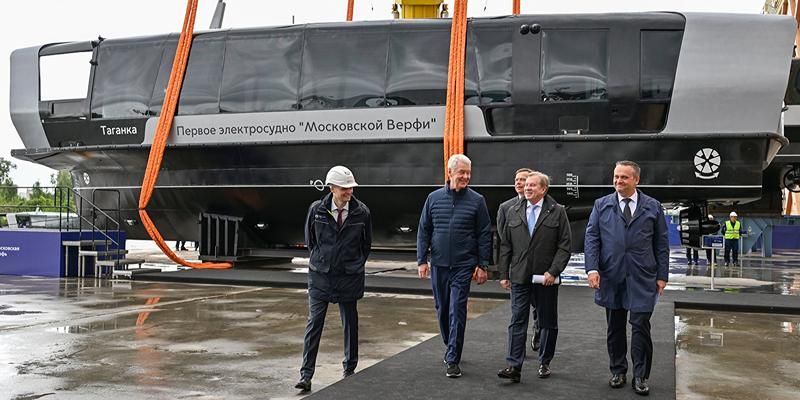
Four Moscow 1.0 electric boats built at the Moscow Shipyard in Nagatinsky Backwater have been launched in the capital. The launch ceremony was attended by Russia’s Deputy Prime Minister Vitaly Savelyev, Moscow Mayor Sergei Sobyanin, and Russian Minister of Transport Andrei Nikitin.
“Four newly built ships are leaving the slipways today. Three more vessels will be launched by the end of the year. So, we will have a full-fledged fleet of electric vessels. By 2030, there would be no more diesel-powered ships navigating the central Moskva River. By 2035, only electric vessels would ply along the Moskva River; that will significantly improve the environment of the Moskva River and its embankment, indeed. So today is a wonderful event. Congratulations to Muscovites, the tourists who will be using these electric vessels, and the shipbuilders who have accomplished a truly remarkable feat in such a short time by launching these cutting-edge boats. I thank everyone. My congratulations,” said Sergei Sobyanin.
In fact, the Moscow Shipyard’s range includes six types of vessels, such as Moscow 1.0, Moscow 2.0, Moscow 3.0 (two types), a canal boat, and the Moscow Golden Ring cruise ship.
“The cabin is equipped with information screens, USB chargers, free Wi-Fi, and bike storage areas. The names of Taganka, Yakimanka, Polyanka and Maroseyka were chosen for them by Muscovites in the Active Citizen project; more than 150,000 residents cast their votes. The electric vessels and related infrastructure with zero harmful emissions, meeting the most stringent environmental requirements,” Sergei Sobyanin wrote on his Max channel.
Source: Sergei Sobyanin’s MAX channel
At the moment, the Moscow Shipyard is assembling four more 21.8-meter-long and six-meter-wide Moscow 1.0 electric boats, which are capable of accommodating up to 56 people, including passengers with reduced mobility, to provide scheduled passenger services. They travel at a speed of 15 kilometers per hour, and their two engines have a power output of 134 to 200 kilowatts.
In addition, the Moscow Shipyard started to build two electric boats under commercial orders and will lay the keel for 16 more electric vessels intended for both municipal and private uses by late 2026.
Moscow Shipyard
Initiated by Russian President Vladimir Putin, the Moscow Shipyard was built in the shortest possible time, within 22 months (2023–2025), the locally arranged ship-building facility serving to Moscow’s river transport strategy.
The enterprise is located on the site of a former utilities area on Melovoy Head on the Nagatinsky Backwater, its production facilities spanning 23,000 square meters and ensuring full-cycle operations such as metal cutting, welding and assembly of hulls, plus vessel equipment and launch.
Moreover, its equipment, machinery and capacity make it possible to maintain and repair the vessels they build. The production cluster will also include a fleet maintenance site and lay-up points with the necessary charging infrastructure, which will further provide maintenance and repair of over 100 electric vessels annually. The Moscow Shipyard has in fact repaired 15 ships since launch, whereas previously, given the lack of related infrastructure, ship owners had to de-service their boats to move them to other regions.
Furthermore, the shipyard’s production processes are highly automated and involve over 70 per cent Russia-made equipment. It employs more than 400 highly educated and highly skilled employees, the overall value-added chain, including manufacturing of electric boat components and devices, involving approximately 50,000 people employed at facilities across Russia.
“We will be prepared to improve the regulatory framework in order to drive river shipping and the continued success of this major, critical project,” said Transport Minister Andrei Nikitin.
The shipyard has an in-house engineering design center engaged in R&D for river electric transport; so all production processes are consolidated in one place, creating a sustainable foundation for boosting river shipbuilding expertise. Indeed, they arrange for training ship crews and improving their employees’ skills as classes use a state-of-the-art simulator. The training programs delivered at the high-tech shipyard definitely enhance the skills of navigators for Moscow’s river transport as a whole.


The Moscow Shipyard has grown into a model of environmentally friendly facility meeting the most stringent legal requirements and seamlessly integrated into the urban environment. The trendy façade design, involving the use of domestically made materials, alludes to Russian shipbuilding traditions. Solar panels on the roof serve as an alternative power source, while cutting-edge treatment and filtration systems prevent wastewater from entering the Moskva River. In addition, they ran an improvement and landscaping project to reinforce the banks, deepen the navigation channel and also arrange a convenient access and ship mooring. The area and the embankment on the residential side have been landscaped and made green, featuring a promenade, a children’s playground and cozy recreation spots.
The new shipyard boasts a production capacity of roughly 40 vessels per year, being capable of assembling in parallel various types of electric vessels, such as Moscow 1.0, Moscow 2.0 and Moscow 3.0, Moscow Golden Ring cruise ships, and unmanned boats for patrolling the Moskva River.
In the coming years, the Moscow Government will buy about 40 advanced electric vessels for scheduled river services in the capital. Moreover, during the summer navigation period, over 130 pleasure boats ply along the Moskva River every day, their average age being approximately 40 years. Therefore, the Moscow 3.0 electric pleasure boats, accommodating 150 to 250 passengers, built at the new shipyard will significantly accelerate the renewal of the local pleasure fleet.
By the end of 2026, the shipyard is going to lay the keel of the Moscow Golden Ring, a state-of-the-art hybrid cruise ship of approximately 100 meters long, which will sail the same-name popular tourist route in the future. Its design is inspired by the best internationally recognized peers, the project involving prominent experts in cruise industry and shipbuilding. The renewal of the cruise fleet will give a new impetus to domestic tourism, including the Moscow Golden Ring water tourist route, the related passenger traffic to increase two to three times by 2035.
“Today, more than 30 electric vessels successfully serve three routes, providing residents with extra options for getting around the city. Moscow effectively operates such vessels and is also starting to produce them. This is no longer just a municipal transport project, but a foundation for domestic electric shipbuilding and further replication of such solutions,” said Vitaly Savelyev, Deputy Prime Minister of the Russian Federation.
The foundation of the shipbuilding cluster is of pivotal importance both for the capital and for the entire country. In recent years, no such facilities used to be built in Russia.
In fact, anyone can see how they build ships at the Moscow Shipyard as in 2026 they offer regular tours around the enterprise to showcase shipbuilding processes, next-gen technologies and give a glimpse of the history of river transport; visitors can also use the simulator, trying their hand at being a captain. More than 1,000 people have taken tours around the Moscow Shipyard to date.
Moscow’s River Transport Strategy
The revival of scheduled passenger services along the Moskva River is a unique project not only in Russia, but also in global practice as it is the world’s trailblazer year-round, cutting-edge electric water transport.
Today passengers can avail themselves of three scheduled boat routes on the Moskva River such as Kievsky — Fili Park, ZIL — Pechatniki, and Novospassky — ZIL with a total length of approximately 29 kilometers.
The first scheduled electric boat service, connecting Kievsky Railway Station with the Heart of the Capital berth near the same-name residential complex on Shelepikhinskaya Embankment, was launched in June 2023; the inaugurating ceremony was attended by Russian President Vladimir Putin.
In June 2024, Sergei Sobyanin ruled that the length of the first river electric transport route should be almost doubled-by more than 12 kilometers. Moreover, it got two more berths such as Beregovoy, on the right bank of the Moskva River, almost opposite the Heart of the Capital, and Fili Park as the terminal station at that time. In September 2024, they set another berth — Krasnopresnensky Park, near the same-name park and the Expocenter Exhibition Complex,
the 11-kilometer-long Route 2, ZIL — Pechatniki, followed in September 2023. A year later, in September 2024, it got three new berths of Nagatinsky, Zaton Novinki, and Kolomenskaya Embankment.
In June 2025, the authorities launched Route 3 Novospassky — ZIL; spanning over five kilometers; it will be extended by 1.5 kilometers to reach the Krasnye Holmy berth on Kosmodamianskaya Embankment as soon as this year.
“Summer is a wonderful time for river rides. And today passengers can avail themselves of three scheduled boat routes on the Moskva River. This year, we will extend our third route by 1.5 kilometers and will also launch another one, Luzhniki — Kievsky,” Sergei Sobyanin announced on his Max channel.
Source: Sergei Sobyanin’s MAX channel
Route 4, Luzhniki — Kievsky, will provide a water connection between Khamovniki, Ramenki, and Dorogomilovo, thus improving transportation services for more than 30,000 residents. As soon as it is set, the Kievsky berth will be made a transfer point for passengers to change between Route 1 and Route 4.
To serve the three existing routes, the municipality bought 31 electric boats named after small rivers in Moscow; all of them are Ice 20 vessels, so they will be able to navigate through small ice up to 20 centimeters thick. They are in fact captained by 134 highly skilled captains, each with an average of over seven years of experience on the water.
With the launch of river transport, over 1.8 million people living in 22 districts of Moscow now have alternatives to get around the capital. Over the three years of scheduled services, they have been used by more than 3.5 million passengers; the most popular berths are Kievsky, Fili Park, Pechatniki, City-Central, ZIL and Southern River Station. The Moskva River has 24 berths in all, including the Moscow Shipyard.
In 2025, Moscow’s scheduled river services alone provided 1.5 million rides, scheduled and recreational river boats accounting for over 4.5 million trips during the 2025 navigation season — a record passenger flow on the river in the last three decades.
The revival of river transport is a favorite project for both Muscovites and tourists. In recent years, it has gained a particularly deep focus, given the support from Moscow Mayor Sergei Sobyanin, the Russian Government, the Russian Ministry of Transport, and the Russian Ministry of Civil Defense, Emergencies, and Elimination of Consequences of Natural Disasters. In 2020, they wrapped up a large-scale Northern River Station restoration project, the Southern River Station was reconstructed in 2023, with the embankment and frontside area landscaped and beautified, accordingly.
As a result, today, Muscovites can set off on a summer-time journey from Moscow’s river stations again, comfortable motor ships carrying them to dozens of Russian cities and tourist centers for them to enjoy historical and present-day landmarks from the deck. In the 2025 season, the Northern and Southern River Stations sent and welcomed 2,200 cruise ships, with 360,000 passengers on board.
Furthermore, the revived berths have become part of the city’s comfortable public space to host musical shows, workshops, sports and dance classes, intellectual games, etc. Indeed, they delivered over 400 events attended by more than two million Muscovites and tourists in 2025.
The river tourism infrastructure is growing not only in the capital, but also in other regions across Russia as it is essential for the full functioning of the Moscow Golden Ring route. In particular, the municipality and the Government of the Yaroslavl Region reached an agreement to built Volga berthing infrastructure for cruise ships. The parties established a joint venture and elaborated the concept and design for the first berth in Uglich.
In total, they are going to build five berths, namely in Uglich, Rybinsk, Tutayev, Breytovo, and Poshekhonye, the project aiming to create or renovate berthing infrastructure with ship maintenance capacity and to also drive passenger services.
The Moskva River is expected to offer up to seven scheduled electric boat routes by 2030, to be served by about 60 vessels. In addition, they will launch 11 tour and pleasure routes with tourists carried by 42 newly built electric boats. The capital’s river fleet will therefore comprise over 100 electric vessels, all built at the Moscow Shipyard. As a result, the total number of riverboat trips in the capital is expected to reach 7.5 million per year by 2030, with the scheduled services accounting for four million rides; passenger services to cover the entire Moskva River within the city.