Sergei Sobyanin: New Mnyovniki floodplain bridge to be ready in 2027
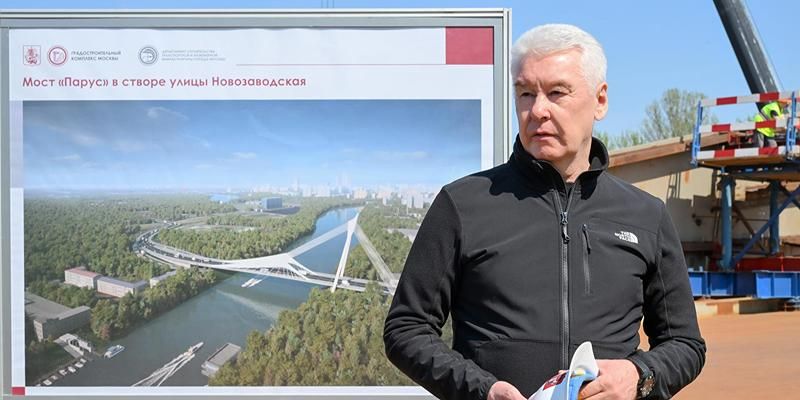
They continue to build the cable-stayed sail-shaped bridge that will connect the Fili and Mnyovniki floodplains in Moscow; the progress was inspected by Sergei Sobyanin.
“We continue to build up the Big City transport network, the Shelepikhinskaya Embankment area, the Fili and Mnyovniki floodplains, with large-scale investment undertakings, new science parks, offices, residential quarters, and sports facilities. In 2024, we launched the Gagarin Bridge, the Academician Korolev Bridge following in 2025. And we are building another bridge crossing, provisionally called the Sail Bridge; it is to be commissioned in 2027,” the Moscow Mayor says.
According to Farkhat Khasanov, CEO, Roads & Bridges, the monolithic construction project is to be wrapped up this June,
the 250-meter-long car bridge with two lanes in each direction to connect Novozavodskaya Street in the Fili floodplain and Proyektiruyemy Proyezd No. 1165 in the Mnyovniki floodplain.
“It has a remarkable design reminiscent of a sail, so it will be another adornment to enhance the beauty of Moscow. The bridge will have two lanes in each direction, thus making it easier to exit Fili Park onto Nizhniye Mnyovniki Street and further onto the Northwestern Lateral Road,” the Moscow Mayor writes on his MAX channel.
Source: Sergei Sobyanin’s MAX channel
The bridge will improve transport accessibility for Khoroshevo-Mnyovniki and Fili Park areas that are home to approximately 300,000 people. Indeed, the new connection will shorten kilometrage by up to five kilometers and travel times will be reduced by twelve minutes as a result.
In addition, it will relieve the Gagarin Bridge (from Myasishchev Street to Proyektiruyemy Proyezd No. 1166) by eight per cent, sections of Proyektiruyemy Proyezd No. 1166 (from Proyektiruyemy Proyezd No. 1165 to Gagarin Bridge) to be five per cent freer, and Bolshaya Filyovskaya Street (from Minskaya to Novozavodskaya Street) to be relieved by four per cent, too.

Unprecedented Design
What makes the bridge unique is its remarkable design. Its stays are attached to the 88-meter tower (ten centimeters for each year of Moscow’s 880-year history, with the anniversary to be celebrated in 2027) and the superstructure via an intermediate adapter shaped as an elegant sail, hence its unofficial name.
The dynamic lighting will definitely add a touch of aesthetic delight for Muscovites. In the evening, the bridge will be particularly beautiful if seen from the embankments of Fili Park and Mnyovniki floodplain.
The construction project involves using a modular assembly method with a rigid continuous working platform, without stopping boat traffic along the Moskva River. Part of the Moscow Government’s program to improve transport accessibility to the National Space Center (NSC) and other popular sites in the Fili and Mnyovniki floodplains, it is in fact 35 per cent ready and is expected to be completed in 2027.
Earlier, in December 2024, Moscow opened the Gagarin Bridge; situated in line with Myasishchev Street, it connects the Fili and Mnyovniki floodplains. Another one, the Academician Korolev Bridge, launched on September 9, 2025, connects the Fili floodplain and Shelepikhinskaya Embankment.
They in fact made it possible to create a vehicular and pedestrian connection between NSC and Mnyovniki station on the Moscow Metro’s Big Circle Line (BCL), the Northwestern Lateral Road, and the areas adjacent to Moscow-City.


Better Transport Accessibility
In recent years, the Mnyovniki floodplain has evolved into the city’s largest development hotspot with an extensively growing trendy city district, including residential quarters, sports centers, a surf park, and plenty of green recreation areas. By the order of Russian President Vladimir Putin, they set the National Space Center in the Fili floodplain, with two BCL stations of Mnyovniki and Terekhovo launched in the Mnyovniki floodplain in 2021 to serve the facilities. Furthermore, the authorities revamped Nizhniye Mnyovniki Street (Northwestern Lateral Road) with bridges erected over the Moskva River and the locks.
Today, they are running a road construction project in the area of both floodplains that provides for the following facilities:
— new streets to open access to residential quarters under construction, sports facilities, and metro stations;
— three car bridges across the Moskva River, such as the Gagarin Bridge in line with Myasishchev Street (commissioned on December 26, 2024), Academician Korolev Bridge in line with Beregovoy Proyezd (launched on September 9, 2025) and the Sail Bridge in line with Novozavodskaya Street (under construction), in addition to an overpass across the main route of the Northwestern Lateral Road towards Rublyovskoye Motorway (commissioned on September 9, 2025);
— two bicycle and pedestrian bridges across the Moskva River towards Ostrovnaya Street in Krylatskoye and towards Fili Park (under construction).
On top of that, they are setting two pedestrian crossings in the Mnyovniki floodplain, including an overhead crossing over the Northwestern Lateral Road and an underground crossing near the intersection of Proyektiruyemy Proyezd No. 1165 and Proyektiruyemy Proyezd No. 1166.
In the future, they are going to reconstruct the Moskva River embankments to cover a section of more than 10 kilometers in all, including the Shelepikhinskaya and Karamyshevskaya embankments, the embankment running from Fili Park to Fomenko Workshop Theater, plus the Mnyovniki floodplain embankments (being designed and constructed at the moment).
Sergei Sobyanin announces Moscow embankments to be improved in the coming years
Road Bridges
Since 2011, the municipality has built 37 road bridges across the Moskva River, the Moscow Canal, the Yauza, Bitsa, Desna, Likhoborka, Molodtsy, Pakhra, Pekhorka, Ramenka, Setun, Sosenka, Skhodnya, and Tsyganka rivers, Kozhukhovsky Backwater and Novinki Backwater.
There are ten more projects in progress, either at design or construction phases; covering a total length of over 1.4 kilometers, they relate to the following structures:
— the Sail Bridge across the Moskva River in line with Novozavodskaya Street (250 meters);
— the bridge across the Moskva River as part of the Rublyovskoye Motorway reconstruction (390 meters);
— the bridge across the Pakhra River as part of the Kievskoye Motorway reconstruction (35 meters);
— the Alyoshin Stream bridge (25 meters);
— the Yauza River bridge (55 meters);
— four bridges across the Neznaika and Desna rivers (622 meters in total); and
— the bridge over the Skhodnya River (90 meters).
Pedestrian Bridges
In 2022–2025, Moscow got six pedestrian bridges, namely:
— across the Yauza River within the Elektrozavodskaya transport hub project (111 meters), near Bauman University (243 meters) and in the area of Budayskaya Street (78 meters);
— across the Tsyganka River as part of the Voskresenskoye — Karakashevo — Shcherbinka road construction project (14 meters);
— across the Moskva River’s Vodootvodny Canal (‘drainage canal’), connecting the spit of Balchug Island and Krymskaya Embankment (58 meters);
— across the Nagatinsky Backwater (219 meters).
In 2026–2028, Moscow will get two more pedestrian bridges:
— across the Moskva River towards Ostrovnaya Street, to connect the Mnyovniki floodplain and Krylatskoye (225 meters);
— across the Moskva River towards Fili Park (200 meters), to connect the park and the Mnyovniki floodplain.
New Roads
In 2011–2025, the local authorities built 1,600 kilometers of roads, or about 30 per cent of the total existing road network, 488 tunnels, overpasses and bridges, thus, increasing the number of artificial transport structures by 70 per cent, along with 364 off-street pedestrian crossings.
In 2026–2028, they will add 283.6 kilometers of roads, 47 artificial structures and 58 pedestrian crossings, in particular 91.3 kilometers of roads, 19 artificial structures and 22 pedestrian crossings to be ready in 2026.
The major facilities that will be commissioned in 2026 include:
— the Kommunarskoye Motorway section with an overpass across Alexandra Monakhova Street (launched in January 2026);
— the Southern Lateral Road section between Kaspiyskaya Street and 1 st Kotlyakovsky Pereulok (partially launched in February 2026);
— the final section of the Moscow High-Speed Diameter along Kaspiyskaya Street, from Kantemirovskaya Street to the Moscow Railway Paveletsky Line;
— the overbridge along the main carriageway of Entuziastov Motorway, at the intersection with Svobodny Prospekt and Bolshoy Kupavensky Proyezd (Phase I);
— reconstruction of Simonovskaya and Krutitskaya embankments; and
— the overpass at the intersection of the Moscow Railway Oktyabrskoye and Savyolovskoye lines, from Bolshaya Akademicheskaya Street to Akademika Koroleva Street.