Sergei Sobyanin and Oleg Belozerov launch new Moscow-City MCD-1 urban terminal
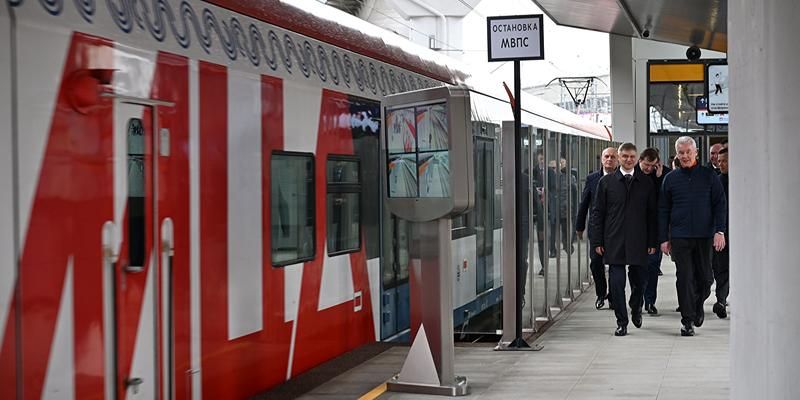
On April 16, Moscow Mayor Sergei Sobyanin and Oleg Belozerov, CEO and Chairman of the Board of Russian Railways, opened the new Moscow-City intra-city terminal, which was built instead of the obsolete Testovskaya railway station. Today, it serves trains of the first Moscow Central Diameter (MCD-1), and in the future, it may also receive long-distance trains, including for international services.
“Moscow-City is a big business center and a major transport hub,” said Sergei Sobyanin. “Today, we are opening the terminal’s main section which will provide transfers for approximately 100,000 passengers per day. And I think that in the coming years, it will serve 140,000 to 150,000, making it one of the largest transport hubs in the world. We thank you very much for the collaboration. It’s really an arduous and crucial project”.
Oleg Belozerov, CEO and Chairman of the Board of Russian Railways, emphasized that the terminal was built in accordance with a newly developed standard agreed upon with the Moscow Government.
“It in fact provides for special signage, five elevators, ten escalators, and a ‘dry feet’ environment. Another thing that is critical for Muscovites is that it reduces travel times. The hub will cut transfer times from 15 minutes to 5 to 10 minutes,” Oleg Belozerov explained.
Back in 2010, the Testovskaya station on the Belorussky line of the Moscow Railroad (MR) was a virtually unused stopping point, with passenger traffic not exceeding 200 people per day.
Its popularity began to grow with the commissioning of the Moscow Central Circle (MCC) and continued after MCD-1 launch. The powerful development of the transport infrastructure is another driver for the rapidly growing area and adjacent residential and business quarters.
“The new intra-city urban terminal has capacity for international passenger services. Indeed, Russian Railways is exploring the possibility of introducing an extra stop at Moscow-City for some Moscow-Minsk trains this fall. Moscow-City MCD-1 is in fact the 89 th intra-city urban terminal built in accordance with the latest standards. All major work is done to date,” Sergei Sobyanin writes on his MAX channel.
Source: Sergei Sobyanin’s MAX channel
Kicked off in Q2 2023, the Testovskaya reconstruction project was running in the densely built up area around the clock utilizing a special technology to avoid train traffic interruptions. Temporary platforms and a pedestrian bridge were erected nearby for passengers to continue to use the MCD-1 train stop and regular routes.
Spanning over 10,000 square meters, the new Moscow-City MCD-1 urban terminal includes the following facilities:
— two trendy platforms with full-length canopies to protect passengers against the sun and precipitation, information boards, benches and SOS desks;
— the southern passenger lobby with turnstiles, ticket offices, restrooms and a dynamic navigation system.
The barrier-free environment, including ten escalators and five elevators, makes the urban terminal usable for passengers with reduced mobility such as seniors, mothers with strollers and people with disabilities.
Its lobby is integrated with the Moscow-City MCD-4 station and the exit to the iCity Business Center at 1/1 Ermakova Roshcha Street. It is also connected to an underground pedestrian crossing across the Third Ring Road, thus enabling transit passage to 2 nd Krasnogvardeisky Proyezd. Previously, it was closed to pedestrians.
This will enable transfers between the metro, MCC, MCD-1 and MCD-4 stations, which are part of the Moscow-City transport hub, in a “dry-feet” environment, taking no more than five minutes.
The northern lobby with an exit towards Shmitovsky Proyezd and the third platform to be launched in August 2026. The opening of the Moscow-City MCD-1 urban terminal has wrapped up the project on the whole.


Improving transport accessibility
The new urban terminal has significantly improved transport accessibility both for the Moscow City International Business Center and for the Greater City, the adjacent areas on both banks of the Moskva River. More than 570,000 residents of the Presnensky, Khoroshyovsky, Dorogomilovo, Khoroshyovo-Mnyovniki, and Filyovsky Park districts live near the new terminal. Given their rapid development, the number of their inhabitants would increase to approximately 700,000 by 2030.
In addition, due to a more convenient schedule, travel times of the Aeroexpress Odintsovo — Sheremetyevo services have been reduced since March 29, 2026. A journey from Moscow-City terminal to the airport on a comfortable double-decker train takes 54 minutes vs. one hour as it took before.
The largest transport hub in Moscow
Ensuring accessibility to Moscow-City has been the capital’s largest rail infrastructure project in recent decades.
In 2010, the area was served by the Filyovskaya metro line, the Belorusskaya line of the Moscow Railroad (Testovskaya station) and a few surface routes.
In 2011–2025, the transport situation in the City improved significantly as the passenger capacity in the area has increased fivefold.
To serve the growing Moscow-City passenger traffic, the authorities have built up a big transport hub comprising Moscow Metro, MCC and MCD stations; five lines are in fact combined into two transport hubs, namely:
— Moscow-City (stations on the Filyovskaya metro line, MCC, MCD-1 and MCD-4), and
— Delovoy Center (stations on the Filyovskaya and Solntsevskaya metro lines to be connected to the Rublyovo-Arkhangelskaya line in the future).
At the moment, the hubs carry more than 100,000 people per day, and the passenger flow is expected to increase up to 170,000 per day by 2030.
The surface transport options in the business quarter include nine bus routes (M31, M32, M34, C344, C369, No. 315, 366, 418 and 27).
In June 2023, authorities also launched the City — Central berth, a main stop of the scheduled electric boat service from Fili Park to the Kievsky Railway Station.
To further improve transport accessibility, the government is running a large-scale project to build a new 27.6-kilometer 12-station Rublyovo-Arkhangelskaya metro line. It will connect Moscow-City and Krasnogorsk in the Moscow Region, with transfers to the MCC, Solntsevskaya, Filyovskaya, Arbatsko-Pokrovskaya, and BCL metro lines.
The Moscow-City area is one of the largest road hubs in the Russian capital, including the Third Ring Road, Kutuzovsky Prospekt, Zvenigorodskoye Highway, Presnenskaya and Krasnopresnenskaya embankments and smaller local roads.
Since 2011, the following structures have been built:
— a new interurban arterial highway, Bagration Prospekt (northern alternate for Kutuzovsky Prospekt) with a multi-level interchange at the intersection with Shelepikhinskaya Embankment and the Third Ring Road;
— a road between Moscow City International Business Center and Zvenigorodskoye Highway;
— additional overpasses and exits from the Third Ring Road;
— a railway overpass (instead of an embankment) over the Belarusian line of the Moscow Railroad;
— an extension of Krasnopresnenskaya Embankment with passage under the Moscow Central Circle;
— a ring overpass that improved transport services near the Afimall City shopping mall and in neighboring areas;
— an overpass across the MCD-1 railway tracks with reconstruction of Barklaya Street;
— a road network along the Moskva River embankment in the area from Bolshaya Filyovskaya Street to the Third Ring Road;
— a section of Projected Passage No. 2017 from Bolshaya Filyovskaya Street to Beregovoy Proyezd; and
— the Academician Korolev Bridge.
Pedestrians in the business district can benefit from using the following options:
— an underground passage from the lobby of the Moscow-City metro station to Moscow-City sections No. 11 and 12;
— a crossing over 1 st Krasnogvardeisky Proyezd, which provides a pedestrian connection with the Kamushki neighborhood.
Moreover, Moscow-City now has a single vehicle access control center. The total number of parking spaces in major parking lots and within the area of Moscow-City is about 20,000.
To further improve accessibility to the Moscow-City area and facilities, by 2030, authorities will build more than 10 kilometers of adjacent roads, including a section of Shelepikhinskaya Embankment from Krasnopresnenskaya to Karamyshevskaya Embankment, and a road network to service the transport hub.
Other plans include:
— reconstruction of Antonova-Ovseenko Street and the adjacent roads to ensure transport accessibility in City-2;
— construction and reconstruction of sections of Novozavodskaya Street and Beregovoy Proyezd;
— renovation of the Moskva River embankment from Fili Park to the Pyotr Fomenko Workshop Theater;
— reconstruction of Kulneva Street;
— reconstruction of a transport interchange at the intersection of the Third Ring Road with Zvenigorodskoye Highway;
— construction of a road network in the area of the Khrunichev State Research and Production Space Center;
— construction of a pedestrian crossing connecting the multifunctional terminal complex at site No. 11 of the Moscow-City International Business Center.
Developing MCD passenger infrastructure
In accordance with the action plan for developing infrastructure of the Central Transport Hub, as approved by Sergei Sobyanin and Oleg Belozerov, CEO and Chairman of the Board of Russian Railways, in 2025–2026, authorities completed the construction and reconstruction of the following facilities:
— Petrovsko-Razumovskaya MCD-1 urban terminal (Platform 1 and the concourse launched on December 26, 2025);
— Kurskaya MCD-2 and MCD-4 urban terminal (Platform 2 and the tunnel launched in fall 2025) with a new operation control center and a digital control system;
— Moscow-City MCD-1 and MCD-4 urban terminal (two platforms and a MCD-4 integrated southern lobby began operations on April 16, 2026).
The following facilities are still under construction or reconstruction:
— Serp i Molot MCD-2 and MCD-4 urban terminal (platforms and concourse integrated with the metro);
— Zheleznodorozhnaya MCD-4 urban terminal (platforms 3 and 4, a northern lobby and transit gallery with descents to the platforms);
— Begovaya MCD-1 and MCD-4 urban terminal (three platforms and a lobby integrated with the metro);
— Tsaritsyno MCD-2 urban terminal (a lobby integrated with the metro);
— Leningradsky Railway Station (passenger terminal).
On top of that, the MCD fleet in was renewed in 2025. 398 cutting-edge trains have entered service since 2014. Since 2010, the average train age has decreased fivefold from twenty three to five years, while the share of upgraded fleet has grown twenty-fold, from five to one hundred per cent. No other megacity in the world can boast such rapid renewal of its commuter train fleet.
In 2025, the government also started to upgrade trains running along the Yaroslavl line of the Moscow Railroad, the fleet to be totally renewed in 2030.
Today, there are 89 urban terminals on the MCD, MCC, Paveletsk and Yaroslavl lines of the Moscow Railroad, including 56 on the MCD-1, MCD-2, MCD-3 and MCD-4, 31 on the MCC, and two on the Yaroslavl and Paveletsk lines (Rostokino and Verkhnie Kotly).
Moscow Central Diameters
The largest infrastructure project implemented by the Moscow Government jointly with Russian Railways, the Moscow Central Diameters, shortly known as MCDs, have become an integral part of the rail framework in the Moscow agglomeration, indeed.
As a result, Moscow and the Moscow Region have been connected by surface metro services creating a reliable transport link. The MCD commissioning has provided more connections within Moscow and beyond — between major cities in the Moscow Region, which was possible in large part with the Moscow transport fare scheme and free transfers to the metro, MCC and between the diameters.
Last November marked six years since the authorities inaugurated the first two diameters,
whereas today the 303-kilometer MCD network consists of 138 stations and 56 urban terminals, including Moscow-City MCD-1. Over 1.7 billion trips have been made on the MCDs since commissioning, with the headway of five to seven minutes during rush hours
for passengers to take about 1.6 million rides every day. As for the growth of the average flow over six years compared to the period before the launch, passenger traffic increased by 1.6 times on MCD-1, by two times on MCD-2, and by 1.8 times on MCD-3 and MCD-4.
MCD-1 and MCD-2 radically changed residents’ attitudes towards rail transport shifting from summer cottage destinations to urban services. Today, up to 325,000 trips per day are made on the MCD-1 Belorussko-Savyolovsky,
spanning 52 kilometers; the 26-station surface metro line terminates in Odintsovo and Lobnya.
MCD-1 passengers have dozens of transfer options to the metro, MCC, and other diameters. Its launch has improved transportation services for 2.3 million residents of more than twenty Moscow districts, and of Lobnya, Dolgoprudny, Odintsovo, and other nearby cities in the Moscow Region.
Moreover, MCD-1 has relieved congestions on nearby metro lines by up to 12 per cent, while the adjacent motorways have got less busy by 5,000 cars per day.