Sergei Sobyanin: Moscow competes not with regional capitals, but with the world’s megacities
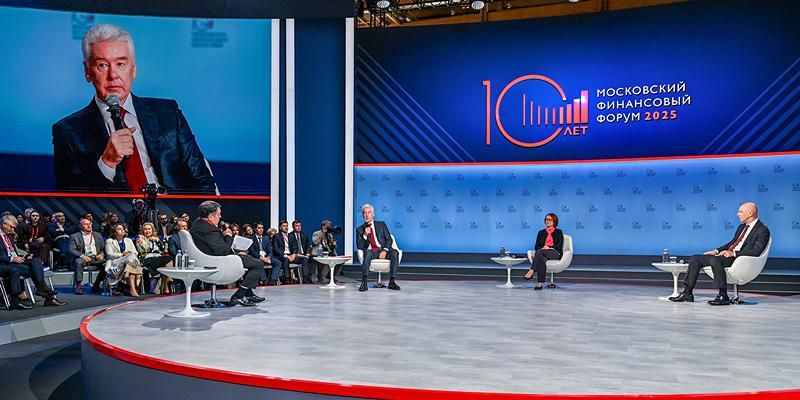
Moscow has seen growth in all areas of the economy. This was announced by Sergei Sobyanin at the plenary session of the 10 th Moscow Financial Forum, entitled Financial System: Challenges and Tasks.
“So far in Moscow in practically all directions we are seeing growth: growth in investment, growth in industrial production, and even a small growth in trade,” said the Mayor of Moscow.
Over the last six years, the investment growth rate in the capital was 2.4 times the Russian average. Moreover, one ruble of investment from the state budget corresponds to 18 rubles of private investment. “A few years ago, investment from the city government was half what it is now. Today, with the same approximate parameters, the budgetary structure is different. And every ruble results in a many times greater increase in private investment. Moreover, this private investment generates budget flows to both the federal and regional budgets. This is actually a kind of magic wand. Optimization of current expenditures, maximum increase in the share of investments, and investments that generate growth of the economy, including tax revenues,” said Sergei Sobyanin.
At the same time, every ruble of tax and non-tax budgetary revenue earned in Moscow is divided in half, with half going to the Ministry of Finance of Russia. Therefore, the Ministry of Finance of Russia is interested in the development of Moscow’s economy. Sergei Sobyanin explained that the growth of the capital’s economy is largely due to stability, which is ensured by the policy of the Russian Government, supported by the President.
“The key is to understand what is going to happen to the rules of play, which we live by, in two years from now, five years from now, 10 years from now. In the last 15 years, of course, we’ve had changes to those rules, but they haven’t been fundamental. We understand them and this gives us the opportunity to plan and optimize all budgetary processes,” said the Mayor of Moscow.


Five to seven years ago, industrial enterprises began to return to Moscow, production is now more high-tech, and labor productivity in the capital today is 1.7 times the national average. For its part, the city is doing its best to provide a good environment for these businesses to grow.
“A technological core has been developed, around which design bureaus, innovations, the whole environment is created. And high-tech industries and districts begin to develop around this axis. This is very important. Especially things like microelectronics, unmanned aircraft manufacturing, and so on. All of this creates a different city altogether, a more balanced city, and a more balanced economy, more sustainable and independent, which is something the President has talked about. An economy and technologies unaffected by any external tensions, sanctions, and so on,” emphasized the Mayor of Moscow.
For its further development, Moscow needs to compete not with Russian regions, but with the world’s leading megacities. In particular, we need to focus on such growth leaders as Singapore, Hong Kong, Beijing and Shanghai.
“We will continue to move forward as quickly as possible on all fronts — in social policy, social services, health care, education, industrial development, transportation, and the creative industries. It’s the only way to ensure that we are competitive. Competitive in terms of the overall economy, as the economic leader of our country, its flagship, and as the last outpost in the fight for human capital,” said the Mayor of Moscow.
It is necessary to fight for people so that they, having left their regions, do not end up moving to a foreign country. And for this purpose Moscow should constantly improve and move forward, and the city is trying its utmost to achieve this, concluded Sergei Sobyanin.