Vladimir Putin and Sergei Sobyanin have opened new stations on the Troitskaya metro line
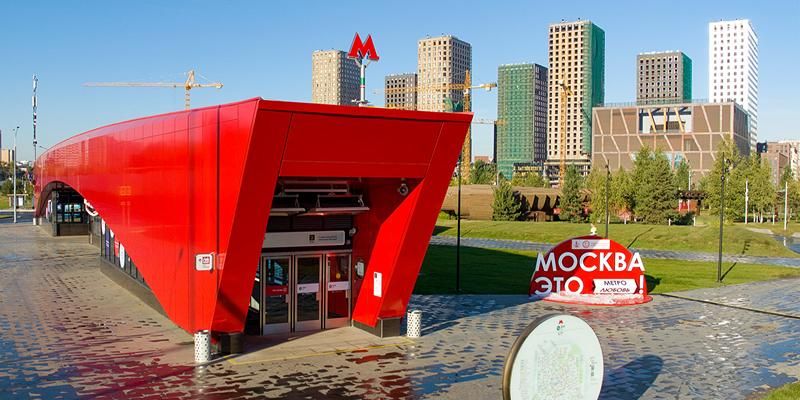
President of the Russian Federation Vladimir Putin and Moscow Mayor Sergei Sobyanin opened the section of track between Novatovskaya and ZIL stations on the Troitskaya Metro line for regular train service. The opening ceremony was held via video link during the visit of Vladimir Putin and Sergei Sobyanin to the National Space Center.
“Today we are opening the first phase of the Troitskaya Metro line. That’s 27 kilometers and 11 stations. We already completed some stations that year, and here are four stations that will connect the section from the Great Ring Subway Line to the MCC-from Novatarskaya to ZIL practically in the center of the city. These four stations were difficult to build due to the crowded underground conditions, making construction challenging. We are opening these four stations, and the whole line to New Moscow, to Kommunarka, will function as a single stage, as a single organism. And then we will continue towards Troitsk,” said the Mayor of Moscow.


Troitskaya line
The line has 11 stations, from ZIL in Danilovsky district to Novomoskovskaya in Kommunarka, including four stations opened today: Vavilovskaya, Akademicheskaya, Krymskaya and ZIL.
“Five transfer hubs have been created on the line. From ZIL and Krymskaya stations passengers can transfer to the stations of the same name on the MCC, from Akademicheskaya station they can transfer to the Kaluzhsko-Rizhskaya line, from Novatarskaya station they can transfer to the BKL, and from Novomoskovskaya station they can transfer to the Sokolnicheskaya line. When the entire project is complete, passengers will be able to transfer from ZIL station to the future Biryulevskaya line,” wrote Sergei Sobyanin on his channel on the MAX messenger.
Source: Moscow Mayor’s channel on the MAX messenger
The creation of the Troitskaya line improved public transport accessibility for more than a million Moscow residents. For many, trips to the center have been reduced by 10–15 minutes or more. For example, the time required to travel from Novatovskaya station on the Bolshaya Koltsevaya line of the metro to the MCC has decreased from 21 minutes to nine minutes.
It is expected that in 2025 the passenger traffic through the 11 stations of the Troitskaya line will amount to 100,000 people per day, and that this will gradually increase to more than 160,000 a day by 2030.
The Stolbovo electric depot was opened in 2025 to serve the trains of the Troitskaya metro line. The Troitskoye electric depot is scheduled for completion in 2029.
The line is served by the most modern Russian-made Moscow-2024 series trains. They have everything needed for passengers to travel in comfort: powerful air conditioning systems, wide doors, walk-through carriages, USB or Type-C sockets, and plenty of information screens. The main advantages of the Moscow-2024 over the Moscow-2020 trains are the new front design, the improved aerodynamics of the train, the modern interiors, wider seats and aisles and the increased passenger capacity. This makes travel even more comfortable for passengers.
Since 2011, the proportion of new rolling stock in operation on the Metro has increased from approximately 13 percent to more than 78 percent. According to the city’s public transport strategy, the proportion of modern carriages will exceed 90 percent in 2030.
A 4G mobile network is available for use by passengers on platforms and in tunnels. Users of major mobile operators can access internet speeds of up to 300 megabits per second and high-quality voice communication. Free wifi is available in the carriages.
The new stations of the Troitskaya metro line are built to maximize passenger comfort. There are modern turnstiles at the entrances and exits, ticket vending machines and terminals, the option to pay by biometrics, and a clear signposting system with a unified, consistent design.
The transfer of passengers from above-ground public transport to the new metro stations has been made more convenient. In particular, from today a number of existing routes have been changed.
New bus stops have appeared on Leninsky Prospekt in time for the opening of Vavilovskaya metro station. The existing routes No. 993 to Ramenki metro station and No. 845 to Kaluzhskaya metro station have been extended, and route No. 1 has been merged with route No. 113.
In time for the opening of Akademicheskaya and Krymskaya metro stations changes have been made to four above-ground public transport routes:
— route No. 111 has been merged with route No. 57 and now passes through Universitetsky Prospekt towards the new Akademicheskaya metro station;
— route No. 196 has been shortened, and ends at Leninsky Prospekt metro station;
— route No. 915 now runs along Krzhizhanovsky Ulitsa to Profsoyuznaya metro station.
In September 2025, route No. 766 will be extended to the new ZIL station.
The Troitskaya line is the first metro line to feature digital navigation displays right from the opening of the stations. 125 digital signs, of a kind unique in Russia, have been installed on the stations from Novatovskaya station to ZIL station.
In total, more than 200 digital signs have installed in the Moscow metro. These innovative navigation aids first appeared a year ago in Maryina Roshcha station on the BKL and in Terminal 1 of the Nizhegorodskaya Moscow urban interchange. Since then, they have proven their effectiveness and received positive feedback from passengers.
Prior to the opening of the new stations, Metro specialists tested and adjusted all systems. They checked the operation of escalators, ticket offices, turnstiles, and the communications, ventilation and security systems.
As a result of the opening of the Troitskaya line an additional 1,400 jobs have been created on the Moscow Metro. These include positions for train drivers, station duty officers, track inspectors, track fitters and electricians.
Prospects for the Troitskaya line
At present the design documentation for the construction of the second stage of the Troitskaya line is being developed. This will be a 16.8 kilometer section with six stations, from Novomoskovskaya station to Troitsk.
As a result, the Troitskaya metro line will run from ZIL station of the MCC in Danilovsky district to the town of Troitsk. The branch will be more than 43 kilometers long with 17 stations and will be one of the longest radii of the Moscow metro and the largest outside the Moscow Ring Road.
The new line will improve public transport services for nearly two million Moscow residents. They will have dozens of options for new routes and will be able to cut their travel time substantially. In particular, residents of Troitsk will be able to get to the BKL and MCC twice as fast-in 45 and 55 minutes respectively.
In addition, the arrival of the metro will stimulate the construction of new neighborhoods, with both residential and commercial real estate, and the creation of tens of thousands of jobs.
The Troitskaya line will reduce the load on the southern sections of the Sokolnicheskaya and Kaluzhsko-Rizhskaya lines, as well as on the Butovskaya line. It will reduce the intensity of vehicular traffic on the adjacent roads, which will improve the environmental situation.
Thanks to the Troitskaya line, the public transport accessibility of Krasnaya Pakhra and the important urban facilities located there, including Europe’s largest electric bus park and a traction battery manufacturing plant, will be significantly improved.
New stations on the Troitskaya line
Vavilovskaya station
Vavilovskaya station is located under Leninsky Prospekt at the intersection with Ulitsa Stroiteley and Ulitsa Panferova. It is a shallow-built station with two underground lobbies and exits onto both sides of Leninsky Prospekt.
It is expected that 12,000 passengers will use the station each day, and that by 2030 passenger traffic will have increased to 16,500 people per day.
The interior of the platform section is dominated by an asymmetrical composition, in which one of the track walls smoothly transitions into the ceiling plane. The cladding material, anodized white aluminum, contrasts effectively with the opposite black wall and the platform floor of natural black stone.
The inlay with mirrored steel elements on the black wall is designed so as not to dazzle the driver. The flickering light is revealed only to passengers waiting for the train to arrive.
The platform light fittings with a diameter of 10 to 30 centimeters enhance the visual perspective and create the effect of movement of light particles.
.jpg)

.jpg)
.jpg)
.jpg)
Akademicheskaya
Akademicheskaya station is located under Ulitsa Dmitrya Ulyanova at the intersection with Profsoyuznaya Ulitsa and Prospekt 60-letiya Oktyabrya. From it passengers can transfer to the station of the same name on the Kaluzhskaya-Rizhskaya line.
This is a shallow-built, columned, three-span station with a column pitch of nine meters. It has two underground vestibules with exits onto both sides of Ulitsa Dmitrya Ulyanova. Elevators and vertical elevators have been installed for passengers with limited mobility.
The projected passenger traffic of the new station is nine thousand people a day. It is expected that when the Troitskaya line is fully opened, this will increase to 12,500 passengers per day. And by 2030 the Akademicheskaya public transport hub (consisting of two metro stations on the Troitskaya and Kaluzhsko-Rizhskaya lines and above-ground public transport facilities) will be used by more than 50,000 passengers per day. The load on the Kaluzhsko-Rizhskaya line station of the same name will be reduced.
In terms of its decoration, on the track walls of the station are images of the building of the Academy of Sciences and portraits of outstanding figures of science from different epochs. These include Lavrentiy Blumentrost (1692–1755) -the personal physician of Peter the Great and the first president of the Saint-Petersburg Academy of Sciences, Ivan Schumacher (1690–1761). -the director of the St. Petersburg Library of the Academy of Sciences, Nikolai Semenov (1896–1986) -one of the founders of chemical physics and a Nobel Prize winner, and the natural scientist and thinker Vladimir Vernadsky (1863–1945). The images are made in a technique that combines elements of classical painting and contemporary art.
The floors on the platform and in the ticket offices of the lobbies are lined with gray granite. The walls are clad with aluminum panels with a face layer of artificial stone, and the plinths of the track walls are polished black granite slabs.


Krymskaya
Krymskaya station is located between the tracks of the Moscow Central Ring and a residential area of the Donskoy district. From it passengers can transfer to the MCC.
Krymskaya is a shallow-built station with two above-ground concourses. The eastern one leads to a residential development, while the western one will be further combined with the Krymskaya MCC station concourse at the intersection of Sevastopolsky Prospekt and the MCC.
It is expected that 8,500 passengers will use the station each day. By 2030, this is forecast to increase to 12,500 people per day. In total, the Krymskaya public transport hub (consisting of the metro and MCC stations, as well as above-ground public transport facilities) will be used by about 30,000 passengers per day.
The interior design is based on a marine theme: the platform has suspended ceilings in the form of sails, and the columns and beams resemble the wings of soaring birds. Lights on the track walls are made in the form of ship portholes, and between them are art compositions made using a glass printing technique.
The escalator slope of the east lobby is decorated with images of soaring seagulls printed onto the cladding panels. The design of the station combines white, black and blue, and the main facade of the western concourse includes an illuminated stainless steel bas-relief in the shape of a silhouette of the Crimean peninsula.
Krymskaya station set an industry record for the fastest ever construction of a station complex. The construction of the station from the completion of excavations to opening took just 15 months. This is half the time spent on the construction of similar stations,” said Maxim Gaman, General Director of Mosinzhproekt JSC.

.jpg)

.jpg)
.jpg)
.jpg)
ZIL
ZIL station is located at the intersection of Prospekt Likhacheva and Ulitsa Lisitskogo, next to Tyufleva Roshcha Park and the MCC platform of the same name. It is located in the center of an rapidly developing cluster on the site of the former I. A. Likhachev plant. From the station ZIL passengers can transfer to the MCC, and in the future an interchange with the Biryulevskaya line is planned.
ZIL is a shallow-built station with one underground concourse. It overlooks Tyufleva Roshcha Park and Ulitsa Lisitskogo.
It is expected that 5,500 passengers will use the station each day. By 2030 this is forecast to increase to 8,500 people per day. In total, the ZIL public transport hub (consisting of two metro stations on the Troitskaya and Biryulevskaya lines, the MCC station and above ground public transport facilities) will be used by about 40,000 passengers per day.
By the end of 2025 more than 20,000 people will live near ZIL metro station, and by 2029 this number will exceed 35,500. It is planned to organize crosswalks for residents of the development which is to be constructed on the other side of the MCC tracks.
Thanks to the opening of ZIL station on the Troitskaya line, public transport accessibility for more than 22,000 people working in this area has been improved. Their number will double in the future.
The new station will also be used by numerous visitors to the CSKA stadium, Water Sports Center, ZIL Technopark, Riviera shopping and entertainment center and other popular venues.
The station was built using the open cut technique. The plinths of the track walls are covered with dark gabbro and the floor with light gray Siberian granite. The platform section has 14 three-meter Russian-made LED lighting fixtures.
The design of ZIL station is dedicated to the history of the famous I. A. Likhachev plant, on the territory of which a residential and leisure district is being created today.
The background color of the platform area design is black, with details in white, gray, blue and red. On the track walls is an art composition inspired by the history of the plant. It was created using a glass printing technique. The vault is formed by suspended dynamic blades of three-layer aluminum panels with light portholes. The station name, written in the style of the famous ZIL logo, is inscribed in scarlet on the track walls, which are faced with red painted aluminum panels. The plinth of the track walls is clad with black stone slabs and the columns are finished in aluminum.

.jpg)
.jpg)
.jpg)
_.jpg)
.jpg)
.jpg)
Results of the implementation of the metro construction program
Since 2011, the Moscow City Government has constructed or reconstructed more than 260 kilometers of track, 127 stations, and 14 electric depots of the Moscow Metro and MCC.
In addition, together with Russian Railways, the city has opened the Moscow Central Diameter (MCD) lines: 303 kilometers of track and 137 stations.
List of new lines and stations of the Moscow Metro, MCC and MCD
Lyublinsko-Dmitrovskaya line:
— section from Maryino station to Zyablikovo station (three stations);
— section from Maryina Roshcha station to Fiztekh station (nine stations).
Kalininskaya and Solntsevskaya lines:
— section from Novogireevo station to Novokosino station (one station);
— section from Delovoy Tsentr to Aeroport Vnukovo station (14 stations).
Zamoskvoretskaya line:
— section from Krasnogvardeiskaya station to Alma-Atinskaya station (one station);
— Technopark station;
— section from Rechnoy Vokzal station to Khovrino station (two stations).
Arbatsko-Pokrovskaya line:
— section from Mitino station to Pyatnitskoye Shosse station (one station).
Tagansko-Krasnopresnenskaya line:
— section from Vykhino station to Kotelniki station (three stations);
— Spartak station.
Butovskaya line:
— section from Starokachalovskaya Ulitsa station to Bittsevsky Park station (two stations).
Sokolnicheskaya line:
— section from Yugo-Zapadnaya station to Potapovo station (eight stations).
Nekrasovskaya line: eight stations.
Bolshaya Koltsevaya line: 31 stations.
Troitskaya line:
- the section from ZIL station to Novomoskovskaya station (11 stations).
Moscow Central Circle: 31 stations.
Moscow Central Diameters (MCD-1, MCD-2, MCD-3, MCD-4): 137 stations, of which 53 have transfers to the Metro, MCC and MCD.
Electric depots (including reconstructed facilities): Mitino, Brateevo, Pechatniki, Vykhino, Planernoye, Nizhegorodskoye, Likhobory, Solntsevo, Vladykino, Rudnevo, Sokol, Aminyevskoye, Yuzhnoye (Brateevo-2) and Stolbovo.