Sergei Sobyanin: Moscow retains its investment leadership and launches new projects
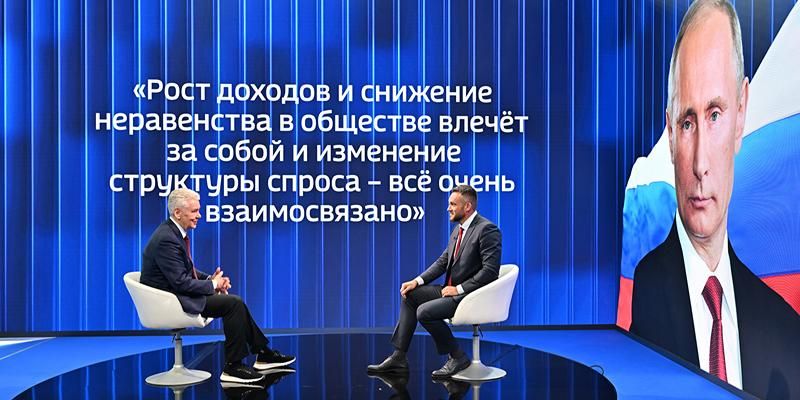
Sergei Sobyanin gave an interview to the Russia 24 TV channel at the Saint-Petersburg International Economic Forum (SPIEF). The Mayor of Moscow spoke about the capital’s key directions of development in the face of new economic realities. Despite external challenges, the city not only maintains its leadership in terms of investment attractiveness, but is also increasing the pace of development in sectors ranging from transport infrastructure and high technologies to the creative industries.
Leadership in investment rating
An investment ranking of Russian regions was announced at the SPIEF. The city once again took first place in the ranking. The Mayor of Moscow noted that this result was made possible by the systematic work of the city team.
“This is the work of a large team that we carry out systematically every year, and as the President has said, it’s important not to rest on our laurels, as those who took second place this year actually got more points than we did last year. Therefore, if we had not carried on moving forwards, then, of course, we would not have been the first. And most importantly, in the end, the result is important, not just the coefficients, figures and so on. And the end result is that the volume of investment in the economy of Moscow is increasing in real terms and at a rapid rate,” Sergei Sobyanin said.
In 2024, the volume of investments in the capital’s economy exceeded eight trillion rubles, and every month 10,000 new enterprises are registered in the city. As the Mayor of Moscow emphasized, this demonstrates the confidence of business in the development of the city and the country as a whole.
Investment levels are expected to remain at the same level until the end of the year. Sergei Sobyanin recalled Vladimir Putin’s words that reducing inflation is not an end in itself. It is important to avoid stagnation and maintain growth in basic industries — manufacturing, high technology, science and the creative economy.
Support measures
The main support measure for business is the city’s own investments in infrastructure.
“Look at Moscow’s targeted investment program, the development program. It is not decreasing — it is increasing. Despite all the difficulties, we continue to invest in social, transport and engineering infrastructure, and the construction of the metro and roads. And it is producing results. For every ruble invested from the state budget we receive 10 rubles of private investment, enabling us to recoup the state budget investment literally within one, two or three years,” said Sergei Sobyanin.
For example, the construction of the Bolshaya Koltsevaya line (BKL) of the metro has paid for itself — the federal and city budgets have recouped their investments, and new business clusters are developing around the BKL. As a result, the city has gained additional jobs, new housing, and its social sphere, business, high-tech industries, technoparks, and office space and so on have all developed.
Among the key industries in the city’s economy are microelectronics, information technology, software, pharmaceuticals, robotics, space technology, aircraft manufacturing.
Unmanned vehicles
Moscow is actively developing unmanned technologies. In 2025, an unmanned tram will begin to carry passengers and in 2026-metro trains without drivers will appear. Sergei Sobyanin also did not rule out that in the future there will be unmanned taxis and delivery drones operating in the capital.
“We have many modes of transport that can be driverless, including our great electric trams. Today, by the way, we launched the third route,” the Mayor of Moscow added.
New agreements at the SPIEF
Moscow signed a number of agreements at the SPIEF, including one with Transmashholding JSC for the supply of 700 metro cars.
“The task is not only to update or put cars on the newly introduced line, but to update old metro cars more intensively, faster than is actually necessary, because many of them are obsolete, both technologically and visually. Our task is to remove most of the old cars from circulation by 2030 and replace them with modern ones. This is a completely different generation of cars, and it’s a pleasure to travel on them. Moreover, our cars, thanks to Moscow’s long-term order, are in no way inferior to equivalents produced elsewhere in the world. And if you take the price to quality ratio into account, then they are leaders,” said Sergei Sobyanin.
The city also signed an agreement with VTB on the construction of three sports centers and with Sberbank on the construction of a unique artificial wave center, which has no equivalents in Russia. Another agreement was signed with Russian Railways. It concerns the reconstruction of the Yaroslavl railway station.
“You know that we recently started a joint project on the reconstruction of the Leningradsky railway station. Work will now begin on reconstruction of the second largest station, Yaroslavsky Station. The s need to be brought up to the level as the rest of the city, and they should not lag behind the development of the rest of the city’s infrastructure. This is important-as millions of people come to Moscow by rail,” Sergei Sobyanin added.
Support for SMO participants and rehabilitation work in the regions
Moscow pays special attention to social support for participants in the special military operation and their families. Special subsidies and additional payments are provided for military personnel serving under contract. According to the mayor of Moscow, this is important, given the difference in income levels between the capital and other regions. The city also implements a comprehensive program of assistance to SMO participants and their family members.
The capital is also actively involved in the reconstruction of new territories, providing support to Donetsk, Luhansk, Crimea, Sevastopol and the border regions-of Belgorod and Kursk.
“We are helping our military in terms of the development of enterprises of the military-industrial complex (MIC) in the city. This is an important direction. Production of drones, and support of Moscow’s air defense — in all these areas there is a considerable range of work,” said Sergei Sobyanin.
Creative Economy and Tourism
The development of the creative industries was also discussed at the Saint-Petersburg International Economic Forum. Moscow is prioritizing the film industry, and is creating large-scale film clusters. On the site of the Gorky film studio modern film complexes are appearing and in the Troitsky and Novomoskovsky Administrative Districts a Russian version of Hollywood is being built for location filming.
Sergei Sobyanin stressed that the capital is actively working with colleagues from China and India, which are looking at these sites and starting to shoot their films there.
“This is another direction, maybe not a typical direction for international relations, but nevertheless a very important one. Plus there is the tourism industry. This is very important. We are increasing the volume of tourist flow from China, India and the United Arab Emirates,” said Sergei Sobyanin.
In conclusion, the mayor of Moscow noted that many foreigners who come to the capital have preconceived ideas about the city, but when they are here they see a rapidly developing and flourishing capital.