Sergei Sobyanin officially opens work on the construction of tunnels on the Biryulevskaya metro line
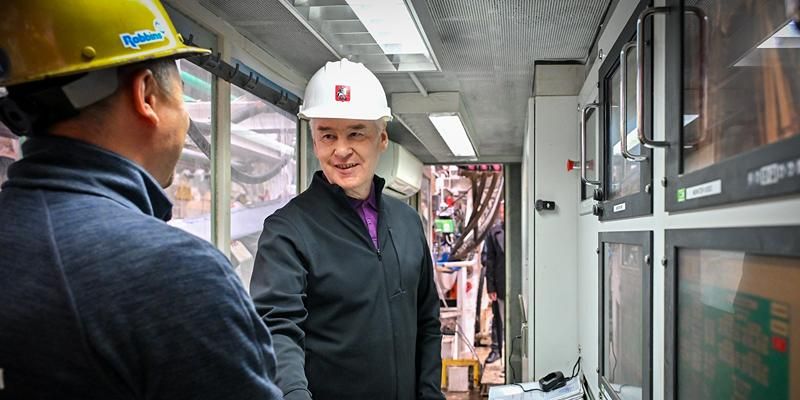
Sergei Sobyanin has taken part in a ceremony to mark the beginning of work on the tunnels on the Biryulevskaya line of the Moscow Metro.
The first (right) tunnel, with a length of 1.67 kilometers and a diameter of six meters, will be constructed between Ostrov Mechty and Klyonovy Bulvar metro stations. In addition, in the coming months it is planned to start the construction of a second (left) tunnel linking these stations. In part, the new tunnels will pass under the bed of the Moskva River, which is a complex engineering task. It is planned that the construction will be completed in the spring of 2026.
“In the Moscow metro construction a historic event: today we launch a tunnel on a new radius of the Moscow metro-Biryulevskaya line.Long-awaited. For a long time, residents of Biryulevo Zapadnoye and Biryulevo Vostochnoye have been asking for the Metro to be extended to their districts,” added Sergei Sobyanin.
The new metro line will be put into operation in stages. The construction of the first stage, the ZIL-Kuryanovo section (8.65 kilometers, four stations) is expected to be completed in 2028, and work on the second stage, the Kuryanovo-Biryulevo section (13.55 kilometers, six stations) should be completed in 2030.
“Today the active phase of work is beginning: the first shield is being installed, and in a couple of months the second shield will be added. Overall, of course, the project is very complex. 22 kilometers, 10 stations, four tunnels under the Moskva River. But I am confident that the builders will manage,” the mayor of Moscow added.
It is expected that the first four stations of the line will be used by 32,000 passengers per day, and after full commissioning of the new line the daily passenger flow will increase to 170,000 thousand.
In the first stage, the trains of the line will be served by the Yuzhnoye electric depot, and from 2030-by the new Biryulevskoye electric depot.
Biryulevskaya Metro Line
“The drilling of the right tunnel of the Biryulevskaya line between Ostrov Mechty and Klyonovy Bulvar metro stations has begun. This is the first stage of a large-scale and complex engineering project. As a result, 10 stations will be built. The length of the entire line will be 22 kilometers. “Work on the construction of the first three stations, ZIL, Ostrov Mechty and Klyonovy Bulvar, has already begun,” Sergei Sobyanin wrote in a post on his Telegram channel.
Source: Sergei Sobyanin’s Telegram channel @mos_sobyanin
The Biryulevsky radial line will be the seventh new line on the Moscow Metro map since 2014. It will mainly serve residents of the south of the capital. For the first time, after a long wait, the Metro will be extended to the Biryulevo Vostochnoye and Biryulevo Zapadnoye districts, which are expected to be home to some 260,000 people by 2030.
The first plans for the construction of a metro line in Biryulevo were drafted half a century ago, in the early 1970s, when mass residential development began on the site of the workers’ village of the same name and the adjacent territory, which became part of the capital in 1960. Then the construction of the Biryulevskaya metro line was included in the Moscow General Plan for the period until 2025, approved in 2010. On behalf of Sergei Sobyanin, in 2021–2023, planning projects for sections of the Biryulevskaya line were developed and approved.


It will extend from ZIL to the Biryulevo Vostochnoye and Biryulevo Zapadnoye districts and as a result will:
— improve transport services for residents (including new quarters being built as part of the renovation program) and those working in the ZIL territory, currently under development, and in the Danilovsky, Nagatinsky Zaton, Nagatino-Sadovniki, Pechatniki, Moskvorechye-Saburovo, Tsaritsyno, Biryulevo Vostochnoye and Biryulevo Zapadnoye districts, with a combined population of over one million people;
— improve the transport accessibility of the Ostrov Mechty amusement park;
— reduce the load on sections of Zamoskvoretskaya and Serpukhovsko-Timiryazevskaya metro lines;
— reduce traffic on adjacent streets, which in turn will improve the environmental situation in the above areas of the city;
— allow passengers to change to the Moscow Central Circle (MCC), the Large Circle, Zamoskvoretskaya and Troitskaya metro lines, and the Paveletskoye line of the Moscow Railway.
By 2030, it is expected that more than 400 thousand jobs will be created in the vicinity of the stations on the Biryulevskaya line.
As part of the new radial line, with a length of more than 22 kilometers, 10 stations will be built:
— ZIL, at the intersection of Prospekt Likhacheva and Ulitsa Bratyev Ryabushinskikh Brothers, near the MCC station of the same name (interchanges with the MCC and the Troitskaya metro line are under construction);
— Ostrov Mechty, near the theme park of the same name, between Prospekt Andropova and the Southern Landscape Park (interchange with the Zamoskvoretskaya metro line);
— Klyonovy Bulvar, along the boulevard of the same name at the intersection with Ulitsa Novinky (interchange with the Bolshaya Koltsevaya metro line);
— Kuryanovo, near the junction of 4 th Kuryanovskaya Ulitsa with Batyuninskaya Ulitsa;
— Moskvorechye, near the junction of Ulitsa Koshkina and Kashirskoye Shosse;
— Kavkavsky Boulevard, along Kavkavsky Boulevard near the junction with Yerevanskaya Ulitsa;
— Kaspiyskaya, near the intersection of 6 th Radialnaya Ulitsa and the planned passage No. 6631;
— Lipetskaya, along the street of the same name near the junction with Pedagogicheskaya Ulitsa;
— Lebedyanskaya, along Lipetskaya Ulitsa, near the junction with Lebedyanskaya Ulitsa;
— Biryulevo, along Bulatnikovskaya Ulitsa, near the junction with Bulatnikovsky passage, near the Biryulevo-Passazhirskaya railway station.
Three metro stations are currently being built: ZIL, Ostrov Mechty, and Klyonovy Bulvar. Work is underway on the installation of the enclosing structures and the development of soil for the foundation pits.
At all the other future stations of the Biryulevskaya line, work on the preparatory stage is underway.
Results of the implementation of the Moscow Metro construction program
Since 2011, 255.5 kilometers of lines, 123 stations and 13 electric depots of the Moscow Metro and MCC have been built and reconstructed in the capital. In partnership with JSC Russian Railways, above-ground metro lines MCD-1, MCD-2, MCD-3 and MCD-4 have also put into operation, with 303 kilometers of track and 137 stations.
New lines and stations of the Moscow metro, MCC and MCD
Lublinsko-Dmitrovskaya line:
— section from Maryino station to Zyablikovo station (three stations);
— section from Maryina Roshcha station to Fiztekh station (nine stations).
Kalininskaya and Solntsevskaya lines:
— section from Novogireevo station to Novokosino station (one station);
— section from the Delovoy Tsentr to Aeroport Vnukovo station (14 stations).
Zamoskvoretskaya line:
— section from Krasnogvardeiskaya station to Alma-Atinskaya station (one station);
— Technopark station;
— section from Rechnoy Vokzal station to Khovrino station (two stations).
Arbatsko-Pokrovskaya line:
— section from Mitino station to Pyatnitskoye Shosse station (one station).
Tagansko-Krasnopresnenskaya line:
— section from Vykhino station to Kotelniki station (three stations);
— Spartak station.
Butovskaya line:
— section from Starokachalovskaya Ulitsa station to Bittsevsky Park station (two stations).
Sokolnicheskaya line:
— section from Yugo-Zapadnaya station to Potapovo station (eight stations).
Nekrasovskaya line: eight stations.
Bolshaya Koltsevaya line: 31 stations.
Troitskaya line:
— section from Novatorskaya station to Novomoskovskaya station (seven stations).
Moscow Central Circle: 31 stations.
Moscow central diameters (MCD-1, MCD-2, MCD-3, MCD-4): 137 stations, of which 53 have interchanges with the metro, MCC and MCD lines.
Electric depots (new and reconstructed): Mitino, Brateevo, Pechatniki, Vykhino, Planernoye, Nizhny Novgorod, Likhobory, Solntsevo, Vladykino, Rudnevo, Sokol, Aminyevskoye, Yuzhnoye (Brateevo-2).