31 more metro stations to be built in Moscow by 2030 — Sergei Sobyanin
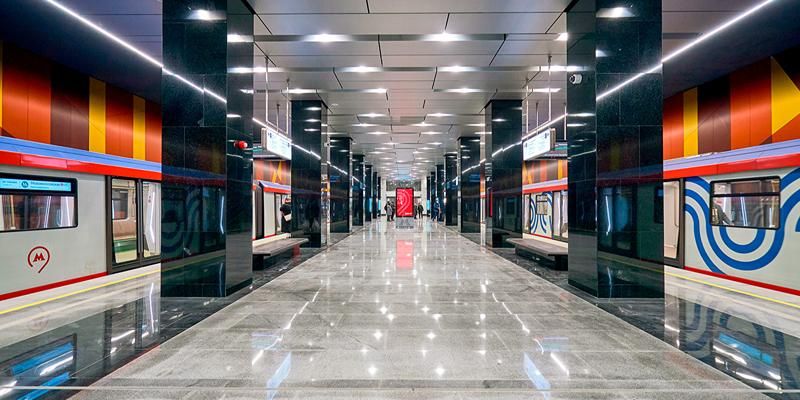
In 2024, 17.4 kilometers of metro lines and eight metro stations were built in Moscow. Events of the year—opening of passenger traffic on the new Troitskaya line and Potapovo station of the Sokolnicheskaya line. The news was announced by Sergei Sobyanin on his Telegram channel.
“We are currently continuing to build the Rublevo-Arkhangelskaya and Troitskaya lines and Dostoevskaya station on the Koltsevaya line, and are also designing and doing preparatory work on the Biryulevskaya line and starting to extend the Arbatsko-Pokrovskaya line to the new terminus station of Golyanovo.” In total, the plans for the period to 2030 include the construction of 71.4 kilometers of lines, 31 stations and five new electric depots,” wrote the Mayor of Moscow.
Source: Sergei Sobyanin's Telegram channel @mos_sobyanin
Metro and Moscow Central Circle
Since 2011, the capital has built and reconstructed 255.5 kilometers of lines, 123 stations, 12 electric depots of the Metro and the Moscow Central Circle (MCC). The Metro network has grown by a factor of 1.8 during that period.
The most important result of last year was the opening of full-fledged passenger traffic on the new Troitskaya metro line. It includes seven stations (Novatovskaya, Peoples’ Friendship University, General Tyulenev, Tyutchevskaya, Kornilovskaya, Kommunarka and Novomoskovskaya) and two interchanges: to the Bolshaya Koltsevaya and Sokolnicheskaya metro lines. In addition, a new terminus station on the Sokolnicheskaya metro line, Potapovo, began to receive passengers.


Plans for 2030 include the construction of 71.4 kilometers of lines, 31 stations and five electric depots. Currently work is continuing on the construction of the Troitskaya and Rublevo-Arkhangelskaya lines, and on Dostoevskaya station on the Koltsevaya line.
Design and preparatory work on the Biryulevskaya metro line, extension of the Arbatsko-Pokrovskaya line with construction of a new terminus station, Golyanovo, are underway.
Railroad transportation
Moscow, jointly with the Russian Ministry of Transport, Russian Railways and the administration of the Moscow Region is implementing a large-scale program to modernize the railway infrastructure of the Central Transport Hub. Since 2011, excluding the MCC, 284.9 kilometers of railway track have been built in the capital, 22 new (excluding the MCC) and 33 existing stopping points have been opened and reconstructed.
In 2024, seven important facilities were put into operation:
- a new concourse at Belorussky Station, which ensured the integration of the Moscow Central Diameter No. 1 (MCD-1) with MCD-4;
- the southern entrance hall of the Lianozovo Moscow urban interchange on MCD-1;
- the northern concourse of Moscow-City station (formerly Testovskaya) on MCD-4 with access to Mukomolny Proezd and the territory of the Big City project;
- an elevated crossing over Lenina Street as part of the Zelenograd—Kryukovo Moscow urban interchange on MCD-3;
- a covered pedestrian gallery which integrates Kutuzovskaya station on MCD-4 with the Metro system;
- a new concourse at Moscow-City station on the MCC, which integrates the MCC with MCD-4;
- a new Moscow urban interchange, Mitkovo, on MCD-3.
In January 2025, the modern Moscow urban interchange Shcherbinka on MCD-2 opened. It was built on the site of an outdated suburban train station.


In 2025-2026 15 major projects for the development of the railway network are to be implemented, including the completion of construction and reconstruction of seven Moscow urban interchanges and opening of:
- the first platform and concourse of Petrovsko-Razumovskaya station on MCD-1;
- the second and third platforms, as well as the tunnel at Kursky station, and the installation of a new operations control center and launching of a digital monitoring system;
- three platforms, a north concourse and a south concourse integrated with MCD-4, at the Moscow-City urban interchange on MCD-1/MCD-4;
- two platforms and a concourse at the Serp i Molot station on MCD-2/MCD-4;
- third and fourth platforms, north concourse and transit gallery with gates to platforms at Zheleznodorozhnaya station on MCD-4;
- three platforms and a vestibule integrated with the Metro system at Begovaya station on MCD-1/MCD-4;
- a vestibule integrated with the Metro system at Tsaritsyno station on MCD-2.
Also in the next two years the renovation of the passenger terminal building at Leningradsky railway station is to be completed.
Street and road network
From 2011 to 2024, 1,460 kilometers of roads were constructed in Moscow, about 25 percent of the existing street and road network. This includes the construction of 454 new tunnels, overpasses and bridges—the number of artificial transportation structures increased by 65 percent. 328 new off-street pedestrian crossings were also opened.
In 2024 alone, 100 kilometers of roads, 25 artificial structures and 15 crosswalks were built. Among other things, the multi-year program of reconstruction of traffic interchanges on the Moscow Ring Road was completed, including the construction or renovation of 22 complex artificial structures. Some of the most significant projects completed include:
- traffic interchanges at the intersection of the Moscow Ring Road with Verkhniye Polya Street and Altufievskoye Highway;
- extension of the southern direction of the MCD beyond the Moscow Ring Road;
- a section of the Solntsevo-Butovo-Varshavskoye Highway from Novomoskovskaya metro station to Edvard Grieg Street;
- overpass in the area of the 24th-25th kilometer of Leningradskoye Highway;
- a bypass road for Kaluzhskoye Highway;
- an overpass over the MCD-1 tracks connecting 800-letiya Moskvy and Inzhenernaya Streets;
- a pedestrian bridge over the Moskva River Water Diversion Canal, connecting the end of Balchug Island and Krymskaya Embankment;
- a bridge over the Moskva River at the Myasishcheva Street crossing;
- a bicycle and pedestrian bridge over the old bed of the Moskva River in Nagatinsky Zaton.
It is planned that in 2025-2027 265.5 kilometers of roads, 50 artificial structures and 51 crosswalks will be constructed or opened.


