Sergei Sobyanin: Moscow to launch around 100 more advanced trams
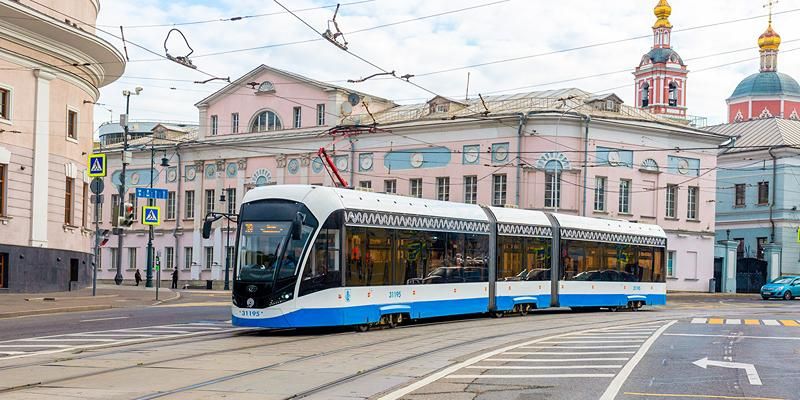
Sergei Sobyanin approved the tram network development strategy for 2025 and the medium term, and Deputy Mayor in the Moscow Government Maxim Liksutov reported on the plans and progress of the country’s first unmanned tram.
Expanding Moscow’s tram network
Moscow’s tram lines span 420 kilometers; 80 per cent of them are separated from highways and are located on dedicated tracks, covering 86 districts. Rail transport stops are arranged near residential neighborhoods that are home to 5.5 million people.
There are 35 routes in Moscow, with passengers making around 700,000 rides every day. Passenger traffic is growing year after year, indeed. The most popular routes are No. 17 Medvedkovo-Ostankino, which is used to make about 54,000 trips on weekdays, and route No. 6 Bratsevo-Metro Sokol serving around 37,000 passengers every day. More than 30,000 trips are made daily on route No. 11 Ostankino-16-ya Parkovaya Street and route No. 36 Metrogorodok-Novogireevo, almost 29,000 passengers traveling daily on trams No. 46 running between Metrogorodok and 3-ya Vladimirskaya Street.
The Moscow Metro fleet holds approximately 550 tram cars, including more than 500 advanced low-floor Russia-made trams, which have been bought in recent years, new rolling stock exceeding 95 per cent.
In the coming years, the authorities are going to buy around 100 more cutting-edge trams Thus it will completely update its tram fleet.
Attention is also paid to related infrastructure.
“96 per cent of the tracks have been reconstructed since 2010. In September, we launched a new tram line on Sergiy Radonezhsky Street and set route No. 2,” Sergei Sobyanin wrote on his Telegram channel.
Source: Sergei Sobyanin’s telegram channel @mos_sobyanin
So, tram services, which existed more than 70 years ago, has been restored in the Tagansky District, the length of the double-track tram line exceeding 860 meters. It was laid along the odd, historical side of the street to connect the existing tram lines on Entuziastov Highway and Andronyevskaya Square.
The new route No. 2 3-ya Vladimirskaya Street — Kursky Vokzal provided transfers to 15 stations on 9 rail lines, including Kursky Railway Station, metro, Moscow Central Diameter 2 and 4 stations in addition to Ploshchad Ilyicha, Rimskaya and other metro stations.
Almost 700,000 residents of the South-Eastern, Eastern and Central Administrative Districts have got more convenient and faster daily travel options, as a result. In particular, over 300,000 residents of eastern Moscow (Lefortovo, Sokolinaya Gora and Perovo) enjoy direct non-stop transport links with Kursky Railway Station.

The technologies used in track reconstruction made it possible to reduce tram noise levels by approximately 30 per cent and, if technically possible, tram tracks are separated from the roadway in order to prevent outside traffic.
As a result, road accidents on such sections decreased 40 per cent; tram delays due to accidents involving other vehicles or improper parking are reduced ten-fold, while tram speeds and passenger traffic grew 20 per cent.
The boarding platforms are raised and are at the same level as the tram entrance for the convenience and safety of passengers. In addition, the platforms have got ramps and special protective fences separating them from the roadway. Today, there are more than 420 improved platforms across the city.
The city is also going to expand Moscow’s tram network in the coming years.
“We are also planning to build a new line on Academician Sakharov Prospekt from Komsomolskaya Square to Chistoprudny Boulevard and to restore the tram line on Trifonovskaya Street to Rizhskaya Square,” Moscow Mayor shared.
The new lines will set extra tram services and will make this type of transport even more popular.
Russia’s first-ever unmanned tram
In 2023, the Moscow Center for Research and Development of Unmanned Transport approached the issue of arranging for movement of unmanned trams, Russia’s debut tram to be introduced in three stages.
At stage I starting May 2024, they tested the unmanned tram running along the city without passengers with a driver and a driver duplicating system, which made the tram move, although final decisions were taken by the human driver. During that stage, the tram traveled more than 800 kilometers along route No. 10 from Shchukinskaya metro station to Kulakova Street, never violating traffic rules.
“The tram traveled more than 2.4 thousand kilometers with and without passengers, never violating traffic rules. During trips in the city, the driver just backs the moving tram. We expect that by the end of 2025 the tram will begin operating in a completely unmanned mode with passengers on the route,” shared Sergei Sobyanin.
After successful completion of stage I, specialists proceeded to stage II in late August, with the trial legal arrangement set by the Russian Government in Moscow to launch unmanned transport. The document from the Russian Ministry of Economic Development was based on Moscow Metro’s initiative.
As a result, Moscow is Russia’s trailblazer in piloting unmanned vehicles.
At stage II, the unmanned tram will serve the route both with and without passengers. The driver will stay idle having the finger on the pulse, since the unmanned driving system has taken over the control and decision-making functions.
The tram will run around the city, its services specifically scheduled. The cabin has a large screen displaying key operating indicators of various systems, which makes it possible to evaluate how the tram sees the surrounding space through the machine vision system. During the piloting period, the innovative vehicle has traveled over 2,400 kilometers and has never violated traffic rules.
At stage III at the end of 2025, the tram is expected to operate on the road with passengers in a completely unmanned mode. Yet, there may be staff in the cabin or just on board to oversee the movement and perform other functions.
The tram’s software is developed by Moscow Metro employees without involving third-party companies, the unmanned technology owned by the Moscow Government. Russia’s capital is Europe’s driverless tram pioneer, while Moscow’s development has no rivals and is more reliable and stable than its overseas counterparts.
In a short time, the capital’s driverless tram has won two major awards, such as Reforum Awards in the Innovation of the Year category and the Company of the Future 2024 in Digital Transformation.