Sergei Sobyanin approves plans to upgrade public transport fleet
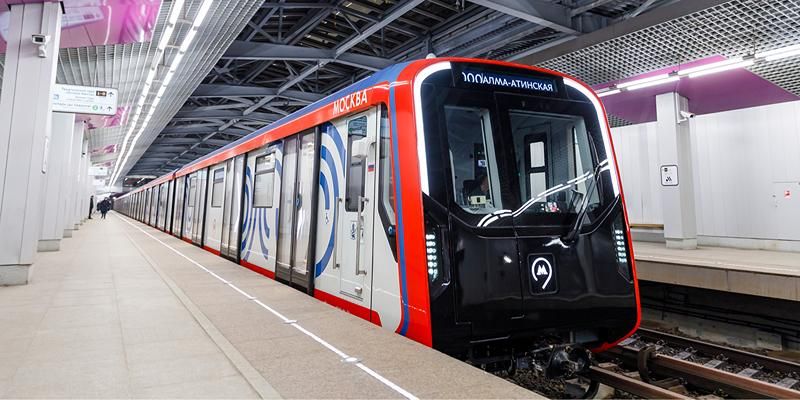
Sergei Sobyanin approved plans to renew the public transport fleet for the next year and the medium term, Maxim Liksutov, Deputy Moscow Mayor for Transport and Industry, reported on the progress in this respect.
The municipality will buy about two thousand metro cars, so the percentage of advanced trains would exceed 90 per cent by 2030, as a result. The rolling stock of the third and fourth Moscow Central Diameters (MCDs) will be renewed by the end of 2025 as well. In addition, Moscow will receive about 3.9 thousand electric buses by the end of 2030.
Renewing the public transport fleet is a long-term program that was launched by the Moscow Government in 2010. In fact, the municipality orders the development of new fleet models to be further bought under life cycle contracts, implying that manufacturers undertake obligations to repair and maintain their products for a period of 15 (for electric buses) to 30 years (for metro cars and trams).
New MCD electric trains are purchased by transport companies in agreement with the governments of Moscow and the Moscow Region using, inter alia, infrastructure budget loans.
_bez.jpg)
.jpg)

_bez.jpg)

_bez.jpg)


Metro
Moscow ranks first among the world’s largest metro systems in terms of rolling stock renewal and average age of train cars. More than 4.7 thousand cars have been purchased since 2010, next-gen rolling stock having grown from 13 per cent up to 76 per cent as the metro gets about 300 new cars every year.
560 Moscow-2024 cars will be delivered in 2024–2025 under the contract, most of them to serve the Zamoskvoretskaya metro line. By 2030, inclusive, they would receive about two thousand more cars, so new trains would make over 90 per cent.


Train cars for the Moscow metro are produced in Russia. The Moscow Government’s share in the total metro car orders reaches 90 per cent. With long-term orders, the capital makes a major contribution to domestic mechanical engineering, ensuring the capacity utilization for more than 360 enterprises across Russian regions, which employ over 30 thousand people in all.
Currently, Moscow’s transport authorities, together with manufacturers, are developing new state-of-the-art, technologically advanced and comfortable trains, called Moscow-2026. Their technical specifications meet wishes of both passengers and drivers whose opinion is a priority for Moscow transport.
MCDs
The Moscow Central Diameters boast Europe’s youngest train fleet as MCD-1 and MCD-2 rolling stock has been completely renewed, MCD-3 and MCD-4 to have 100% new trains by the end of 2025. Passengers are carried by cutting-edge EP2D trains, double-decker Aeroexpress ESh2 and 75 Russia-made EG2Tv and EGE2Tv Ivolga trains of the first (1.0), second (2.0), third (3.0) and fourth (4.0) generations, which are specially designed for the MCDs.
Ivolga are intra-city commuter trains produced by Transmashholding, JSC, Russia’s major developer and manufacturer of rolling stock for railway and in-city rail transport. 97 per cent of Ivolga components are made in Russia, the production chain involving more than 600 enterprises in Moscow, St. Petersburg, Tver, Nizhny Novgorod, Penza, and other cities, which employ about 50 thousand people. The Moscow Government generates 75 per cent of orders for the whole Russian transport engineering industry.
The Ivolga trains have no lobbies, and their entrance doors are almost 15 per cent (1.4 meters) wider than those of regular commuter trains for faster and more convenient passenger boarding. The cars have advanced climate control and air disinfection systems, USB ports, bike racks and warning systems, not to mention advanced security systems and automated online monitoring of technical condition. They are also convenient for parents with children and strollers, as well as for people with reduced mobility as there are changing tables and special places for disabled persons.


To operate efficiently with frequent stops, a train needs to accelerate as quickly as possible and stop as smoothly as possible, and Ivolga fully meets these requirements. So, passengers can enjoy fast and comfortable rides. The pneumatic suspension technology makes the trains run smoothly with low noise and vibration levels, with through passages for passengers to move along the train freely and three-level handrails with a warm coating for the comfort of standing travelers.
This year, the MCDs got newly developed Ivolga 4.0 trains including 11 cars that can accommodate more than 2.5 thousand passengers at a time. Ivolga 4.0 differs from Ivolga 3.0 in several respects. For instance, in Ivolga 4.0 there is a third door in its cars (except for the head ones) for the passengers to board and de-board more quickly by up to 30 per cent, with metro trains as the only peer example. The door opening buttons are very conveniently located on the sides of each car door (like in later versions of the Ivolga 3.0). The exterior and the interior have also changed as the train’s front has got darker and more laconic, the headrests and handrails now coming in blackberry color. The trains can accommodate almost by 100 more passengers at a time than the previous models;
compared to Ivolga 1.0 and Ivolga 2.0, new Ivolga 4.0 has an average acceleration of 10 per cent, up to 1 m/s2 and moves 30 per cent faster — up to 160 km / h.
MCD-3 and MCD-4 commuter trains
|
Parameters |
ET2M (1999–2010) |
ET4M (1996–2016) |
Ivolga 4.0 (2024) |
|
Capacity (pax) |
2,114 |
2,499 |
2,533 |
|
Acceleration |
0.6 m/s2 |
0.6 m/s2 |
1 m/s2 |
|
Speed |
130 km/h |
130 km/h |
160 km/h |
|
Door width |
1,180 mm |
1,250 mm |
1,400 mm |
|
Door glazing area |
> 20% |
> 20% |
40% |
|
Doors per train car |
Two |
Two |
Three |
|
Through passage |
No |
No |
Yes |
|
Passage width |
700 mm |
700 mm |
1,000 mm |
|
Adaptive lighting |
No |
No |
Yes |
|
Floor height |
1,400 mm |
1,400 mm |
1,300 mm |
|
Next-gen security systems |
No |
No |
Yes |
|
Climate control system |
No |
No |
Yes |
|
Information systems |
No |
No |
Yes |
Today, 75 Ivolgas of various generations serve the four MCDs, 15 Ivolga 4.0 trains carrying passengers on MCD-3 and MCD-4, another 10 fourth-generation trains to arrive by the end of 2024.
Ground public transport
Moscow boasts the youngest fleet of ground public transport in Europe, as upon decision of Sergei Sobyanin the authorities are largely renewing the rolling stock. Started in 2010, the project is 100 per cent complete to date, the trains’ age being less than five years.
Passengers are served by more than 8.3 thousand trendy conventional and electric buses running on almost 850 routes. Passengers take an average of four million rides on a weekday.
More than 700 routes (80 per cent) are serviced by Mosgortrans, commercial carriers accounting for over 130 routes (20 per cent). In 2016, they shifted to governmental contracts so that commercial services could meet the high standards of Moscow transport, fares and benefits are the same regardless of route.

Electric buses
Moscow also ranks number one in Europe in terms of the electric bus fleet as over 2.2 thousand EVs serve more than 170 routes. In terms of price and quality, Moscow’s electric buses are among the best in the world.
They minimize the negative impact of transport on the environment in the city since using an electric bus instead of a conventional one reduces CO2 emissions by 60 tons per year. In 2018—2023, the transition to that type of transport made it possible to reduce CO2 emissions in the city by 130 thousand tons.
Moscow buys electric buses under life cycle contracts. After a bus arrives to a Mosgortrans garage, the manufacturer is fully responsible for its technical serviceability for 15 years.
In 2024, manufacturers began to supply innovative electric buses with even better design. The new LiAZ buses have vivid black side panels; the latest KamAZ models have a changed shape of the front hood and bumper and other vertical marker lights, fog lights, and main external light cases. On the rear body part, the vertical side lights with direction indicators and the location of main external lights have changed, too; a red element has been added to visually connect the rear lights.


Moreover, the latest electric bus developed by order of the Moscow Government is being prepared for mass production starting 2025. It will feature an increased range after recharging, machine vision and active safety systems, its traction electric batteries to be manufactured at a plant in Krasnaya Pakhra (TiNAO).
By order of Sergei Sobyanin, the Moscow Government takes effort to implement a 100 % shift to ground electric transport. It is expected that about 3.9 thousand electric buses will have been delivered to the capital by the end of 2030, their total number to reach almost six thousand. In 2035, electric buses will almost completely replace conventional buses in the Mosgortrans fleet.
Trams
Today, the Moscow Metro fleet holds approximately 550 tram cars, including more than 500 advanced low-floor Russia-made trams, which have been bought in recent years. They include 464 next-gen three-section cars Vityaz-Moscow that are durable, fast, noiseless and comfortable for passengers.
Compared to previous generations and modifications, the capacity of the Vityaz-Moscow tram is one and a half to two times greater as up to 260 passengers can ride on it at the same time (in particular up to 70 seats). The cars are completely low-floor and are adapted for passengers with reduced mobility, with a space for strollers and bicycles on board. The tram’s designed speed is 75 kilometers per hour. Each car has six doors (two single-leaf and four double-leaf), which make boarding and de-boarding 30 per cent faster.
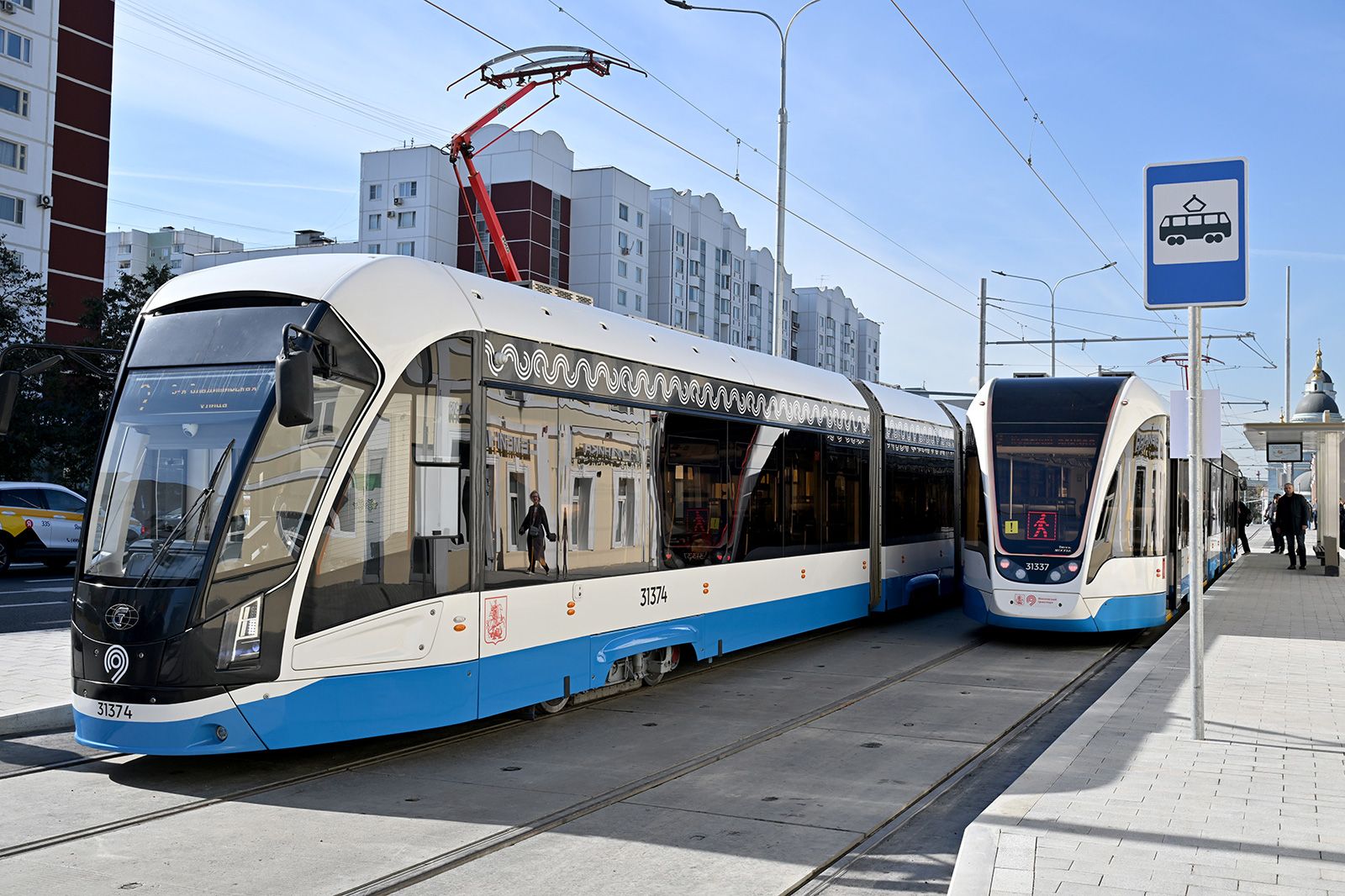
Standard tram equipment includes advanced control systems, GLONASS/GPS location sensors, video surveillance, mobile device charging ports, Wi-Fi, multimedia screens, and climate control systems. The air conditioning system is installed both in the passenger compartment and in the driver’s cabin.
New trams run more quietly as their noise level is 25–30 per cent lower (60 vs. 82 dB). The special design of the tram bogie makes it possible to achieve the smoothest possible ride. The sound of the wheels is practically inaudible when it turns, so local residents do not even feel they are moving past.
The service life of Vityaz-Moscow trams under the life cycle contract is 30 years, which is almost twice as long as that of conventional trams (16 years). In the coming years the authorities are going to buy about 100 more advanced Russia-made low-floor trams to 100 per cent renew the tram fleet.