Sergei Sobyanin: The largest electric bus maintenance center in Russia to be built in Moscow
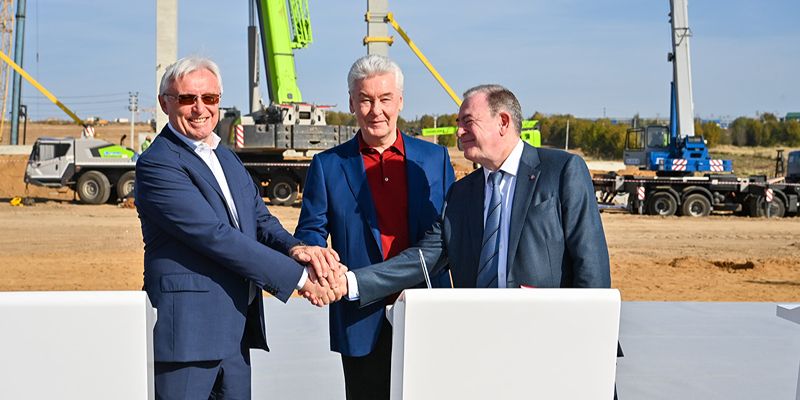
Sergei Sobyanin, Moscow Mayor, Alexander Lokshin, First Deputy Director General of Rosatom State Corporation, and Sergey Kogogin, Director General of KAMAZ PTC, have signed an agreement on cooperation aimed at the development of electric vehicle technologies.
In addition, an offset contract was signed between Mosgortrans State Unitary Enterprise and Renera LLC (a subsidiary of JSC TVEL, which is part of Rosatom State Corporation) which is already the 14 th of the kind. The document stipulates the construction of a plant to produce cells, modules, packs, and stationary systems based on lithium-ion cells in Krasnaya Pakhra (TiNAO). We expect to start production and reach design capacity in 2025–2026.
The total investment in the creation and modernization under the signed offset contracts will amount to about 82 billion rubles.
“A historic event for the technological sovereignty of our country — Russia’s largest plant is being built to produce traction batteries, which are, in fact, the heart of electric cars and cost a third of the car. Creating our domestic electric car is virtually impossible without this facility. I believe this project will succeed with such partners as Rosatom and KamAZ, and a state-of-the-art plant will be created here in two years,” said Sergei Sobyanin.
The launch of two major high-tech projects is part of a large-scale effort to create and develop the Moscow electric vehicle cluster. The city is holding it on instructions of Vladimir Putin. It is also crucial for the technological sovereignty of the whole country.
Under the signed agreements, the Russian capital is to purchase over 155 thousand traction batteries for electric buses, Moskvich cars, and river electric vessels for 172 billion rubles within six years. The city is also committing to constructing production buildings in record time: just in one year. Rosatom State Corporation will provide the plant with modern equipment, ensure its launch and the entire further production process. KAMAZ PTS will help introduce and install the products on personal and municipal transport, created and used in Moscow and all over Russia.
So today, Moscow boasts 20,500 registered electric motor cars. Mosgortrans has over 1,250 electric buses in its fleet, with Moscow ranking first in Europe by this indicator. The e-buses run along 90 routes and carry about 500,000 passengers daily. Besides, Muscovites are increasingly using both personal and rented electric scooters or e-bikes.
“We are definitely looking forward to bringing in batteries from a neighboring plant on our products, rather than from overseas, from China, for instance. I am sure our constant interaction with Rosatom on what batteries will be needed in two or five years will allow us to make a modern product at the required cost,” said Sergey Kogogin, Director General of KAMAZ.
About 3.5 thousand charging stations have been installed in the Russian capital for electric cars, and more than 250 ultra-fast charging stations for electric buses. Parking is free for owners of light electric vehicles in paid parking zones.
In addition, the development of regular river electric transportation routes on the Moskva River continues. The first one (from Kievsky Station to the Heart of the Capital berth) was opened in June 2023. The second route, from ZIL to Pechatniki, is to be launched soon. Today, electric vessels make about 2,500 trips a day. Over 220 thousand people used the first route in three months.
An electric vehicle manufacturing cluster has been created in the Technopolis Moscow special economic zone, where electric cars and trucks, special vehicles, all-terrain vehicles, and traction batteries are produced. It brought together more than 50 manufacturing companies.
According to Sergei Sobyanin, traction electric batteries are needed for domestic electric cars. It would be hard to build such cars without them.
Sergey Kogogin confirmed that prototypes of electric batteries were manufactured in mid-May, and today they have already been tested.
Today, about 35 per cent of the cost of electric vehicles is the traction battery. Locating the production of this component in Krasnaya Pakhra will reduce production costs and allow for its further expansion. In the long term, this will favorably affect the ecological situation in Moscow and will boost the development of cutting-edge passenger cars and electric buses throughout Russia.
Production of batteries for electric vehicles in Krasnaya Pakhra
The new plant for producing lithium-ion cells, modules, traction batteries, and stationary energy storage systems will be the largest in Russia. The Moscow Government provided a land plot of 20.4 hectares in Krasnaya Pakhra for its construction. The production will occupy 160 thousand square meters and create 900 jobs.
The capacity of the new plant will enable to produce up to 50 thousand lithium-ion batteries per year for electric cars (cabs, carsharing, personal transportation), electric buses, streetcars (providing autonomous running), river electric vessels, and means of individual mobility (electric bicycles, electric scooters, electric scooters).
It is estimated that by using the latest technology for electric buses, the basic battery capacity will increase by 30 per cent, while the estimated autonomous travel will increase by 50 kilometers to 180 kilometers. For the Moskvich electric car, this figure will increase by 26 per cent, and the estimated autonomous travel will increase by more than 105 kilometers and amount to 515 kilometers. As battery capacities increase, their mass will remain unchanged or even decrease, while charging speeds will increase by more than 10 to 15 per cent.
The plant’s products are expected to be used for the production of uninterruptible power supply units, electric charging stations, and emergency power supply systems for industrial, social, and strategic facilities, as well as for the accumulation of energy from renewable sources (wind generators, solar batteries) and autonomous energy supply for public events. Metro trains could also switch to batteries by partially removing the catenary rail from the tunnels and keeping charging only at the station during passenger boarding and disembarkation.
The plant will be one of the most modern and environmentally friendly in the world concerning the level of equipment and automation. The new full-cycle plant will install 150 units of high-tech equipment for preparation of cathode and anode mixture, electrolyte and application of materials on electrode tape, formation of module from cells and battery and other works. The automation level will reach 90 per cent, and the total length of process lines will be 2.5 kilometers.
The operation of the facility will be fully compliant with the highest standards of environmental stewardship. Waste-free production will avoid harmful emissions into the atmosphere.
“The technologies to be used here belong to Rosatom. They will evolve and scale. By signing today’s Agreement and Contract, we gain reliable partners and, which is very important for scaling up, a guaranteed market for most of our products. Therefore, there is every reason to assert that we will fulfill our commitments and Moscow will get electric transport,” said Alexander Lokshin, First Deputy Director General of Rosatom State Corporation.
Total project investments will reach 52 billion rubles. The production buildings are to be built in 2024. It is intended to start production of lithium-ion batteries and reach the design capacity in 2025–2026.
A high-tech R&D center for the production of advanced batteries is going to be created based on the enterprise in Krasnaya Pakhra. It will attract young specialists — students and graduates of leading universities (Bauman Moscow State Technical University, Lomonosov Moscow State University, and others) for scientific and applied research.
The technologies used to create lithium-ion batteries contribute to Moscow’s export potential and the development of new technologies in various fields. These include microprocessor technology, the chemical industry, high-tech materials manufacturing, electronics, communication systems, transportation, and space technologies.
KAMAZ PJSC’s largest technical service center in Russia
KAMAZ PJSC will build a state-of-the-art repair plant and components warehouse on a 14-hectare plot of land provided by the Moscow Government in TiNAO. It is located near the Red Pakhra electric bus park. The new facility will be able to repair and maintain the city’s electric buses, buses, and municipal vehicles in a timely and quality manner. In addition, it will be possible to train new qualified personnel and improve the comfort and safety of ground passenger transportation.
The new technical service center will be the largest in Russia. Enhancing the quality and reliability of transportation in the entire Moscow region is among its main tasks. The center’s work will increase the technical readiness factor of bus and electric bus fleets, thereby boosting the output of passenger vehicles on city routes.
The total construction area is almost 40 thousand square meters. The new center of KAMAZ in TiNAO will include a building for an overhaul of electric buses (9350 square meters), and a production and storage building for storing spare parts for vehicles under repair and maintenance (20 thousand square meters). In addition, a service station for commercial repair of vehicles on the basis and chassis of KamAZ and regulated maintenance of city buses and electric buses (6888 square meters) and an administrative and training building for staff accommodation and advanced training of employees (2592 square meters) will be located here. The degassing facility (144 square meters) will ensure safety, economy, and environmental impact reduction in the operation of compressed natural gas vehicles. There will also be a garage for machinery (384 square meters), a checkpoint (200 square meters), and a boiler room (276 square meters). The enterprise will create more than 500 jobs.
The annual plant capacity will allow servicing of up to five thousand electric buses and buses, 1.5 thousand units of municipal vehicles, and 13 thousand units of commercial vehicles.
Sergey Kogogin specified that the life cycle contract that KAMAZ has signed with Moscow pushes it to be ahead of the curve. “At the time of the seven-year term, when major repairs will be required, we must have decent fixed assets, where qualitatively, quickly we will be able to carry out this major repair. That is, the chain is as follows: delivery, then the opening of assembly production at SVARZ, and now the overhaul plant. We short-circuit the entire chain of KAMAZ products in interaction with our primary customer,” said Sergey Kogogin.
Investments in the project implementation will amount up to 7.3 billion rubles. The facility is scheduled to launch in the fourth quarter of 2025.
Krasnaya Pakhra electric bus park
Construction of Russia’s first and Europe’s largest house for electric buses near the village of Krasnaya Pakhra with an area of over 20 thousand square meters began in May 2021 and was completed in June 2022. It was financed under the Targeted Investment Program of the Moscow City.
The Krasnaya Pakhra Park is designed for storage, technical operation, maintenance and repair of up to 500 electric buses. It can serve conventional diesel buses of particularly large capacity if required.
The park has 203 charging points for electric buses, the power supply of which is provided by 34 modern charging stations with dynamic power distribution systems, three lines of portal bus washes, as well as the most modern in Russia control-technical point for checking the technical condition of the rolling stock. The facility building is equipped with modern equipment for maintenance and repair of electric buses. There is also an administrative building with a canteen, changing rooms, comfortable rest rooms for drivers, premises for repair crews, and mobile complexes of photo and video fixation of the Traffic Management Center (storage building, flat parking lot). The necessary engineering infrastructure includes a modern gas-fired roof-top boiler house, four transformer substations (including a distribution station), and a sewage treatment plant.


It will employ more than 1,600 people as it reaches operational capacity. About 950 people (60 per cent) have been employed so far.
Electric buses will be maintained by KAMAZ PJSC under life cycle contracts.
Streets and roads were laid around the park: a new section of Akademika Franka Street was built (570 meters), and the automobile road to the Bylovo village (300 meters) was reconstructed.
The commissioning of the Krasnaya Pakhra electric bus fleet made it possible to transfer almost 50 per cent of the rolling stock serving the routes of the new territories to TiNAO. Thus, zero passenger-free runs from bus fleets located within the boundaries of the Moscow Ring Road were reduced to two hours of work per driver per shift. Total savings from the reduction of zero mileage will amount to about 180 million rubles per year. Also, rolling stock repair costs and wear rate decreased, and the environmental situation in TiNAO improved due to the gradual transfer of routes to the electric buses (emission reduction will be up to 18.2 thousand tons of carbon dioxide per year). New passenger routes covering the entire territory of TiNAO have appeared, and travel for residents has become even more convenient and faster.
The placement of the service unit of the Central Department of Road Traffic Safety in the Krasnaya Pakhra Park allowed city services to save time on the road and more quickly perform their work on repairing road signs, and traffic lights and fixing traffic violations. The turnaround time has been reduced three-fold, and the time to close during traffic accidents has been halved.
Currently, 174 routes of ground urban transport operate in TiNAO, used by nearly 396 thousand passengers a day.