Sobyanin broadcasts completion of the Solntsevskaya metro line
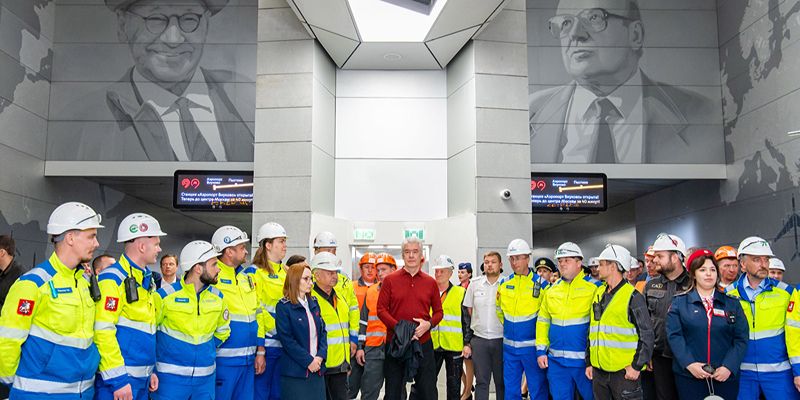
The authorities have inaugurated the Rasskazovka — Vnukovo Airport segment of the Solntsevskaya metro line.
“We’ve done a great job, indeed. The construction of one of the longest metro lines — the Solntsevskaya branch from Delovoy Tsentr to Vnukovo Airport — is all over. To do this, metro builders had to bore 70-kilometer tunnels, one of the deepest stations in the Park Pobedy area. 14 metro stations are built. Today we are launching the last two stations of Pykhtino and Vnukovo Airport. So, it takes 40 minutes to get from Delovoy Tsentr to one of the largest airports in our country. This is a remarkable line that connects downtown and the operating airport,” said Sergei Sobyanin at the opening ceremony.
About one and a half million people live within walking distance from the Solntsevskaya line. “This is a difficult, complex, but very popular metro line,” the Moscow Mayor said.
He took one of the first trains to travel from Pykhtino to Vnukovo Airport, thanked the metro builders for their work and talked to Vnukovo Airport pilots and flight attendants who said they would go to work only by metro as in this case they could accurately calculate travel times and that passengers would no longer be late for flights, thanks to the new line.
“There is one line; it runs straight to Delovoy Tsentr, but it intersects with many other branches — the Big Circle Line and the Moscow Central Circle. In fact, it connects entire central Moscow, so you can get to anywhere,” Sergei Sobyanin says.
At the terminal station, he met passengers and congratulated them on the opening of new stations. “You also have Aeroexpress trains here, the MCD-4 is opening nearby — a ground metro at Vnukovo station (two ground transport stops from here) — and the metro,” Sergei Sobyanin said. He added that the fourth Moscow Central Diameter (MCD-4) would be launched that week for people to get to downtown in half an hour.
New quality of transport services
Extending the Solntsevskaya metro line from the Rasskazovka station to Vnukovo Airport will improve the transport situation for about 350,000 locals and those who come or will come to work in existing or future neighborhoods in the Vnukovo area, plus the settlements of Vnukovo, Marushkinskoye and Filimonkovskoye, new stations to save up to 60 minutes on daily trips.
The quality of transport services at Moscow Vnukovo Airport, which ranks fourth in Russia by passenger flows (projected at 14.5 million pax in 2023), has radically improved. Travel time from the airport to the city will be almost halved; for example, it will take 23 vs. 37 minutes to get to the Michurinsky Prospekt metro station and 40 vs. 70 minutes to Delovoy Tsentr.
Air passengers and other visitors have got a wider selection of the shortest routes to the airport with different types of transport, such as metro/Aeroexpress trains, regular or electric buses, taxis, car sharing or personal cars.
In addition, the new line has relieved traffic on the adjacent motorways, such as Kievskoye (by 5 per cent) and Borovskoye Motorways (by 12 per cent), as well as the Rasskazovka station on the Solntsevskaya line (by 25 per cent) and Salaryevo on the Sokolnicheskaya metro line (by 15 per cent).
How they were building the Rasskazovka — Vnukovo Airport segment
They kicked off construction of the 4.9-kilometer-long Solntsevskaya line segment with two stations of Pykhtino and Vnukovo Airport in October 2019 and wrapped up in September 2023, this involving an arrangement of two 6-meter single-track tunnels as is typical of the Moscow Metro, whereas the main line tunnels between Rasskazovka and Pykhtino were built using the trenchless method.
Within the segment from Pykhtino to Vnukovo Airport, trains will run on the surface along the 460-meter-long metro bridge over the Likova River to further go underground again. The Likovsky (Pykhtinsky) metro bridge is the 12 th one in Moscow (launched in 1937, the Smolensky metro bridge on the Filyovskaya line is Russia’s oldest one) and the second longest after the 1,178-meter Luzhnetsky bridge; the longest metro bridges are Mitinsky (439 meters), Preobrazhensky (330 meters), Smolensky (approx. 300 meters) and Nagatinsky (233 meters), while the rest do not have open sections and are quite shorter).
Now, when the Rasskazovka — Vnukovo segment is ready, the Solntsevskaya metro line is more than 30 kilometers long with 14 stations.
Its passengers are carried by Oka 81–760 trains equipped with climate control systems, including air disinfection, which are served by the modern Solntsevo electric train depot.
Pykhtino and Vnukovo Airport, like all new Moscow metro stations, are highly advanced to enable better passenger experience in accordance with the Moscow transport standards, including practical turnstiles featuring bank card payment and Face Pay solutions, ticket vending machines and similarly styled user-friendly navigation system; services of the Passenger Mobility Center are also available at the new stations.
The construction of the entire Solntsevskaya line involved a few stages:
— the first segment between Delovoy Tsentr and Park Pobedy (3.4 kilometers, 2 stations) beneath the Moskva River opened for passengers in early 2014, the 84-meter deep Park Pobedy with 126-meter escalators being the deepest station of the Moscow Metro;
— the second segment from Park Pobedy to Ramenki (7.3 kilometers, 3 stations) was launched in March 2017;
— the third one, Ramenki — Rasskazovka, including the Solntsevo train depot (15.3 kilometers, 7 stations) opened in August 2018; and
— the fourth, Rasskazovka — Vnukovo Airport segment (4.9 kilometers, 2 stations) opened in September 2023.
Pykhtino station of the Solntsevskaya metro line
The Pykhtino station is located in the settlement of Vnukovo along Borovskoye Motorway near the village of Pykhtino and the Solntsevo Park residential quarter.
This shallow station has one above-ground concourse; due to the complex terrain, it features different track walls — one is solid, like at most metro stations, and the other has panoramic glazing.
The focal point of the architectural and artistic solution is the aviation theme due to the station’s proximity to the airport and the streets named after famous Russian pilots or aircraft designers.
The solid wall dedicated to the aircraft industry is decorated with images of famous domestic aircraft, which are arranged chronologically from historical propeller-driven aircraft to contemporary jets.
The ceiling has light structures in the form of turbine cylinders, and above the sloping escalator there is a model of Tu−144 aircraft surrounded by concentrically diverging aluminum panels.
The floors and walls are finished in light gray granite with black gabbro. The platform is equipped with aluminum honeycomb panels of a Rust Patina color, imitating aged iron and steel, and on the ceiling there are bent elements of light construction from honeycomb panels with a stainless steel surface.


After Pykhtino is launched, instead of a 15-minute ride by ground public transport 15,000 residents of the new Solntsevo Park neighborhood will have a 5-minute walk to get the metro; about 11,000 passengers are expected to use the station every day. By 2030, passenger traffic is projected to double up to 22,000 people.
Passengers can get from Pykhtino to the Big Circle Line in just 20 minutes, whereas previously the journey by ground urban transport took much longer, the ride to Delovoy Tsentr has also been significantly shortened to 37 minutes.
In 2023–2024, the municipality will landscape the adjacent area, including Letchika Ulyanina Street and Aviakonstruktora Polyakova Street, Proektiruemy Proyezd No. 7653 and Proektiruemy Proyezd No. 7654, sections of Letchika Gritsevtsa Street and Borovskoye Motorway. Sidewalks and roadway sidewalks will be renewed to improve transport and pedestrian accessibility, modern stop pavilions and contrasting lighting will be installed at crossings, with parking spaces, new streetlights, benches, and garbage cans; a skate park and a leash-free site will be arranged on Letchika Ulyanina Street.
Vnukovo Airport: Russia’s first metro station at an airport
Vnukovo Airport station is integrated into the infrastructure of the Vnukovo International Airport named after A.N. Tupolev, located in the same-name district in the west of Moscow.The station has a multi-level structure, including platforms, an underground lobby, technical rooms and a traction power substation.
Passengers can go from the station through an underground walkway to Terminal A, underground Aeroexpress terminal, the land side and 1 st Reisovaya Street.
Its architectural solution is inspired by civil aircraft of the Tupolev Design Bureau, the airport bearing the designer’s name, as the track walls and the end wall are decorated with the digital painting called Civil Airplanes of the Tupolev Design Bureau and Their Creators.
The station’s passenger capacity is estimated at over 22,000 pax per day, while by 2030 passenger traffic is projected to increase almost 1.5 times up to 31,000 pax per day.
The improvement concept for the adjacent area encompasses landscaping, granite paving and asphalt refreshing.


Moscow Metro program outcomes
Since 2011, the Moscow Government has built or reconstructed 230 kilometers of lines, 111 stations, 4 extra station lobbies and 11 train depots for the Moscow Metro and the Moscow Central Circle (MCC) to ultimately increase the Moscow Metro network 1.6 times.
In addition, together with Russian Railways, the municipality put into operation the above-ground metro lines of the first, second and third Moscow Central Diameters, i.e., 217 kilometers of tracks and 100 stations.
New Moscow Metro, MCC and MCD stations
Lyublinsko-Dmitrovskaya line:
— Maryino-Zyablikovo section (3 stations);
— Maryina Roscha-Seligerskaya section (6 stations);
— 2 nd lobby (exit) for Maryina Roscha station;
— 2 nd lobby for Petrovsko-Razumovskaya station;
— 2 nd lobby for Okruzhnaya station.
Kalininskaya and Solntsevskaya lines:
— Novogireevo-Novokosino section (1 station);
— Delovoy Tsentr-Vnukovo Airport section (14 stations);
Zamoskvoretskaya line:
— Krasnogvardeyskaya-Alma-Atinskaya section (1 station);
— Technopark station;
— Rechnoy Vokzal-Khovrino station (2 stations).
Arbatsko-Pokrovskaya line:
— Mitino-Pyatnitskoye Shosse section (1 station).
Tagansko-Krasnopresnenskaya line:
— Vykhino-Kotelniki section (3 stations);
— Spartak station.
Butovskaya line:
— Ulitsa Starokachalovskaya-Bitsevsky Park section (2 stations).
Sokolnicheskaya line:
— Yugo-Zapadnaya-Kommunarka section (7 stations);
They also launched 7 Nekrasovskaya line stations, 31 BCL stations, the second lobby for Mezhdunarodnaya station of the Filyovskaya line and 31 MCC stations.
100 stations were opened on the Moscow Central Diameters (MCD-1, MCD-2 and MCD-3), these including 34 interchange stations for passengers to transfer to metro lines, the MCC and the MCD,
and that’s not counting newly built or renovated train depots of Mitino, Brateevo, Pechatniki, Vykhino, Planernoye, Nizhegorodskoye, Likhobory, Solntsevo, Vladykino, Rudnevo, and Sokol.